
Opening your dashboard
Class 10 Biology Chapter 4: Absorption by Roots – The Processes Involved Solutions
50 textbook questions with step-by-step answers, free to read, for ICSE 2026-27.
Get talked through Ch 4, not just shown the answer
Reading a finished solution is not the same as being able to do it. The AI tutor takes one question at a time and works it with you, in your own words, until you can.
- Ask it out loud, in your own words
- It gives you the next step, not the answer
- Stuck on part (ii)? Start there
50 questions with solutions
1–14 marks · Mixed difficulty
- 11 mark
Question 1
List the three primary functions of root.
Solve with AIWritten solution
Solution:
Concept: A root is the part of the plant that grows down into the soil. Its jobs follow from where it is: it holds the plant in place, takes in what the plant needs from the soil, and sends it up into the stem.
Step 1 — Fixation.
The roots spread through the soil and grip it, so they fix the plant firmly in the soil and give it support against wind and rain.
Step 2 — Absorption.
The roots absorb water and mineral nutrients from the soil. This is their most important, life-supporting function, because the plant gets its water and minerals only through the roots.
Step 3 — Conduction.
The roots conduct the absorbed water and minerals into the stem, which carries them on to the leaves, flowers and fruits.
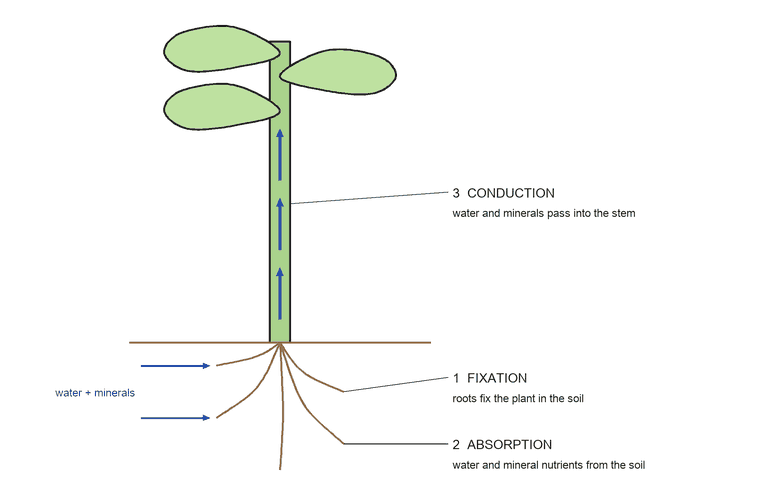
Watch out: Storage of food (as in carrot) is a special function of some roots only, not one of the three primary functions.
Therefore, the three primary functions of the root are fixation, absorption and conduction.
- 21 mark
Question 2
Mention four purposes for which the plants need water.
Solve with AIWritten solution
Solution:
Concept: Water makes up most of the protoplasm, but the plant also uses water for four separate jobs inside its body.
Step 1 — Photosynthesis.
In the green leaves water is used up as a raw material: it combines with carbon dioxide to make glucose.
Step 2 — Transpiration.
A large quantity of water evaporates from the leaves as water vapour. This cools the plant in hot weather and creates a suction force that pulls more water up.
Step 3 — Transportation.
Substances move through the plant dissolved in water: mineral salts go up from the roots to the shoot, and sugar goes from the leaves to the other parts.
Step 4 — Mechanical stiffness.
Water keeps the cells turgid (fully distended). Turgid cells press against one another, and this gives stiffness to the soft tissues, so leaves and young stems stand firm.

Watch out: Being a constituent of protoplasm is true of water, but the question asks for the purposes for which the plant uses water, so give these four.
Therefore, plants need water for photosynthesis, transpiration, transportation of substances and mechanical stiffness (turgidity).
- 31 mark
Question 3
Where are the mineral nutrients mostly used in plants?
Solve with AIWritten solution
Solution:
Concept: Mineral nutrients are elements the plant takes from the soil. They are the building and working materials of the cell.
Step 1 — Say where they are used.
Mineral nutrients are used mostly inside the cells of the plant.
Step 2 — Say what they are used for.
Inside the cell they are used:
- as constituents of the cell and of the cell organelles, and
- in the synthesis of a variety of compounds and enzymes.
Step 3 — Say how they reach the cells.
The plant gets minerals only from the soil, through the roots. Some are absorbed as salts (nitrates, phosphates, sulphates) and some simply as ions (potassium, calcium, magnesium, chlorine).
Therefore, mineral nutrients are mostly used inside the cells, as constituents of the cell and its organelles and in making compounds and enzymes.
- 41 mark
Question 4
List three main characteristics of the roots that enable them to draw water from the soil.
Solve with AIWritten solution
Solution:
Concept: A root draws water from the soil by osmosis. Osmosis works best through a large, thin surface with a stronger solution inside than outside, and the root hairs provide exactly this.
Step 1 — Huge surface area.
The numerous rootlets and root hairs give an enormous surface in contact with the soil water. Each rootlet bears hundreds of root hairs. For example, a four-month-old rye plant was found to have more than 14 billion root hairs, with a total length of over 10,000 km.
Step 2 — Cell sap of higher concentration.
The cell sap of a root hair is more concentrated than the surrounding soil water. So water molecules move from the soil water, where they are more concentrated, into the root hair.
Step 3 — Thin walls.
A root hair has a thin, freely permeable cell wall and, just inside it, a very thin, semi-permeable cell membrane. Water passes easily through both, while the larger molecules of the dissolved salts in the cell sap are held back.
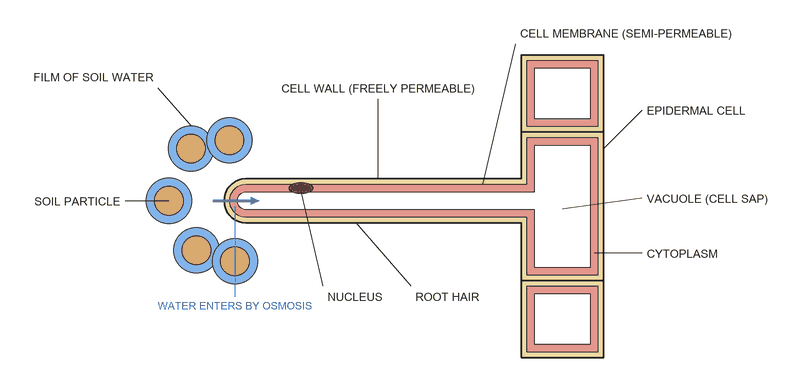
Watch out: It is the cell membrane, not the cell wall, that is semi-permeable; the wall lets almost everything through.
Therefore, the roots draw water because of their huge surface area, their more concentrated cell sap and their thin, permeable walls with a semi-permeable cell membrane.
- 56 marks
Question 5
Write true or false.
(i) Diffusion is the movement of molecules from a region of their lower concentration to that of a higher one.
(ii) Osmosis includes diffusion, but not vice versa.
(iii) Osmosis is unidirectional.
(iv) Exosmosis may cause bursting of a cell.
(v) Semi-permeable membrane prevents the passage of the solute molecules.
(vi) In an experiment on osmosis, if external pressure is applied on a dilute solution, less water will pass into the concentrated solution.
Solve with AIWritten solution
Solution:
Concept: diffusion is the free movement of molecules from the region of their higher concentration to the region of their lower concentration. Osmosis is a special kind of diffusion: only water molecules move, and they move through a semi-permeable membrane.
Step 1 — (i) False.
Diffusion goes from the region of higher concentration of the molecules to the region of their lower concentration, not the other way round.
Step 2 — (ii) True.
Osmosis is itself diffusion (of water molecules through a semi-permeable membrane). But diffusion needs no membrane at all, so not every diffusion is osmosis.
Step 3 — (iii) True.
In osmosis only the water molecules cross the membrane, and their net movement is in one direction: from the dilute solution to the concentrated solution.
Step 4 — (iv) False.
Exosmosis is the outward movement of water, which makes a cell shrink. It is endosmosis, the inward movement of water, that may make a cell swell and burst.
Step 5 — (v) True.
A semi-permeable membrane lets the water (solvent) molecules through but prevents the passage of the solute molecules, such as sugar or salt.
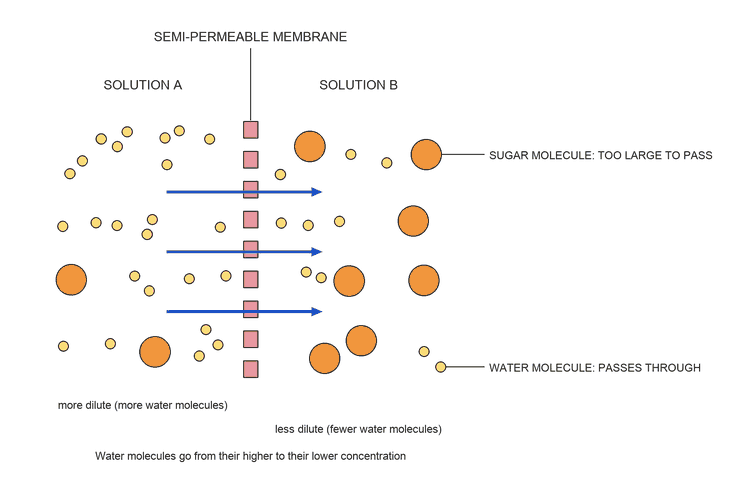
Step 6 — (vi) False.
Pressure applied on the dilute solution (or pure water) pushes its water across the membrane, so more water passes into the concentrated solution. Less water passes only when the pressure is applied on the concentrated solution; the minimum pressure that just stops the entry of water is the osmotic pressure.
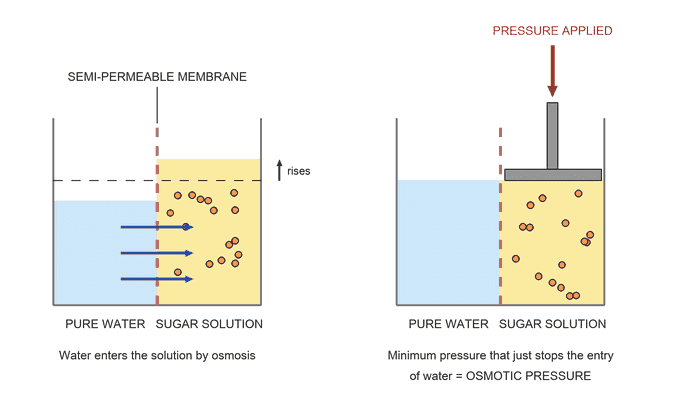
Watch out: In (iv) do not mix up the prefixes: exo- means out (cell shrinks), endo- means in (cell swells).
Therefore, (i) False, (ii) True, (iii) True, (iv) False, (v) True, (vi) False.
- 62 marks
Question 6
In what way is active transport opposite to diffusion?
Solve with AIWritten solution
Solution:
Concept: Substances move across a cell membrane either down a concentration gradient (from higher to lower concentration) or up it (from lower to higher concentration). Only the second needs energy.
Step 1 — Compare the direction.
We compare which way each process moves the substance:
Diffusion Active transport Direction From the region of higher concentration to the region of lower concentration From the region of lower concentration to the region of higher concentration (against the gradient) Energy No energy is used Uses energy (ATP) supplied by the living cell Step 2 — Give an example.
A root hair already holds mineral ions such as nitrates and potassium at a higher concentration than the soil water. It still takes in more of them by active transport, spending energy. Diffusion alone could never do this, because it would carry the ions out.
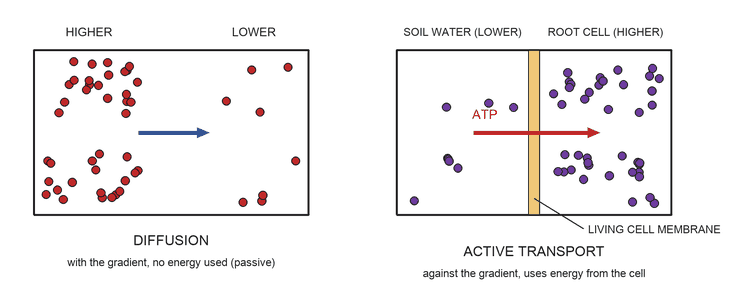
Watch out: Active transport is not just faster diffusion; it runs in the opposite direction and needs a living cell.
Therefore, active transport is opposite to diffusion because it moves substances from lower to higher concentration (against the gradient), using energy, while diffusion moves them from higher to lower concentration without energy.
- 72 marks
Question 7
A cell kept in a certain solution bursts after some time. Comment upon the kind of solution.
Solve with AIWritten solution
Solution:
Concept: A cell gains water when the solution outside is more dilute than its contents (a hypotonic solution), and it bursts only if it takes in more water than it can hold.
Step 1 — Find the direction of water.
The cell burst, so water must have entered it. Water enters a cell by endosmosis only when the solution outside has more water molecules (a lower solute concentration) than the cell contents.
Step 2 — Explain the bursting.
As water keeps entering, the cell swells. A cell with no strong cell wall to resist the swelling, such as a red blood cell, is stretched until it bursts.
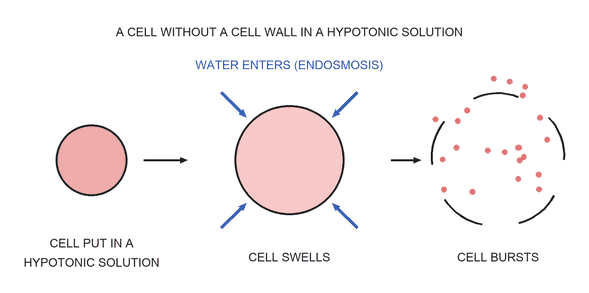
Watch out: A plant cell in the same solution only becomes turgid, because its cell wall stops it from bursting.
Therefore, the solution was hypotonic (more dilute than the cell contents, for example pure water).
- 81 mark
Question 8
Which process– diffusion, osmosis or active transport, needs involvement of energy ?
Solve with AIWritten solution
Solution:
Concept: A process needs energy only when it moves a substance against its concentration gradient, from lower to higher concentration.
Step 1 — Check diffusion and osmosis.
Both move molecules from their higher to their lower concentration. They happen on their own, so they need no energy.
Step 2 — Check active transport.
Active transport carries ions from their lower to their higher concentration through a living cell membrane. This uphill movement uses energy (ATP) supplied by the cell.
Watch out: Osmosis needs a membrane, but a membrane is not energy; osmosis is still a passive process.
Therefore, active transport is the process that needs energy.
- 92 marks
Question 9
Can we call diffusion passive transport ? If so, how?
Solve with AIWritten solution
Solution:
Concept: passive transport is any movement of substances that takes place without the cell spending energy.
Step 1 — Recall how diffusion happens.
In diffusion the molecules move freely, on their own, from the region of their higher concentration to the region of their lower concentration (down the gradient).
Step 2 — Check the energy.
Because the molecules move down the gradient by themselves, the cell does not use any energy for it. So diffusion fits the meaning of passive transport.
Step 3 — Give an example.
A crystal of a dye placed in water slowly spreads out until all the water is evenly coloured, with nothing pushing it.
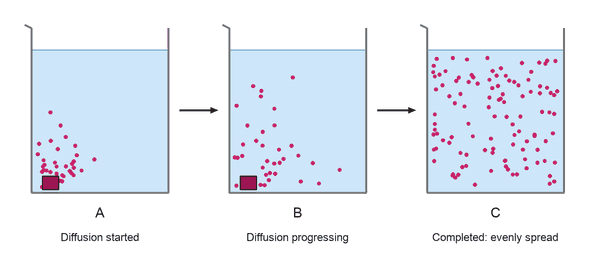
Therefore, yes: diffusion is passive transport, because the molecules move down their concentration gradient without any energy being used.
- 105 marks
Question 10
Name the following :
(i) The state of a cell when it cannot accommodate any more water.
(ii) Pressure of the cell contents on the cell wall.
(iii) The condition that is opposite to turgid.
(iv) The state of a plasmolysed cell after the re-entry of water.
(v) The pressure under which water passes from the living cells of a root into xylem.
Solve with AIWritten solution
Solution:
Concept: These are the terms for the water relations of a plant cell: what happens when water enters it, leaves it, and enters it again.
Step 1 — (i) A cell that cannot take in more water.
Such a cell is fully distended with water and its wall is stretched to the limit. It is turgid (the condition is turgidity).
Step 2 — (ii) Pressure of the cell contents on the wall.
The swollen contents press outwards on the cell wall. This is turgor pressure; the wall presses back with an equal and opposite wall pressure.

Step 3 — (iii) The opposite of turgid.
A cell that has lost water has shrunken contents and is no longer tight. It is flaccid (the condition is flaccidity).
Step 4 — (iv) A plasmolysed cell after water re-enters.
When a plasmolysed cell is put in water, water re-enters by endosmosis and the protoplasm swells back against the wall. The cell is deplasmolysed (the recovery is deplasmolysis).

Step 5 — (v) Pressure pushing water into the xylem.
Continued cell-to-cell osmosis in the root builds up a pressure that pushes water from the living cells into the xylem. This is root pressure.
Watch out: Turgor pressure acts outwards (contents on wall); wall pressure acts inwards (wall on contents).
Therefore, (i) turgid, (ii) turgor pressure, (iii) flaccid, (iv) deplasmolysed, (v) root pressure.
- 112 marks
Question 11
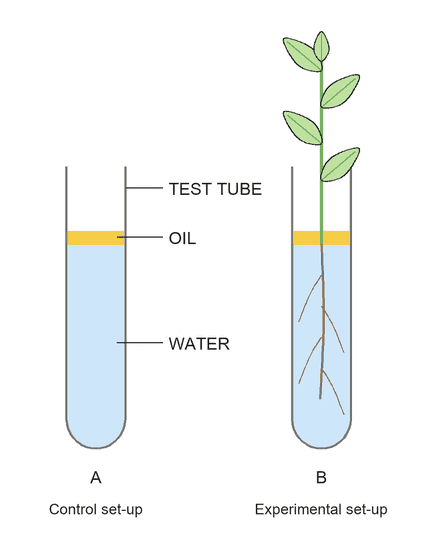
Look at Fig. 4.15. Why was oil added over water in the test tubes ?
 Solve with AI
Written solution
Solution:
Concept: An experiment must have only one cause for the result it measures. Here the result is the fall of the water level, and it must be caused only by the roots.
Step 1 — Say what the oil does.
Oil floats on water and forms a layer over it. This layer prevents the evaporation of water from the surface in the test tubes.
Step 2 — Say why this matters.
With evaporation stopped, any fall in the water level can be due only to the absorption of water by the roots.
Step 3 — Read the result.
The level falls in test tube B, which has the plant. It stays the same in test tube A (the control, without a plant). This proves that the roots absorb water.
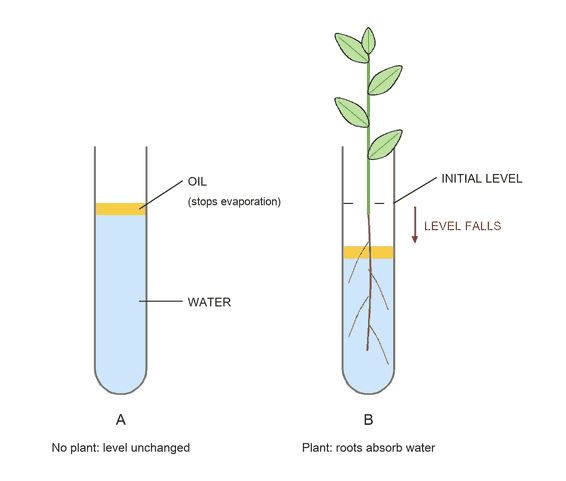
Watch out: The oil does not stop the plant from losing water through its leaves; it only seals the water surface.
Therefore, the oil was added to prevent evaporation from the water surface, so that the fall in level shows only the water absorbed by the roots.
- 122 marks
Question 12
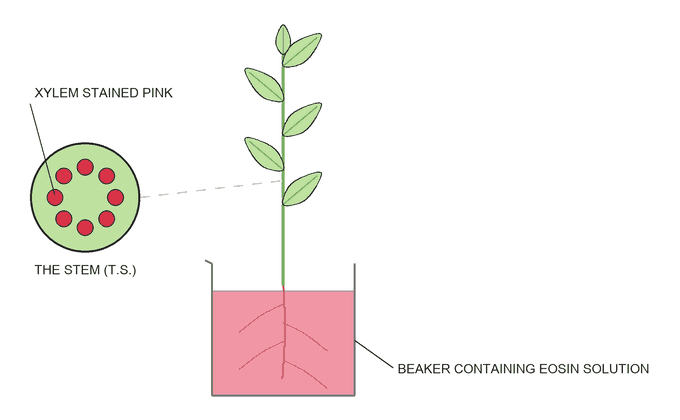
Look at the experiment shown in Fig. 4.16. Why was it necessary to take coloured eosin solution in water in the beaker?
 Solve with AI
Written solution
Solution:
Concept: Water itself leaves no mark on the tissues it passes through. A coloured solution leaves a stain, so it shows the path the water takes.
Step 1 — Say what eosin does.
Eosin is a red dye. As the coloured water rises in the plant, it stains the tissue through which it travels.
Step 2 — Say what is seen.
When thin sections of the root, stem and leaf are cut and examined, only the xylem is found stained pink.
Step 3 — Draw the conclusion.
So the water absorbed by the roots is conducted upwards through the xylem.

Therefore, coloured eosin was used so that the tissue carrying the water is stained and can be seen; it shows that water rises through the xylem.
- 131 mark
Question 13
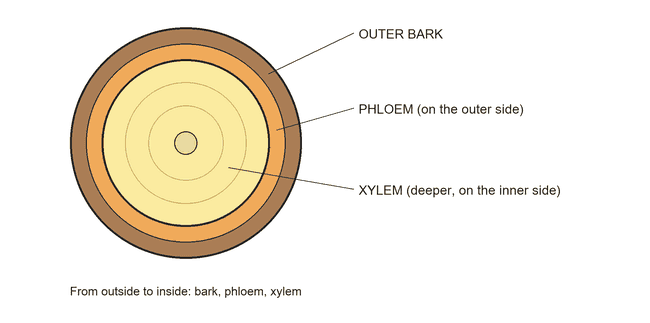
Which part of the stem, the xylem or the phloem, is located deeper internally ?
Solve with AIWritten solution
Solution:
Concept: In a stem the two conducting tissues lie in a fixed order: the phloem towards the outside (just under the bark) and the xylem towards the centre.
Step 1 — Recall the order from outside to inside.
From outside to inside a stem has the bark, then the phloem, then the xylem.
Step 2 — Use it as evidence.
That is why, when a ring of bark is removed from a stem, the phloem comes away with it while the deeper xylem stays intact.
Therefore, the xylem is located deeper internally.
- 142 marks
Question 14
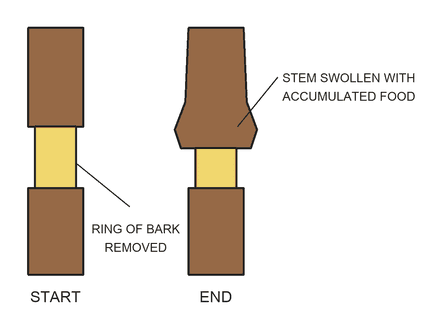
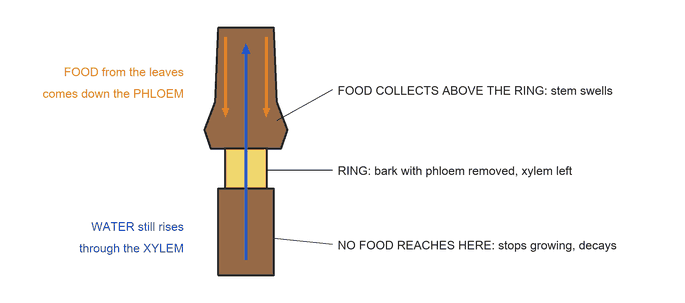
Look at Fig. 4.18. Why has the stem below the ring stopped growing and even slightly decayed?
 Solve with AI
Written solution
Solution:
Concept: Removing a ring of bark (girdling) removes the phloem, the tissue that carries food from the leaves downwards. The deeper xylem is left intact.
Step 1 — Food cannot pass the ring.
Food made in the leaves travels down the stem through the phloem. At the ring the phloem is missing, so the food cannot pass. It collects just above the ring, and the stem there swells.
Step 2 — The part below the ring starves.
No food reaches the part of the stem below the ring. This part uses up its stored food and then stops growing and starts to decay.
Step 3 — Why the leaves stay fresh.
Water still rises to the leaves through the intact xylem, so the leaves above do not wilt.

Watch out: The stem below the ring does not die for lack of water; the xylem still carries water. It dies for lack of food.
Therefore, the stem below the ring stopped growing and decayed because the removed phloem could no longer bring it food from the leaves.
- 151 mark
Question 15
The hydrostatic pressure of the cell sap on the cell wall is called :
Solve with AIAnswer
- Correct
(A) Turgor pressure
(B) Osmotic pressure
(C) Wall pressure
(D) Atmospheric pressure
Answer: (A) Turgor pressure
Concept: turgor pressure is the pressure of the cell contents (cell sap) on the cell wall. It acts outwards.
Step 1 — See where the pressure comes from.
When water enters a plant cell by endosmosis, the vacuole fills with cell sap and swells.
Step 2 — Name the pressure.
The swollen contents press outward on the cell wall. This hydrostatic pressure of the cell sap on the wall is the turgor pressure. The stretched wall presses back with an equal and opposite wall pressure.
Watch out: Wall pressure is the reverse push, of the wall on the contents.
Why the other options are wrong:
- (B) Osmotic pressure: it is the minimum pressure needed to stop pure water from entering a solution through a semi-permeable membrane, not the push of the sap on the wall.
- (C) Wall pressure: it is the pressure of the cell wall on the cell contents. It acts inwards, opposite to turgor pressure.
- (D) Atmospheric pressure: it is the pressure of the air around us, not of the cell sap.
Therefore, the pressure of the cell sap on the cell wall is turgor pressure, option (A).
- 161 mark
Question 16
When a cell in solution shrinks and loses its shape, then the solution is :
Solve with AIAnswer
(A) Isotonic
(B) Potable water
(C) Hypotonic
- Correct
(D) Hypertonic
Answer: (D) Hypertonic
Concept: A cell shrinks only when it loses water, and water leaves a cell when the solution outside is more concentrated than the cell contents. Such a solution is hypertonic.
Step 1 — Find the direction of water.
In a hypertonic solution water moves out of the cell by exosmosis.
Step 2 — See the effect.
The cell contents shrink and the cell loses its shape. In a plant cell the protoplasm pulls away from the cell wall (plasmolysis).

Watch out: Hypo- means less concentrated (the cell swells); hyper- means more concentrated (the cell shrinks).
Why the other options are wrong:
- (A) Isotonic: it has the same concentration as the cell contents, so there is no net gain or loss of water and the cell keeps its shape.
- (B) Potable water: drinking water is very dilute, so water would enter the cell and make it swell, not shrink.
- (C) Hypotonic: it is less concentrated than the cell contents, so water enters the cell and it swells.
Therefore, a cell shrinks in a hypertonic solution, option (D).
- 171 mark
Question 17
The process for which energy is required is :
Solve with AIAnswer
(A) Passive transport
(B) Diffusion
(C) Osmosis
- Correct
(D) Active transport
Answer: (D) Active transport
Concept: Moving a substance against its concentration gradient, from lower to higher concentration, does not happen on its own. The living cell must spend energy (ATP) on it. This is active transport.
Step 1 — Look at the situation in a root.
Mineral ions such as nitrates and potassium are often more concentrated inside the root cells than in the soil water.
Step 2 — See what the cell does.
To take in still more of them, the living cell membrane carries the ions inward, using energy supplied by the cell.

Why the other options are wrong:
- (A) Passive transport: by its very meaning, passive transport is movement without any energy from the cell.
- (B) Diffusion: it is the free movement of molecules from their higher to their lower concentration, which needs no energy.
- (C) Osmosis: it is the movement of water from its higher to its lower concentration through a semi-permeable membrane, which also needs no energy.
Therefore, the process that requires energy is active transport, option (D).
- 181 mark
Question 18
The highest water potential is that of :
Solve with AIAnswer
(A) 10% sugar solution
(B) Honey
(C) 10% salt solution
- Correct
(D) Pure water
Answer: (D) Pure water
Concept: water potential measures how freely the water molecules can move out of a liquid. It is highest in pure water, and dissolving any solute in water lowers it.
Step 1 — Look at pure water.
Pure water has no solute, so its water molecules are the most concentrated and the most free to move.
Step 2 — Compare the others.
Each of the other three liquids has a dissolved solute, so each has a lower water potential than pure water. This is why, in osmosis, water moves from pure water into a solution.
Watch out: A solution's water potential falls as its solute concentration rises, so honey (very concentrated) is the lowest, not the highest.
Why the other options are wrong:
- (A) 10% sugar solution: the dissolved sugar lowers its water potential below that of pure water.
- (B) Honey: it is a very concentrated sugar solution, so its water potential is very low.
- (C) 10% salt solution: the dissolved salt lowers its water potential below that of pure water.
Therefore, pure water has the highest water potential, option (D).
- 191 mark
Question 19
When the cells of a plant are fully distended, the condition is called :
Solve with AIAnswer
(A) Flaccidity
(B) Shrinkage
(C) Plasmolysis
- Correct
(D) Deplasmolysis
Answer: (D) Deplasmolysis
Concept: A cell fully distended with water is turgid; the exact name of the condition is turgidity. Turgidity is not among the options, so we choose the option that ends in a fully distended cell.
Step 1 — Recall deplasmolysis.
Deplasmolysis is the recovery of a plasmolysed cell: water re-enters the cell by endosmosis.
Step 2 — See where it ends.
The shrunken protoplasm swells and presses against the cell wall again, so the cell becomes fully distended (turgid) once more. Of the four options, only deplasmolysis gives this state.
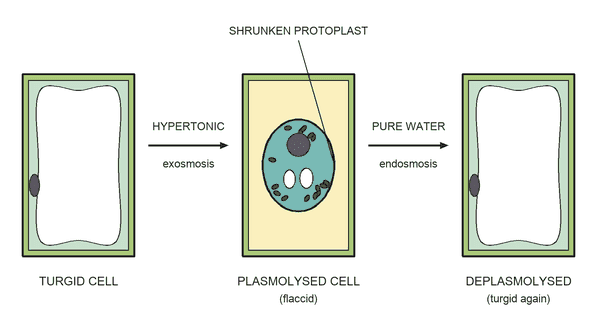
Watch out: The best one-word answer is turgidity; deplasmolysis is the process that restores it, and it is the printed key.
Why the other options are wrong:
- (A) Flaccidity: it is the opposite condition: the cell has lost water and its contents are shrunken.
- (B) Shrinkage: it means the cell contents become smaller, not distended.
- (C) Plasmolysis: it is the shrinking of the protoplasm away from the cell wall when water leaves the cell.
Therefore, of the options given, the fully distended condition is reached by deplasmolysis, option (D).
- 201 mark
Question 20
Which of the following creates a suction force in plants ?
Solve with AIAnswer
(A) Transportation
(B) Translocation
- Correct
(C) Transpiration
(D) Transformation
Answer: (C) Transpiration
Concept: transpiration is the loss of water as vapour from the leaves. As water is lost at the top, more water is pulled up from below; this pull is the suction force (transpirational pull).
Step 1 — Water is lost at the top.
The leaf cells lose water by evaporation and then draw water from the xylem of the leaf veins.
Step 2 — The pull passes down.
The water in the xylem forms an unbroken column, so the pull is passed down the stem to the roots, and the whole column moves up.
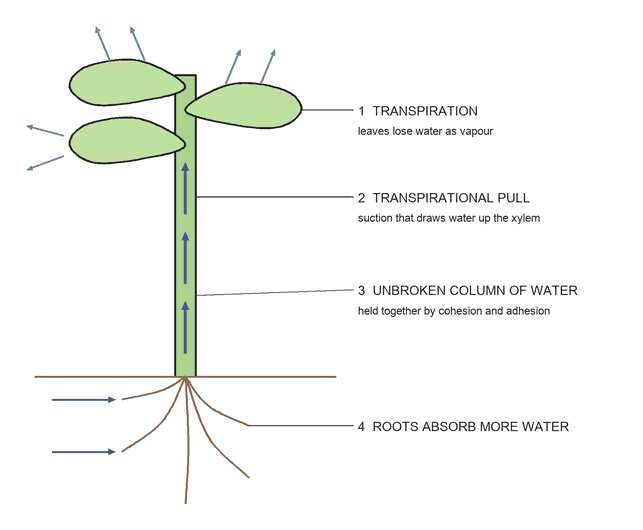
Watch out: The words in the options look alike; only transpiration removes water from the plant and so creates a pull.
Why the other options are wrong:
- (A) Transportation: it is the carrying of substances in solution inside the plant. It is helped by the suction force but does not create it.
- (B) Translocation: it is the movement of prepared food through the phloem.
- (D) Transformation: it means a change from one form into another; it does not move water in plants.
Therefore, the suction force in plants is created by transpiration, option (C).
- 211 mark
Question 21
The phenomenon by which living/dead plant cells absorb water by surface attraction is called :
Solve with AIAnswer
(A) Inhibition
(B) Cohesion
(C) Adhesion
- Correct
(D) Imbibition
Answer: (D) Imbibition
Concept: imbibition is the phenomenon by which living or dead plant cells absorb water by surface attraction.
Step 1 — See what attracts the water.
Materials such as cellulose and proteins have a strong attraction for water (they are hydrophilic).
Step 2 — See the effect.
They take up water on their surfaces and swell. Dry seeds and wooden doors swell in this way, and in germinating seeds the pressure of imbibition ruptures the seed coat.
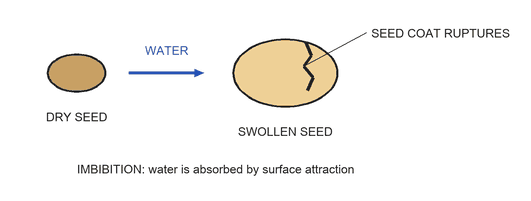
Watch out: Inhibition and imbibition sound alike but mean different things.
Why the other options are wrong:
- (A) Inhibition: it means slowing down or stopping a process; the word only looks like imbibition.
- (B) Cohesion: it is the attraction between molecules of the same kind, such as water molecules holding on to one another.
- (C) Adhesion: it is the attraction between water and a surface, such as the wall of a xylem vessel; it is not the absorption of water by a cell.
Therefore, absorption of water by surface attraction is imbibition, option (D).
- 221 mark
Question 22
Which of the following is a living semi-permeable membrane ?
Solve with AIAnswer
(A) Cell wall
- Correct
(B) Cell membrane
(C) Cellulose
(D) None
Answer: (B) Cell membrane
Concept: A plant cell has two outer layers. The cell wall is non-living and freely permeable. The cell membrane just inside it is living and semi-permeable.
Step 1 — Check which layer is living.
The cell membrane is a part of the living protoplasm; the cell wall is not.
Step 2 — Check which layer is semi-permeable.
The cell membrane lets water molecules through but not the larger molecules of dissolved salts. So it is a living semi-permeable membrane, and the absorption of water by the roots depends mainly on it.
Watch out: The cell wall comes first from outside, but it is freely permeable, not semi-permeable.
Why the other options are wrong:
- (A) Cell wall: it is non-living and permeable; water and dissolved substances pass freely through it.
- (C) Cellulose: it is the non-living material of which the cell wall is made, not a membrane.
- (D) None: the cell membrane is a living semi-permeable membrane, so 'None' cannot be right.
Therefore, the living semi-permeable membrane is the cell membrane, option (B).
- 231 mark
Question 23
Addition of salt to pickles is a method of killing the bacteria by :
Solve with AIAnswer
(A) Imbibition
(B) Diffusion
(C) Deplasmolysis
- Correct
(D) Plasmolysis
Answer: (D) Plasmolysis
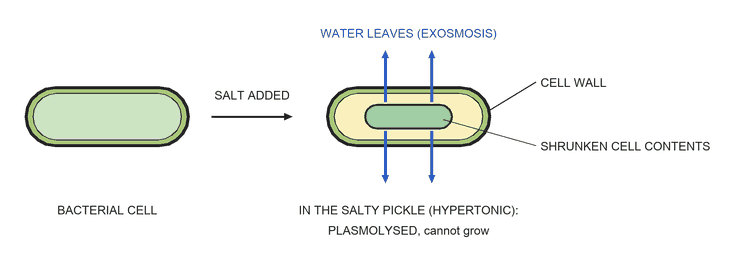
Concept: Plenty of salt makes the pickle a hypertonic solution, far more concentrated than the contents of a bacterial cell. Water then leaves the bacteria.
Step 1 — Water leaves the bacteria.
Water moves out of the bacterial cells into the salty surroundings by exosmosis.
Step 2 — The bacteria are plasmolysed.
The cell contents shrink away from the cell wall. The bacteria are plasmolysed, so they cannot grow and are killed. That is why salted pickles keep for a long time.
Why the other options are wrong:
- (A) Imbibition: it is the absorption of water by surface attraction; it adds water and does not kill a cell.
- (B) Diffusion: it is the general spreading of molecules from higher to lower concentration; the exact effect that kills the bacteria is the loss of water and shrinking of their protoplasm, which is plasmolysis.
- (C) Deplasmolysis: it is the recovery of a plasmolysed cell when water re-enters it, the opposite of what salt does.
Therefore, salt kills the bacteria in pickles by plasmolysis, option (D).
- 241 mark
Question 24
Root pressure can be measured by using :
Solve with AIAnswer
(A) Sphygmomanometer
(B) Barometer
- Correct
(C) Manometer
(D) Thermometer
Answer: (C) Manometer
Concept: A manometer measures the pressure of a liquid or a gas. Root pressure is the pressure with which the root pushes water up into the stem, so it is measured with a manometer.
Step 1 — Set up the plant.
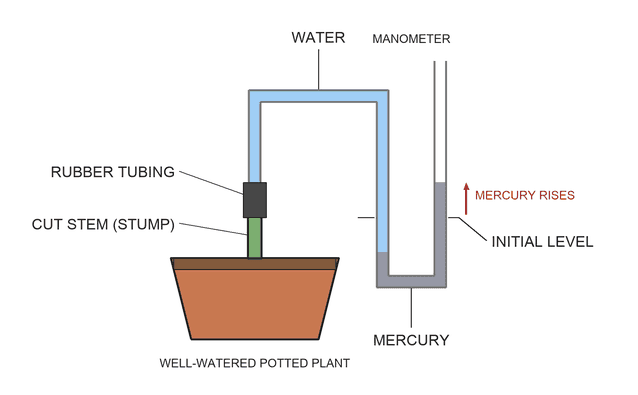
The stem of a well-watered potted plant is cut a little above the soil, and a manometer is joined to the stump with rubber tubing.
Step 2 — Read the pressure.
The root keeps pushing sap up out of the cut stem. The sap pushes on the mercury of the manometer, and the rise of the mercury in the far arm measures the root pressure.
Why the other options are wrong:
- (A) Sphygmomanometer: it measures human blood pressure.
- (B) Barometer: it measures atmospheric pressure.
- (D) Thermometer: it measures temperature, not pressure.
Therefore, root pressure is measured with a manometer, option (C).
- 251 mark
Question 25
Two plant cells are placed in two different liquids and observed after 4-6 hours.
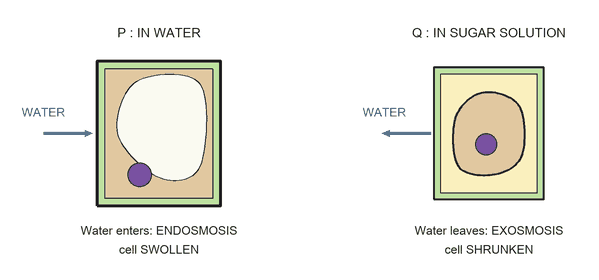
Cell Liquid Change in the shape of plant cell P Water Swollen Q Sugar solution Shrunken Identify the correct pair of the processes happening in plant cells P and Q.
Solve with AIAnswer
(A) P – Plasmolysis, Q – Deplasmolysis
(B) P – Plasmolysis, Q – Turgidity
(C) P – Exosmosis, Q – Endosmosis
- Correct
(D) P – Endosmosis, Q – Exosmosis
Answer: (D) P – Endosmosis, Q – Exosmosis
Concept: A cell swells when water enters it (endosmosis) and shrinks when water leaves it (exosmosis). The liquid outside decides the direction.
Step 1 — Cell P in water.
Water is more dilute than the cell sap (hypotonic). Water moves into the cell and it becomes swollen. Inward movement of water is endosmosis.
Step 2 — Cell Q in sugar solution.
The sugar solution is more concentrated than the cell sap (hypertonic). Water moves out of the cell and it becomes shrunken. Outward movement of water is exosmosis.
Watch out: Match the process to the change seen: swollen means water came in, shrunken means water went out.
Why the other options are wrong:
- (A) P – Plasmolysis, Q – Deplasmolysis: P is swollen, so it is not plasmolysed, and Q is shrunken, so it is not deplasmolysed; both are reversed.
- (B) P – Plasmolysis, Q – Turgidity: plasmolysis is shrinkage, but P is swollen; turgidity is the swollen state, but Q is shrunken.
- (C) P – Exosmosis, Q – Endosmosis: the two processes are interchanged: P gains water (endosmosis) and Q loses water (exosmosis).
Therefore, P shows endosmosis and Q shows exosmosis, option (D).
- 261 mark
Question 26
The following questions are Assertion-Reason based questions. Choose the answer based on the codes given below.
Assertion (A): Roots absorb water and mineral nutrients from the soil.
Reason (R): Soil is the storehouse of all the essential minerals for photosynthesis that are absorbed by the plant through the roots of the plant by the process of diffusion.
Solve with AIAnswer
- Correct
(A) (1) A is True and R is False
(B) (2) A is False and R is True
(C) (3) Both A and R are True
(D) (4) Both A and R are False
Answer: (A) (1) A is True and R is False
Concept: Judge the Assertion and the Reason separately. Roots take in water by osmosis, but most mineral ions are taken in by active transport, using energy.
Step 1 — Judge A.
The most important function of the roots is to absorb water and mineral nutrients from the soil. A is true.
Step 2 — Judge R.
Two parts of R are wrong. Minerals are not used only for photosynthesis: they are constituents of the cell and its organelles and are used to make many compounds and enzymes. Also, the ions are usually more concentrated inside the root cells than in the soil water, so they are absorbed mainly by active transport, not by diffusion. R is false.
Watch out: A Reason with one wrong word ('diffusion') is a false Reason.
Why the other options are wrong:
- (B) (2) A is False and R is True: it says A is false, but A is a correct statement.
- (C) (3) Both A and R are True: it says R is also true, but R is false.
- (D) (4) Both A and R are False: it says A is false, but A is true.
Therefore, A is true and R is false, option (A).
- 271 mark
Question 27
The following questions are Assertion-Reason based questions. Choose the answer based on the codes given below.
Assertion (A): Diffusion is the process of free movement of liquid molecules only. It does not occur in gaseous state.
Reason (R): The main condition which regulates the process of diffusion is the concentration gradient and not the state of matter. It always occurs from higher to lower concentration.
Solve with AIAnswer
(A) (1) A is True and R is False
- Correct
(B) (2) A is False and R is True
(C) (3) Both A and R are True
(D) (4) Both A and R are False
Answer: (B) (2) A is False and R is True
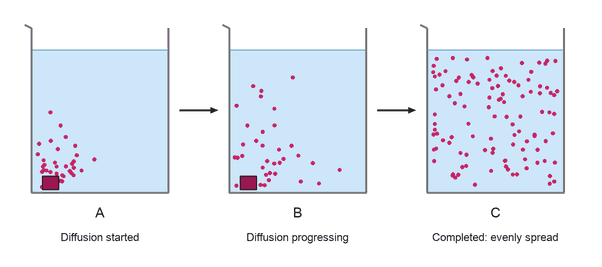
Concept: diffusion is the free movement of molecules of any substance (gas or liquid, solute or solvent) from the region of their higher concentration to the region of their lower concentration.
Step 1 — Judge A.
Diffusion is not limited to liquids. Gases diffuse too: the smell of a perfume spreads through a room, and water vapour diffuses out of a leaf during transpiration. A is false.
Step 2 — Judge R.
What drives diffusion is the difference in concentration (the concentration gradient), not the state of matter, and the molecules always move from their higher to their lower concentration. R is true.
Why the other options are wrong:
- (A) (1) A is True and R is False: it has the two verdicts interchanged: A is false and R is true.
- (C) (3) Both A and R are True: it says A is true, but A is false because gases also diffuse.
- (D) (4) Both A and R are False: it says R is false, but R is a correct statement.
Therefore, A is false and R is true, option (B).
- 281 mark
Question 28
The following questions are Assertion-Reason based questions. Choose the answer based on the codes given below.
Assertion (A): Translocation of prepared food material in plants always occurs through the phloem tissue in an upward direction.
Reason (R): Phelom is a kind of a complex permanent tissue in plants which surrounds the xylem tissue. It is present all throughout the plant – root, stem or leaves.
Solve with AIAnswer
(A) (1) A is True and R is False
- Correct
(B) (2) A is False and R is True
(C) (3) Both A and R are True
(D) (4) Both A and R are False
Answer: (B) (2) A is False and R is True
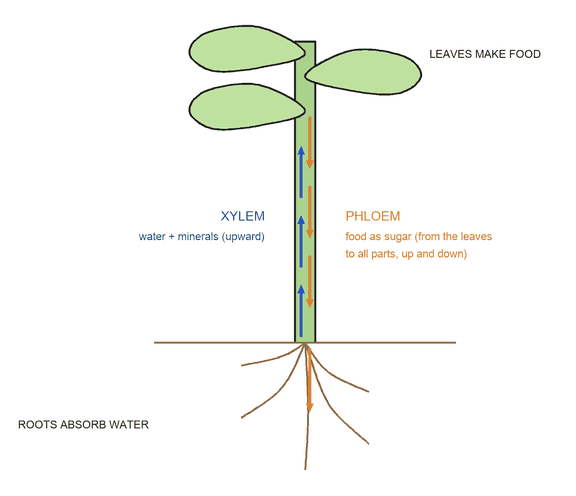
Concept: Food made in the leaves is carried by the phloem to all parts of the plant, so it moves both downwards and upwards.
Step 1 — Judge A.
Food does travel through the phloem, but not always upwards. Most of it goes down from the leaves to the stem and roots; some goes up to growing buds, flowers and fruits. The word "always" makes A false.
Step 2 — Judge R.
Phloem is a complex permanent tissue. It lies on the outer side of the xylem and is present throughout the plant, in the root, stem and leaves. ("Phelom" in R is a misprint of phloem.) R is true.
Watch out: Words such as 'always' and 'only' in an Assertion usually need checking first.
Why the other options are wrong:
- (A) (1) A is True and R is False: it has the two verdicts interchanged: A is false and R is true.
- (C) (3) Both A and R are True: it says A is true, but food does not always move upwards.
- (D) (4) Both A and R are False: it says R is false, but R is a correct statement.
Therefore, A is false and R is true, option (B).
- 291 mark
Question 29
The following questions are Assertion-Reason based questions. Choose the answer based on the codes given below.
Assertion (A): Active transport does not occur through a non-living semi-pesmeable membrane.
Reason (R): Active transport is in a direction opposite to that of diffusion, i.e. from a region of lower concentration to higher concentration.
Solve with AIAnswer
(A) (1) A is True and R is False
(B) (2) A is False and R is True
- Correct
(C) (3) Both A and R are True
(D) (4) Both A and R are False
Answer: (C) (3) Both A and R are True
Concept: active transport is the passage of a substance (salt or ion) from its lower to its higher concentration through a living cell membrane, using energy from the cell.
Step 1 — Judge A.
Active transport needs energy (ATP), and only a living cell can supply it. A non-living membrane has no energy to give, so active transport cannot take place through it. ("semi-pesmeable" is a misprint of semi-permeable.) A is true.
Step 2 — Judge R.
Diffusion goes from higher to lower concentration; active transport goes the other way, from lower to higher concentration. R is true.
Why the other options are wrong:
- (A) (1) A is True and R is False: it says R is false, but R correctly gives the direction of active transport.
- (B) (2) A is False and R is True: it says A is false, but active transport does need a living membrane.
- (D) (4) Both A and R are False: it says both are false, but both statements are true.
Therefore, both A and R are true, option (C).
- 307 marks
Question 30
Name the following :
(a) The condition of a cell placed in a hypotonic solution.
(b) The process by which intact plants lose water in the form of droplets from leaf margins.
(c) The process by which water enters root hairs.
(d) The tissue concerned with upward conduction of water in plants.
(e) The term for the inward movement of solvent molecules through the plasma membrane of a cell.
(f) The process by which molecules distribute themselves evenly within the space they occupy.
(g) The pressure which is responsible for the movement of water molecules across the cortical cells of the root.
Solve with AIWritten solution
Solution:
Concept: Each description points to one term of the water relations of a plant. Find the process or structure first, then give its exact name.
Step 1 — (a) A cell in a hypotonic solution.
A hypotonic solution is more dilute than the cell sap, so water enters the cell by endosmosis until it is fully distended. The condition is turgidity (the cell is turgid).
Step 2 — (b) Drops of water from leaf margins of an intact plant.
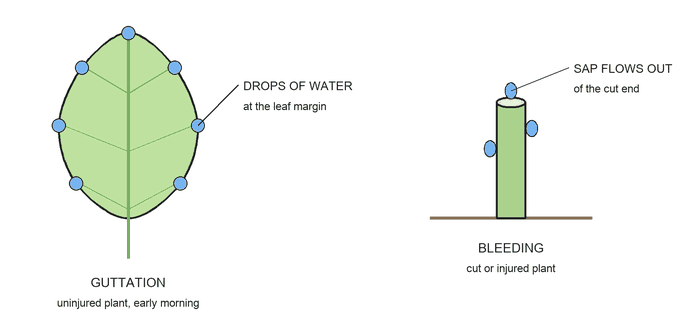
In the early morning root pressure forces water out as drops along the margins of the leaves of an uninjured plant. This is guttation.
Step 3 — (c) Entry of water into root hairs.
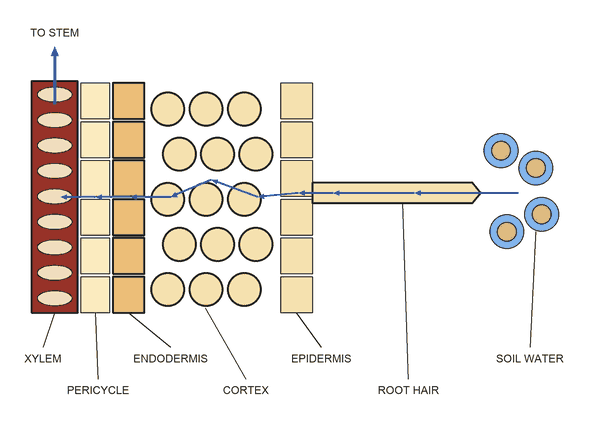
The cell sap of a root hair is more concentrated than the soil water, so water passes in through its semi-permeable cell membrane by osmosis (endosmosis).
Step 4 — (d) Tissue for upward conduction of water.
The vessels of the xylem carry water and dissolved minerals up from the roots to the leaves.
Step 5 — (e) Inward movement of solvent through the plasma membrane.
Water entering a cell through its semi-permeable membrane from a less concentrated solution is endosmosis; the outward movement is exosmosis.
Step 6 — (f) Molecules spreading evenly through a space.
Molecules move freely from their higher to their lower concentration until they are evenly spread. This is diffusion.
Step 7 — (g) Pressure moving water across the cortex.
Continued cell-to-cell osmosis across the cortical cells builds up root pressure, which drives the water on into the xylem.
Watch out: In (a) the answer is a condition (turgidity), not a process such as endosmosis.
Therefore, (a) turgidity, (b) guttation, (c) osmosis, (d) xylem, (e) endosmosis, (f) diffusion, (g) root pressure.
- 313 marks
Question 31
Give the equivalent terms for the following :
(a) Pressure exerted by the cell contents on the cell wall.
(b) The condition in which the cell contents are shrunken.
(c) Loss of water through a cut stem.
Solve with AIWritten solution
Solution:
Concept: Each description has a one- or two-word technical term from the water relations of a plant.
Step 1 — (a) Pressure of the cell contents on the wall.
The swollen contents push outwards on the cell wall; the wall pushes back with an equal wall pressure. The outward push is turgor pressure.
Step 2 — (b) Cell contents shrunken.
A cell that has lost water is no longer tight; it is the reverse of turgidity. The condition is flaccidity (the cell is flaccid).
Step 3 — (c) Loss of water through a cut stem.
Root pressure pushes sap out of a cut or injured part of the plant. This is bleeding.
Watch out: Bleeding (from a cut) and guttation (from the leaf margins of an uninjured plant) are both caused by root pressure, but they are different terms.
Therefore, (a) turgor pressure, (b) flaccidity, (c) bleeding.
- 323 marks
Question 32
Complete the following statements :
(a) Hypotonic solution is one in which the solution kept outside the cell has .......... solute concentration than inside the cell.
(b) Active transport is one in which the ions outside the roots move in by utilising ..........
(c) The bending movements of certain flowers towards the sun and the sleep movements of certain plants at night are examples of .......... .
Solve with AIWritten solution
Solution:
Concept: Recall the exact words used for tonicity, active transport and turgor movements.
Step 1 — (a) Hypotonic solution.
"Hypo" means less: a hypotonic solution has a lower solute concentration than the cell contents, so water enters the cell from it.
Step 2 — (b) Active transport.
The ions move in from their lower concentration outside to their higher concentration inside, which cannot happen on its own, so the cell uses energy (as ATP).

Step 3 — (c) Sun-tracking and sleep movements.
These movements are caused by a gain or loss of turgor (water) in certain cells, so they are turgor movements.
Therefore, (a) lower, (b) energy, (c) turgor movements.
- 333 marks
Question 33
Fill in the blanks by choosing the correct alternative from those given in brackets.
(a) When placed in a more concentrated solution, the cell contents will .......... (shrink / swell up)
(b) The pressure by which the .......... molecules tend to cross the semi-permeable membrane is called osmotic pressure. (salt / water)
(c) Active transport is in a direction .......... to that of diffusion. (opposite / same)
Solve with AIWritten solution
Solution:
Concept: Water moves out of a cell placed in a stronger solution, and only water molecules can cross a semi-permeable membrane.
Step 1 — (a) Cell in a more concentrated solution.
A more concentrated solution is hypertonic. Water leaves the cell by exosmosis, so the cell contents shrink.
Step 2 — (b) Molecules that cross the membrane.
A semi-permeable membrane lets the water molecules through but stops the salt molecules, so osmotic pressure is the pressure of the water molecules.

Step 3 — (c) Direction of active transport.
Diffusion goes from higher to lower concentration; active transport goes from lower to higher concentration, using energy. So it is opposite to diffusion.
Therefore, (a) shrink, (b) water, (c) opposite.
- 345 marks
Question 34
Match the items in column I with those in column II
Column I Column II (a) Xylem (i) semi-permeable (b) Phloem (ii) permeable (c) Cell membrane (iii) downward flow of sap (d) Root pressure (iv) upward flow of water (e) Cell wall (v) guttation Solve with AIWritten solution
Solution:
Concept: Pair each tissue or layer with its property, and the force with its effect.
Step 1 — Match the conducting tissues.
The xylem carries water and minerals up from the roots, so (a) goes with (iv). The phloem carries the food (sap) made in the leaves down to the stem and roots, so (b) goes with (iii).

Step 2 — Match the two layers of the cell.
The cell membrane lets water molecules through but not the larger molecules of dissolved salts, so (c) goes with (i) semi-permeable. The cell wall lets water and dissolved substances pass freely, so (e) goes with (ii) permeable.
Step 3 — Match the force.
Root pressure forces water out as drops at the leaf margins, which is guttation, so (d) goes with (v).
Step 4 — Write the matched table.
Putting the pairs together:
Column I Column II (a) Xylem (iv) upward flow of water (b) Phloem (iii) downward flow of sap (c) Cell membrane (i) semi-permeable (d) Root pressure (v) guttation (e) Cell wall (ii) permeable Watch out: Do not swap (i) and (ii): the wall is permeable, the membrane is semi-permeable.
Therefore, (a)–(iv), (b)–(iii), (c)–(i), (d)–(v), (e)–(ii).
- 358 marks
Question 35
Differentiate between the following :
(a) Plasmolysis and deplasmolysis
(b) Turgor pressure and wall pressure
(c) Hypotonic and Hypertonic solution
(d) Turgidity and Flaccidity
Solve with AIWritten solution
Solution:
Concept: Each pair describes opposite water relations of a cell: water going out or coming in, a push outwards or a push inwards.
Step 1 — (a) Plasmolysis and deplasmolysis.
We compare what happens to the protoplasm and why:
Plasmolysis Deplasmolysis Shrinkage of the protoplasm away from the cell wall. Swelling back of the shrunken protoplasm against the cell wall. Caused by the outflow of water (exosmosis) in a hypertonic solution. Caused by the re-entry of water (endosmosis) when the plasmolysed cell is put in water. The cell becomes flaccid. The cell becomes turgid again. 
Step 2 — (b) Turgor pressure and wall pressure.
We compare which way each pressure acts:
Turgor pressure Wall pressure Pressure of the cell contents on the cell wall. Pressure of the cell wall on the cell contents. Acts outwards. Acts inwards, opposing the turgor pressure. In a fully turgid cell the two are equal and opposite, so the cell is in a balanced state.
Step 3 — (c) Hypotonic and hypertonic solution.
We compare the solution outside with the cell sap:
Hypotonic solution Hypertonic solution The solution outside has a lower solute concentration than the cell sap. The solution outside has a higher solute concentration than the cell sap. Water enters the cell (endosmosis); the cell swells and becomes turgid. Water leaves the cell (exosmosis); the cell shrinks and becomes flaccid. 
Step 4 — (d) Turgidity and flaccidity.
We compare the two states of a cell:
Turgidity Flaccidity The state of a cell fully distended with water, its wall stretched. The state of a cell whose contents are shrunken; the cell is no longer tight. Results from endosmosis. Results from exosmosis. Gives stiffness to soft parts; leaves stand out firmly. Makes soft parts limp; leaves wilt and droop. Watch out: In each table keep the same point of comparison on the same row, so the difference is clear.
Therefore, each pair differs in the direction of water movement or of the pressure, as shown in the four tables.
- 365 marks
Question 36
Mention whether the following statements are true (T) or false (F). Correct the false statements by altering the last word only.
(a) Addition of salt to pickles prevents growth of bacteria because they turn turgid. (T/F)
(b) Cells that have lost their water content are said to be deplasmolysed. (T/F)
(c) Xylem is the water conducting tissue in plants. (T/F)
(d) The protoplasm shrinks, when a cell is kept in hypotonic solution. (T/F)
(e) The cell wall of the root cell is a differentially permeable membrane. (T/F)
Solve with AIWritten solution
Solution:
Concept: Test each statement against three ideas: plasmolysis (water lost in a strong solution), tonicity (which way water moves) and permeability (cell wall freely permeable, cell membrane semi-permeable). Only the last word may be changed.
Step 1 — (a) Salt in pickles: F.
Salt makes the pickle hypertonic, so water leaves the bacterial cells and they shrink; turgid cells would be full of water.
Corrected: Addition of salt to pickles prevents growth of bacteria because they turn plasmolysed.
Step 2 — (b) Cells that have lost water: F.
Deplasmolysed cells are those that have got their water back.
Corrected: Cells that have lost their water content are said to be plasmolysed.
Step 3 — (c) Xylem: T.
Xylem does conduct water and dissolved minerals upwards from the roots, so the statement is true.
Step 4 — (d) Protoplasm shrinks: F.
In a hypotonic solution water enters the cell and the protoplasm swells. The statement ends with "hypotonic solution", so the word to alter is "hypotonic".
Corrected: The protoplasm shrinks, when a cell is kept in hypertonic solution.
Step 5 — (e) Cell wall of the root cell: F.
The cell wall lets water and dissolved substances pass freely. It is the cell membrane, just inside the wall, that is differentially permeable.
Corrected: The cell wall of the root cell is a freely permeable membrane.
Watch out: Change only the last word; changing the subject (for example 'cell wall' to 'cell membrane') is not what the question allows.
Therefore, (a) F – plasmolysed, (b) F – plasmolysed, (c) T, (d) F – hypertonic, (e) F – freely permeable.
- 3710 marks
Question 37
Mention whether the following statements are true (T) or false (F) and give explanation in support of your answer.
(a) Guttation is another name for bleeding in plants. (T/F)
(b) Soaked seeds burst their seed coats. (T/F)
(c) If the phloem of a twig is removed keeping the xylem intact, the leaves of a twig wilt. (T/F)
(d) Guttation in plants occurs maximum at mid-day. (T/F)
(e) Raisins when submerged in water swell up due to endosmosis. (T/F)
Solve with AIWritten solution
Solution:
Concept: Decide each statement from the process behind it: root pressure (guttation, bleeding), imbibition, conduction through xylem and phloem, and osmosis.
Step 1 — (a) Guttation and bleeding: False.
Guttation is the loss of water as drops from the margins of the leaves of an uninjured plant. Bleeding is the flow of sap from a cut or injured part of a plant. Both are due to root pressure, but they are two different things.

Step 2 — (b) Soaked seeds: True.
Dry seeds absorb water by imbibition and swell up. The imbibition pressure that builds up is strong enough to rupture the seed coat.

Step 3 — (c) Phloem removed: False.
Water rises to the leaves through the xylem, which is still intact, so the leaves keep getting water and stay turgid. Removing the phloem only stops the downward flow of food. The leaves would wilt only if the xylem were removed.
Step 4 — (d) Guttation at mid-day: False.
Guttation is greatest in the early morning or at night. Then the air is humid and transpiration is low, while the roots go on absorbing water, so root pressure forces the extra water out. At mid-day transpiration is high and guttation does not occur.
Step 5 — (e) Raisins in water: True.
The cell sap of raisins is far more concentrated than water. Water therefore enters the cells of the raisins by endosmosis, and they swell up.
Watch out: In (c), wilting is caused by a lack of water (xylem), not a lack of food (phloem).
Therefore, (a) False, (b) True, (c) False, (d) False, (e) True.
- 383 marks
Question 38
Give two examples of turgor movements in plants.
Solve with AIWritten solution
Solution:
Concept: turgor movements are movements of plant parts caused by a quick gain or loss of turgor (water) in certain cells.
Step 1 — Example 1: the sensitive plant.
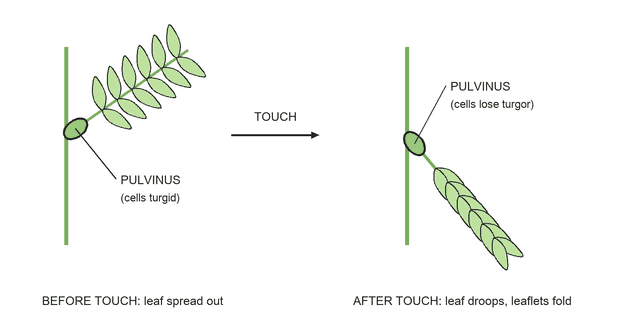
When a leaf of the sensitive plant (Mimosa pudica) is touched, the cells of the pulvinus (the swollen base of the leaf stalk and of the leaflets) suddenly lose water and their turgor. As a result the leaflets fold and the leaf droops.
Step 2 — Example 2: opening and closing of stomata.
When the two guard cells take in water and become turgid, they bend apart and the stoma opens. When they lose water and become flaccid, the stoma closes.
Step 3 — Other examples.
The bending of certain flowers towards the sun, the sleep movements of the leaves of some plants at night, and the closing of the leaves of insectivorous plants on their prey.
Watch out: Turgor movements are reversible changes in turgor, not growth movements.
Therefore, two examples of turgor movements are the drooping of the touched leaf of Mimosa pudica and the opening and closing of stomata.
- 3914 marks
Question 39
Define the following terms :
(a) Imbibition
(b) Diffusion
(c) Osmosis
(d) Osmotic Pressure
(e) Active transport
(f) Tonicity
(g) Root pressure
Solve with AIWritten solution
Solution:
Concept: Write each definition with its key words: what moves, from where to where, through what, and whether energy is used.
Step 1 — (a) Imbibition.
The phenomenon by which living or dead plant cells absorb water by surface attraction. Example: dry seeds and wooden doors swell up on contact with water or moist air.
Step 2 — (b) Diffusion.
The free movement of molecules of a substance (solute or solvent, gas or liquid) from the region of their higher concentration to the region of their lower concentration, when the two are in direct contact. Example: a crystal of dye in water slowly colours all the water evenly.
Step 3 — (c) Osmosis.
The movement of water molecules from the region of their higher concentration (dilute solution) to the region of their lower concentration (concentrated solution) through a semi-permeable membrane. Example: water passing from the soil into a root hair.

Step 4 — (d) Osmotic pressure.
The minimum pressure that must be applied to prevent the passage of the pure solvent into a solution when the two are separated by a semi-permeable membrane. The more concentrated the solution, the higher its osmotic pressure.

Step 5 — (e) Active transport.
The passage of a substance (salt or ion) from its lower to its higher concentration through a living cell membrane, using energy from the cell. Example: root hairs taking in nitrate and potassium ions that are already more concentrated inside.

Step 6 — (f) Tonicity.
The relative concentration of two solutions that decides the direction and extent of diffusion (of water) between them. Compared with the cell sap, a solution may be isotonic (same concentration), hypotonic (lower solute concentration) or hypertonic (higher solute concentration).
Step 7 — (g) Root pressure.
The pressure developed in the roots by the continued inward movement of water through cell-to-cell osmosis, which helps to push the sap up the stem. It is seen as guttation and as bleeding from a cut stem.
Watch out: Osmosis is only of water (the solvent) and needs a semi-permeable membrane; diffusion needs neither.
Therefore, the seven terms are defined above; the key words are surface attraction (imbibition), higher to lower concentration (diffusion), water through a semi-permeable membrane (osmosis), pressure to stop the solvent (osmotic pressure), lower to higher using energy (active transport), relative concentration (tonicity) and cell-to-cell osmosis in the root (root pressure).
- 4010 marks
Question 40
Give reasons for the following :
(a) If you sprinkle some common salt on grass growing on a lawn, it is killed at that spot.
(b) If you uproot a plant from the soil, its leaves soon wilt.
(c) It is better to transplant seedlings in a flower-bed in the evening and not in the morning.
(d) A plant cell when kept in a hypertonic salt solution for about 30 minutes becomes plasmolysed.
(e) Potato cubes when placed in water become firm and increase in size.
Solve with AIWritten solution
Solution:
Concept: Each case depends on which way water moves by osmosis, or on the balance between the water a plant absorbs and the water it loses.
Step 1 — (a) Salt kills the grass at that spot.
Cause: the salt dissolves in the soil water and makes it hypertonic to the cell sap of the root hairs.
Effect: water moves out of the root cells by exosmosis. The cells are plasmolysed, the roots cannot absorb water, and the grass there dries up and dies.

Step 2 — (b) An uprooted plant soon wilts.
Cause: on uprooting, the root hairs are torn off and the roots are out of the soil, so they cannot absorb water, while the leaves go on losing water by transpiration.
Effect: the leaf cells lose their turgidity and the leaves wilt.
Step 3 — (c) Seedlings are transplanted in the evening.
Cause: transplanting damages some roots, so for a while the seedling absorbs little water. In the evening and at night it is cool and transpiration is low.
Effect: the seedling loses very little water and has the whole night to settle its roots and recover. Planted in the morning, it would face a hot day of rapid transpiration and would wilt.
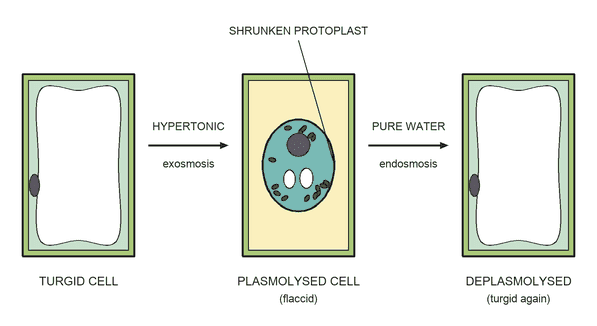
Step 4 — (d) A cell in hypertonic salt solution is plasmolysed.
Cause: the salt solution outside is more concentrated than the cell sap, so water leaves the cell by exosmosis.
Effect: the protoplasm shrinks away from the cell wall, which is plasmolysis.
Step 5 — (e) Potato cubes in water become firm and larger.
Cause: the cell sap of the potato cells is more concentrated than the water outside, so water enters the cells by endosmosis.
Effect: the cells become turgid, so the cubes turn firm and increase in size.
Watch out: In (a) the grass is not 'burnt' by salt; it dies because it loses water by exosmosis.
Therefore, (a) exosmosis plasmolyses the root cells, (b) water lost by transpiration is not replaced, (c) low evening transpiration lets the seedling recover, (d) exosmosis shrinks the protoplasm, (e) endosmosis makes the potato cells turgid.
- 413 marks
Question 41
What are the four main forces which contribute to the ascent of sap (upward movement of water and minerals) ? Name them and explain in short.
Solve with AIWritten solution
Solution:
Concept: The sap is pushed up from below (root pressure), pulled up from above (transpirational pull), and held up in the narrow vessels (capillarity and adhesion).
Step 1 — Root pressure.
Continued cell-to-cell osmosis in the root builds up a pressure that pushes the sap into the xylem vessels and up the stem to a certain height. It is enough for small, herbaceous plants.
Step 2 — Capillarity.
The xylem vessels are very narrow tubes, so water rises in them by capillary force. The narrower the tube, the higher the water rises.
Step 3 — Transpirational pull.
As the leaves lose water by transpiration, more water is pulled up from below. The water molecules hold on to one another (cohesion), so the water moves up as a continuous column. This is the main force in tall trees.
Step 4 — Adhesion.
The water molecules also stick to the walls of the xylem vessels. This helps to hold the column up and to draw water upward when the leaf cells lose water.

Watch out: Cohesion (water to water) and adhesion (water to the vessel wall) are different forces.
Therefore, the four main forces of the ascent of sap are root pressure, capillarity, transpirational pull (with cohesion) and adhesion.
- 423 marks
Question 42
What is transpirational pull ? How is it caused ?
Solve with AIWritten solution
Solution:
Concept: Water lost at the top of the plant pulls up the whole column of water below it, because the water molecules hold together.
Step 1 — Define it.
Transpirational pull is the suction force created in the leaves by transpiration, which draws water upwards through the xylem of the stem.
Step 2 — Water is lost from the leaves.
The cells of the leaves lose water by evaporation (transpiration).
Step 3 — The leaf cells draw water.
These cells take water from the neighbouring cells, and finally from the xylem of the leaf veins.
Step 4 — The column holds together.
Water molecules hold on to one another by cohesion and stick to the xylem walls by adhesion, so the water in the xylem is a continuous column from the leaves down to the roots.
Step 5 — The whole column moves up.
As each lot of water is lost at the top, the whole column is pulled up, and the roots absorb more water from the soil. This pull is the main force that raises water in tall trees.

Watch out: Transpirational pull pulls from above; root pressure pushes from below.
Therefore, transpirational pull is the suction force created by transpiration; it is caused by the loss of water from the leaves, which pulls up the continuous, cohesive column of water in the xylem.
- 437 marks
Question 43
A leaf cell of a water plant was placed in a liquid other than pond water. After sometime, it assumed a shape as shown below :
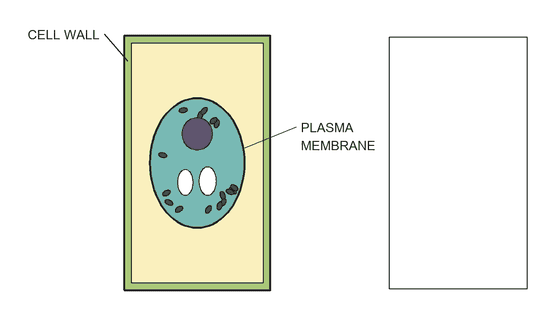
(a) Give the term for the state of the cell it has acquired.
(b) Name the structure which acts as a selectively permeable membrane.
(c) Comment on the nature (tonicity) of the liquid surrounding the cell.
(d) Name any one feature of this plant cell which is not present in an animal cell.
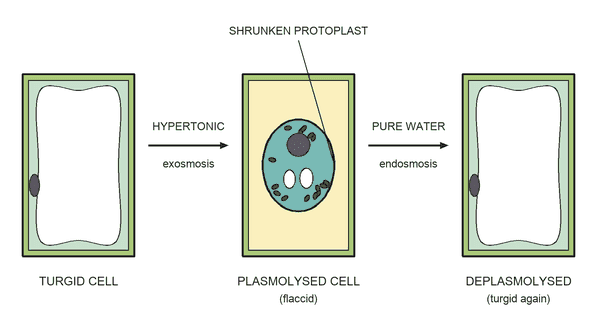
(e) Redraw in the space provided, the diagram of the cell if it is soon placed in ordinary water for some time.
Solve with AIWritten solution
Solution:
Concept: In the figure the protoplasm has shrunk away from the cell wall, so the cell has lost water by exosmosis. This happens only in a solution stronger than the cell sap.
Step 1 — (a) Name the state.
A cell whose protoplasm has shrunk away from the wall is plasmolysed (it is flaccid; the process is plasmolysis).
Step 2 — (b) Name the selectively permeable membrane.
The plasma membrane (cell membrane) lets water molecules pass but not the larger solute molecules.
Step 3 — (c) Judge the liquid.
Water left the cell, so the liquid outside was hypertonic: its solute concentration was higher than that of the cell sap (for example, a strong salt or sugar solution).
Step 4 — (d) A plant-only feature.
The cell wall is not present in an animal cell. (A large central vacuole and chloroplasts are other such features.)
Step 5 — (e) The cell put back in ordinary water.
Ordinary water is hypotonic to the cell sap. Water re-enters by endosmosis, the protoplasm swells and presses against the cell wall again, and the cell is deplasmolysed (turgid). The redrawn cell, labelled cell wall, plasma membrane, cytoplasm, vacuole (cell sap) and nucleus:

Watch out: The cell wall is freely permeable; the selectively permeable layer is the plasma membrane inside it.
Therefore, (a) plasmolysed, (b) plasma membrane, (c) hypertonic, (d) cell wall, (e) the cell becomes deplasmolysed (turgid) as drawn.
- 4411 marks
Question 44
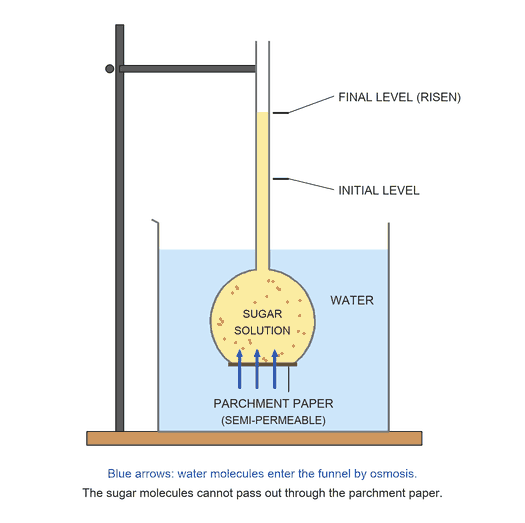
The diagram given below represents an experimental set-up to demonstrate a certain process. Study the same and answer the questions that follow :

(a) Name the process.
(b) Define the above-named process.
(c) What would you observe in the experimental set-up after an hour or so?
(d) What control experiment can be set up for comparison?
(e) Keeping in mind the root-hair, cell and its surroundings, name the parts that correspond to (1) concentrated sugar solution (2) parchment paper and (3) water in the beaker.
(f) Name any other material that can be used instead of parchment paper in the above experiment.
(g) Mention two advantages of the process to the plants.
Solve with AIWritten solution
Solution:
Concept: The parchment paper is a semi-permeable membrane. Water molecules pass from the beaker through it into the sugar solution, but the sugar molecules cannot pass out.
Step 1 — (a) Name the process.
Water passes through a semi-permeable membrane into a stronger solution, so the process is osmosis.
Step 2 — (b) Define it.
Osmosis is the movement of water molecules from the region of their higher concentration (dilute solution) to the region of their lower concentration (concentrated solution) through a semi-permeable membrane.
Step 3 — (c) The observation.
Water enters the funnel, so the level of the sugar solution in the stem of the thistle funnel rises, and the water level in the beaker falls slightly. The water in the beaker does not turn sweet, because the sugar cannot cross the parchment paper.
Step 4 — (d) The control.
Set up an identical apparatus in which the thistle funnel holds plain water instead of sugar solution. Its level does not change, which shows that the rise is due to the sugar solution.
Step 5 — (e) Match with the root hair.
The set-up is a model of a root hair in the soil:
In the experiment In the root hair and its surroundings (1) Concentrated sugar solution Cell sap of the root hair (in its vacuole) (2) Parchment paper Cell membrane (plasma membrane) of the root hair (3) Water in the beaker Soil water around the root hair Step 6 — (f) Another membrane.
Cellophane paper works in the same way. (An egg membrane or an animal bladder can also be used.)
Step 7 — (g) Two advantages to plants.
Any two:
- The roots absorb water from the soil by osmosis, and the water passes from cell to cell to the xylem.
- Osmosis keeps the cells turgid, which gives stiffness to soft parts such as leaves.
- It brings about the opening and closing of stomata through the turgidity of the guard cells.
Watch out: In (e) parchment paper matches the cell membrane, not the cell wall, because the cell wall is freely permeable.
Therefore, (a) osmosis; (c) the level in the funnel stem rises; (d) a funnel with plain water as control; (e) cell sap, cell membrane, soil water; (f) cellophane paper; (g) absorption of water and turgidity (or stomatal movement).
- 457 marks
Question 45
The diagram below represents a layer of epidermal cells showing a fully grown root hair. Study the diagram and answer the questions that follow:

(a) Name the parts labelled A, B, C and D.
(b) The root hair cell is in a turgid state. Name and explain the process that caused this state.
(c) Mention one distinct difference between the parts labelled A and B.
(d) Draw a diagram of the above root hair cell as it would appear when a concentrated solution of fertilizers is added near it.
Solve with AIWritten solution
Solution:
Concept: A root hair is an outgrowth of an epidermal cell. It is bounded by a cell wall with a cell membrane just inside it, and its cytoplasm lines a large vacuole.
Step 1 — (a) Name the parts.
A — cell wall; B — cell membrane (plasma membrane); C — cytoplasm; D — nucleus.

Step 2 — (b) The process that made it turgid.
The process is endosmosis (osmosis). The cell sap of the root hair is more concentrated than the soil water, so water enters through the freely permeable cell wall and the semi-permeable cell membrane. As a result the vacuole swells, presses the cytoplasm against the wall, and the cell becomes turgid.
Step 3 — (c) A and B differ.
We compare their permeability:
A (cell wall) B (cell membrane) Freely permeable: lets water and dissolved substances pass through. Semi-permeable: lets water molecules pass, but not the larger molecules of the dissolved salts. Step 4 — (d) Root hair beside a strong fertiliser solution.
The concentrated fertiliser solution is hypertonic to the cell sap. Water leaves the root hair by exosmosis, and the cell is plasmolysed: the cytoplasm shrinks away from the cell wall, and the space fills with the concentrated solution. Labelled: cell wall, shrunken cytoplasm, vacuole, nucleus, concentrated solution in the space.

Watch out: In (d) the cell wall keeps its shape; only the cytoplasm and vacuole shrink.
Therefore, (a) A cell wall, B cell membrane, C cytoplasm, D nucleus; (b) endosmosis; (c) A is freely permeable, B is semi-permeable; (d) the plasmolysed root hair as drawn.
- 469 marks
Question 46
Study the diagram given below and answer the questions that follow :
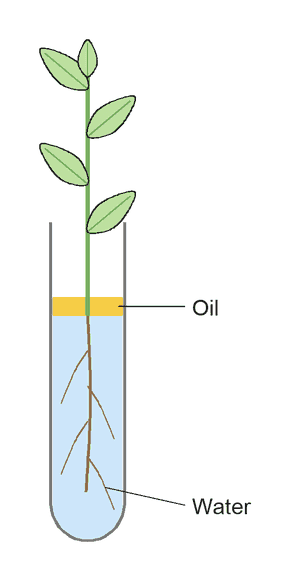
(a) Name the process being studied in the above experiment.
(b) Explain the process mentioned in (a) above.
(c) Why is oil placed over water?
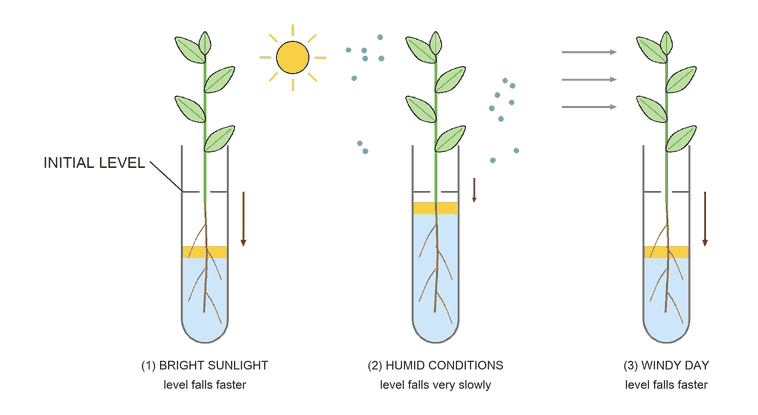
(d) What do we observe with regard to the level of water when this set up is placed in (1) bright sunlight (2) humid conditions (3) windy day?
(e) Mention any three adaptations found in the roots of the plant which enable them to carry out the process mentioned in (a).
Solve with AIWritten solution
Solution:
Concept: The fall in the water level shows how much water the roots absorb, and the roots absorb faster when the leaves lose water faster.
Step 1 — (a) Name the process.
The experiment studies the absorption of water by the roots.
Step 2 — (b) Explain it.
The cell sap of the root hairs is more concentrated than the water outside, so water enters the root hairs by osmosis. It then passes from cell to cell across the cortex into the xylem and rises up the stem. As the leaves lose water by transpiration, the transpirational pull draws up more water, and the roots absorb more.
Step 3 — (c) Why oil is placed over the water.
The oil prevents evaporation of water from the surface, so the fall in level is due only to absorption by the roots.
Step 4 — (d) The level in three conditions.
We link each condition to the rate of transpiration:
(1) Bright sunlight: transpiration is rapid, so the roots absorb more water and the level falls faster.
(2) Humid conditions: transpiration is low in humid air, so little water is absorbed and the level falls very slowly.
(3) Windy day: the wind carries away the water vapour, transpiration increases, and the level falls faster.
Step 5 — (e) Three adaptations of the roots.
- Huge surface area, from the numerous rootlets and root hairs.
- Cell sap of higher concentration in the root hairs than the soil water.
- Thin walls: a freely permeable cell wall and a thin, semi-permeable cell membrane.
Watch out: In (d) the roots respond to transpiration: more water lost by the leaves means more water absorbed.
Therefore, (a) absorption of water by roots; (c) oil prevents evaporation; (d) falls faster, falls very slowly, falls faster; (e) large surface area, concentrated cell sap, thin permeable walls.
- 477 marks
Question 47
Three cylinders of potato were carefully dried on a blotting paper and weighed. Each piece weighed 3 grams. Each one was placed in the beaker as shown below :
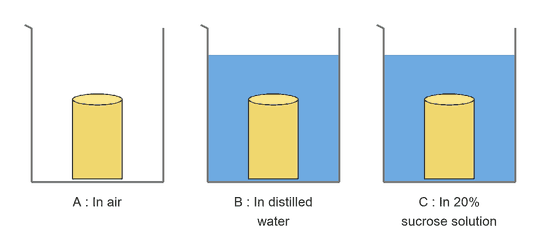
Answer the following questions :
(a) After 48 hours, which potato cylinder would be the heaviest ?
(b) The movement of which substance is mainly responsible for the weight change in the potato cylinders ?
(c) Name and define the process which is responsible for the movement of substance mentioned in answer (b).
(d) Write specific names of the processes which occur in beakers B and C. [kinds of processes defined in answer (c)].
(e) Would there be any difference in the weight of the potato cylinder in beaker A after 48 hours ? Give reason.
Solve with AIWritten solution
Solution:
Concept: Compare each surrounding with the cell sap of the potato. Distilled water is hypotonic to it, and the 20% sucrose solution is hypertonic to it.
Step 1 — (a) The heaviest cylinder.
In distilled water, water enters the potato cells, so the cylinder in beaker B gains weight and is the heaviest.
Step 2 — (b) The substance that moves.
The weight changes because water moves into or out of the potato cells.
Step 3 — (c) The process.
Osmosis: the movement of water molecules from the region of their higher concentration (dilute solution) to the region of their lower concentration (concentrated solution) through a semi-permeable membrane.
Step 4 — (d) The processes in B and C.
Beaker B — endosmosis: water enters the potato cells, so the cylinder becomes heavier and firm.
Beaker C — exosmosis: water leaves the potato cells, so the cylinder becomes lighter and limp.

Step 5 — (e) The cylinder in air.
In air there is no liquid around the cylinder, so there is no osmosis. But the cylinder loses some water by evaporation from its cut surface, so after 48 hours it weighs slightly less and looks a little shrivelled.
Watch out: In (e) do not say 'no change': there is no osmosis in air, but evaporation still removes some water.
Therefore, (a) beaker B; (b) water; (c) osmosis; (d) B endosmosis, C exosmosis; (e) yes, slightly lighter, because it loses water by evaporation.
- 485 marks
Question 48
The figure given below is a diagrammatic representation of a part of the cross-section of the root in the root hair zone. Study the same and then answer the questions that follow :

(a) The parts labelled as 1, 2, 3 and 4 are :
(i) Root hair, Xylem vessel, Soil particles, Cortex respectively.
(ii) Xylem vessel, Soil particles, Root hair, Cortex respectively.
(iii) Root hair, Xylem vessel, Cortex, Soil particles respectively.
(iv) Cortex, Soil particles, Xylem vessel, Root hair respectively.
(b) The process that enables the passage of water from soil into the root hair is :
(i) Diffusion (ii) Active transport
(iii) Osmosis (iv) Passive absorption
(c) The kind of force which exists between a liquid and any surface is called as :
(i) Cohesive force (ii) Adhesive force
(iii) Capillarity (iv) Suction force
(d) The kind of force between the same kind of liquid molecules is :
(i) Capillary force (ii) Transpirational pull
(iii) Adhesive force (iv) Cohesive force
(e) Sometimes exudation of water occurs from the margin of the leaves in early morning or night. It is termed as :
(i) Transpiration (ii) Bleeding
(iii) Guttation (iv) Osmosis
Solve with AIWritten solution
Solution:
Concept: Water passes from the film around the soil particles into the root hair, then from cell to cell across the cortex, and finally into the xylem vessel.
Step 1 — (a) Identify parts 1 to 4.
1 is the long outgrowth of an epidermal cell (root hair); 2 is the vessel deep inside the root (xylem vessel); 3 are the particles outside the root, each with a film of water (soil particles); 4 are the rounded cells between the epidermis and the xylem (cortex). This order matches option (i).

Step 2 — (b) Water from soil into the root hair.
The cell sap of the root hair is more concentrated than the soil water, so water enters through its semi-permeable cell membrane by (iii) osmosis.
Step 3 — (c) Force between a liquid and a surface.
The attraction between a liquid and a surface, such as water and the wall of a xylem vessel, is the (ii) adhesive force.
Step 4 — (d) Force between molecules of the same liquid.
The attraction between molecules of the same kind, such as one water molecule and the next, is the (iv) cohesive force.
Step 5 — (e) Water drops at leaf margins in the early morning.
In the early morning or at night transpiration is low, and root pressure forces water out as drops at the leaf margins. This is (iii) guttation.
Watch out: Bleeding is sap from a cut; guttation is drops from the leaves of an uninjured plant.
Therefore, (a) (i), (b) (iii) osmosis, (c) (ii) adhesive force, (d) (iv) cohesive force, (e) (iii) guttation.
- 497 marks
Question 49
Study the experimental set up in figure and then answer the questions that follow :
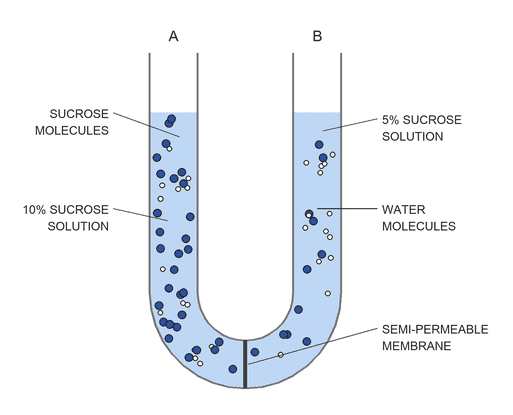
(a) What phenomenon is being studied by this set up ?
(b) Explain the phenomenon mentioned in (a) above
(c) What is meant by 'semipermeable membrane' ?
(d) What will you observe in the set up after about half an hour ? Give a reason for your answer.
Solve with AIWritten solution
Solution:
Concept: Arm A (10% sucrose) is more concentrated than arm B (5% sucrose). Only the water molecules can cross the membrane, and they move towards the stronger solution.
Step 1 — (a) Name the phenomenon.
Water moving through a semi-permeable membrane between two solutions is osmosis.
Step 2 — (b) Explain it.
The 5% solution in arm B has more water molecules in a given volume than the 10% solution in arm A. So water molecules move from B to A through the semi-permeable membrane, from their higher to their lower concentration. The larger sucrose molecules cannot pass through the membrane.
Step 3 — (c) Semi-permeable membrane.
A semi-permeable membrane lets the solvent (water) molecules pass through freely but prevents the passage of the solute (sugar or salt) molecules.
Step 4 — (d) The observation and its reason.
Water keeps moving from B into A, so the level rises in arm A and falls in arm B. The reason is osmosis from the less concentrated solution (B) into the more concentrated solution (A).
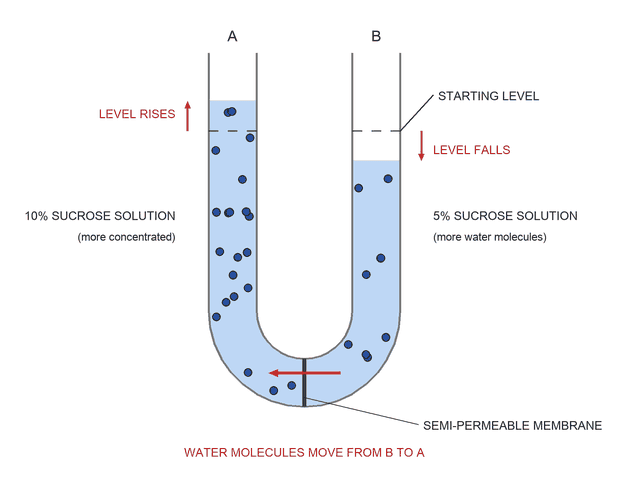
Watch out: Water moves towards the more concentrated solution, not away from it.
Therefore, (a) osmosis; (d) after half an hour the level rises in arm A and falls in arm B, because water passes by osmosis from the 5% to the 10% sucrose solution.
- 506 marks
Question 50
Given below is the figure of a plant cell showing different kinds of pressure acting upon it. Study the figure and answer the questions that follow :
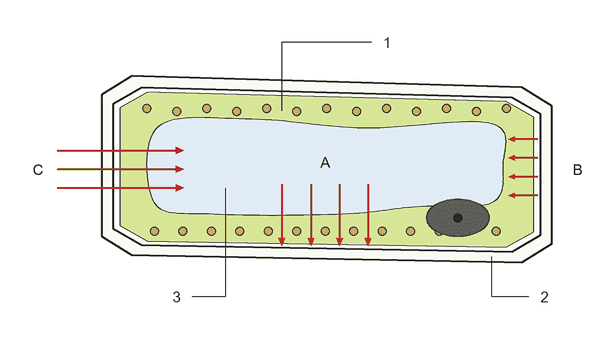
(a) In the figure, 1, 2 and 3 represent :
(i) Cytoplasm, Nucleus, Vacuole respectively
(ii) Vacuole, Cytoplasm, Cell wall respectively.
(iii) Cytoplasm, Cell membrane and vacuole respectively.
(iv) Cytoplasm, Cell wall and Vacuole respectively.
(b) B in the figure represents :
(i) Osmotic pressure (ii) Turgor pressure
(iii) Wall pressure (iv) Diffusion pressure
(c) A in the figure represents :
(i) imbibition pressure (ii) Wall pressure
(iii) Turgor pressure (iv) Osmotic pressure
(d) C in the figure represents :
(i) Turgor pressure (ii) Osmotic pressure
(iii) Wall pressure (iv) Imbibition pressure
(e) Draw a neat and labelled diagram of a plasmolysed plant cell.
Solve with AIWritten solution
Solution:
Concept: Water is drawn into the cell by osmosis (C). The swollen contents press outwards on the wall (A, turgor pressure), and the wall presses back on the contents (B, wall pressure).
Step 1 — (a) Identify 1, 2 and 3.
1 is the layer with chloroplasts just inside the wall (cytoplasm), 2 is the outermost boundary of the cell (cell wall), and 3 is the large clear space in the centre (vacuole). This matches option (iv).
Step 2 — (b) Pressure B.
B points inwards from the cell wall, so it is the pressure of the wall on the cell contents: (iii) wall pressure.
Step 3 — (c) Pressure A.
A points from the cell contents towards the wall, so it is the pressure of the contents on the wall: (iii) turgor pressure.
Step 4 — (d) Pressure C.
C shows water being drawn into the cell because of the concentration of the cell sap: (ii) osmotic pressure.
Step 5 — (e) Draw a plasmolysed plant cell.
A plant cell kept in a hypertonic solution loses water by exosmosis, and its protoplasm shrinks away from the wall. Labelled: cell wall, plasma membrane, shrunken cytoplasm, nucleus, vacuole, and the hypertonic solution filling the space between the wall and the protoplast.
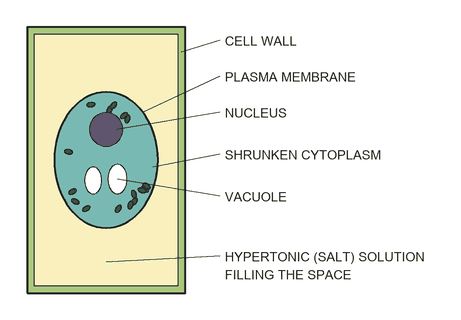
Watch out: (b) and (c) both have option (iii), but with different words: (iii) is wall pressure in (b) and turgor pressure in (c).
Therefore, (a) (iv), (b) (iii) wall pressure, (c) (iii) turgor pressure, (d) (ii) osmotic pressure, (e) the plasmolysed cell as drawn.
What Class 10 Biology Ch 4 covers
The sections of the chapter, in the order the book takes them. Every question above comes from one of these.
- 01Absorption by the Roots
- 02Need of Water and Minerals for Plants
- 03Characteristics of Roots for Absorbing Water
- 04Absorption and Conduction of Water and Minerals
- 05Root Pressure
- 06Upward Movement of Absorbed Water and Minerals
More ways to study this chapter
The same chapter asked three other ways. Practise it, revise it, and see what the board has set on Ch 4 before.
- Competency-Based Questions (CBQ)Case study questions: a situation, and the part of the chapter that answers it.40questionsOpen
- Previous Year QuestionsQuestions that have actually appeared in board papers, each tagged with its year.38questionsOpen
- Practice QuestionsExtra questions per chapter, for when one attempt at a method is not enough.45questionsOpen
Ch 4 in past ICSE papers
The same chapter as the board has actually asked it. These are worded differently from the textbook exercise, which is the point of reading them.
- 11 mark
Board paper question 1
Choose the correct answer from the four options given below:
A plant cell may burst when:
Solve with AIAnswer
(A) Turgor pressure equalises wall pressure.
- Correct
(B) Turgor pressure exceeds wall pressure.
(C) Wall pressure exceeds turgor pressure.
(D) None of the above
Answer: (B) Turgor pressure exceeds wall pressure.
Concept: Turgor pressure is the pressure of the swollen cell contents on the cell wall (outward). Wall pressure is the equal and opposite pressure of the cell wall on the contents (inward). A cell stays whole only while the wall can push back as hard as the contents push out.
Step 1 — Follow the water into the cell.
In a dilute (hypotonic) solution water keeps entering the cell by endosmosis. The vacuole swells and the contents press harder and harder on the cell wall, so the turgor pressure rises.
Step 2 — Compare the two pressures.
The wall can stretch only a little. While it can press back with an equal wall pressure, the cell is simply turgid. If the turgor pressure becomes greater than the pressure the wall can exert back, the wall gives way and the cell bursts.
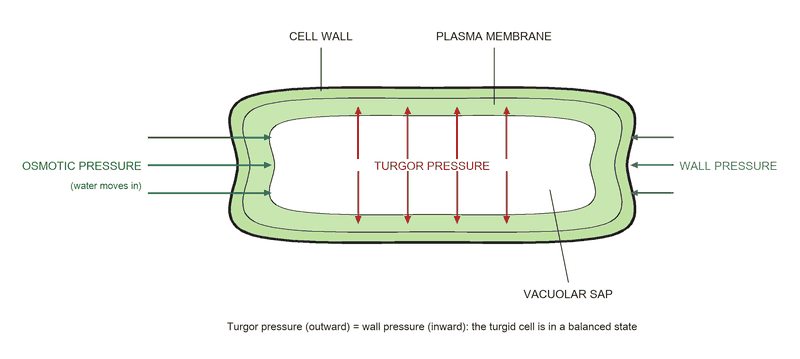
Step 3 — Match with the options.
Only option (B) describes turgor pressure exceeding wall pressure.
Watch out: A turgid cell (pressures equal) is the normal, healthy state of a plant cell; it is not about to burst.
Why the other options are wrong:
- (A) Turgor pressure equalises wall pressure: when turgor pressure equals wall pressure the cell is turgid and balanced; no more water enters, so it does not burst.
- (C) Wall pressure exceeds turgor pressure: if the wall pressure were greater, the wall would push the contents inward; nothing pushes the wall outward, so the cell cannot burst.
- (D) None of the above: option (B) correctly describes when a plant cell may burst, so 'None of the above' is wrong.
Therefore, a plant cell may burst when turgor pressure exceeds wall pressure, option (B).
- 25 marks
Board paper question 2
The figure given below is a diagrammatic representation of a part of the cross section of the root in the root hair zone. Study the same and then answer the questions that follow:
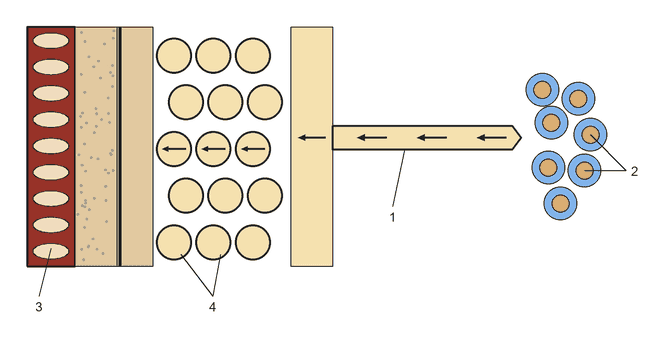
(i) Name the parts indicated by the guidelines 1 to 4.
(ii) Which is the process that enables the passage of water from the soil into the root hair?
(iii) Name the pressure that is responsible for the movement of water in the direction indicated by the arrows. Define it.
(iv) Due to an excess of this pressure sometimes drops of water are found along the leaf margins of some plants especially in the early mornings. What is the phenomenon called?
(v) Draw a well labelled diagram of the root hair cell as it would appear if an excess of fertiliser is added to the soil close to it.
Solve with AIWritten solution
Solution:
Concept: Water moves from the soil into the root hair by osmosis, then from cell to cell across the cortex into the xylem. The continued inward flow of water builds up root pressure, which pushes water up the xylem.
Step 1 — (i) Parts 1 to 4.
Read each guideline in the figure: 1 is the long outgrowth reaching into the soil, 2 marks the particles outside the root, 3 is the vessel at the centre and 4 marks the round cells between the epidermis and the stele.
- 1 — Root hair
- 2 — Soil particles (each surrounded by a film of soil water)
- 3 — Xylem (xylem vessel)
- 4 — Cortex (cortical cells)
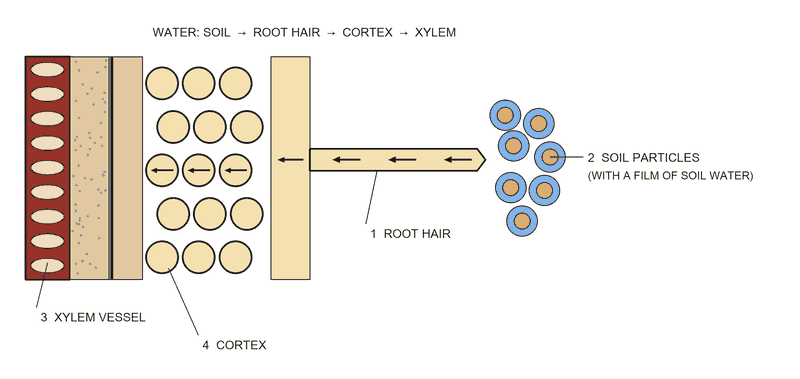
Step 2 — (ii) Passage of water from the soil into the root hair.
The process is osmosis. The cell sap of the root hair is more concentrated than the soil water, so water molecules pass from the soil water into the root hair through its semi-permeable cell membrane.
Step 3 — (iii) Pressure that moves water in the direction of the arrows.
The pressure is root pressure. Root pressure is the pressure developed in the roots by the continued inward movement of water by cell-to-cell osmosis; it helps the ascent of sap up the stem.
As each cell takes in water it passes water on to the next cell inward, so the push of the inward flow builds up until water is forced into the xylem vessels.
Step 4 — (iv) Drops of water along the leaf margins in the early morning.
The phenomenon is guttation. When root pressure is high (warm, moist soil and humid nights, so that little water is lost by transpiration), water is forced out as droplets through hydathodes, the water pores at the ends of the veins along the leaf margins. It is seen in plants such as grasses, tomato and Colocasia.
Step 5 — (v) The root hair cell after excess fertiliser is added close to it.
The fertiliser dissolves in the soil water and makes it hypertonic (more concentrated than the cell sap). Water leaves the root hair cell by exosmosis and the cytoplasm shrinks away from the cell wall: the cell is plasmolysed.
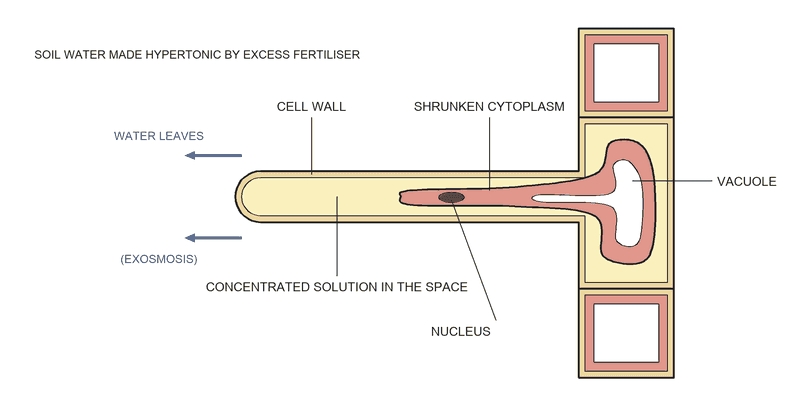
The diagram shows the cell wall keeping its shape, the shrunken cytoplasm pulled away from it, and the concentrated (fertiliser) solution filling the space between the two.
Watch out: The cell wall of a plasmolysed cell keeps its shape; only the protoplast (cytoplasm with the vacuole) shrinks.
Therefore, 1 = root hair, 2 = soil particles, 3 = xylem, 4 = cortex; water enters by osmosis; root pressure moves it inward and up; excess root pressure causes guttation; excess fertiliser plasmolyses the root hair.
- 31 mark
Board paper question 3
Give the Biological / technical term for the following:
The process of uptake of mineral ions against the concentration gradient using energy from the cell.
Solve with AIWritten solution
Solution:
Concept: Active transport is the movement of a substance (usually ions of mineral salts) across a living cell membrane from the region of its lower concentration to the region of its higher concentration, using energy (ATP) from the cell.
Step 1 — Read what the definition describes.
The ions are taken up against the concentration gradient, that is, from where they are fewer (soil water) to where they are more (root cells).
Step 2 — Name the process.
Such uphill movement cannot happen on its own; the cell must spend energy (ATP) on it. Movement against the gradient using the cell's energy is active transport.

Root hair cells take in mineral ions such as nitrates and potassium in this way, because these ions are already more concentrated inside the root cells than in the soil water.
Watch out: Diffusion and osmosis go down a concentration gradient and need no energy, so neither fits.
Therefore, the term is active transport.
- 41 mark
Board paper question 4
Name the following:
The process by which root hairs absorb water from the soil.
Solve with AIWritten solution
Solution:
Concept: A root hair is a long, thin outgrowth of one epidermal cell of the root. Its cell sap is more concentrated than the soil water around it, so water enters it by osmosis.
Step 1 — Compare the two solutions.
The cell sap of the root hair contains dissolved salts and sugars, so it is more concentrated than the dilute soil water outside.
Step 2 — Name the process.
Water molecules therefore move from the soil water (more water molecules) into the root hair (fewer water molecules) through the semi-permeable cell membrane. This is osmosis; because the water moves into the cell, it is also called endosmosis.
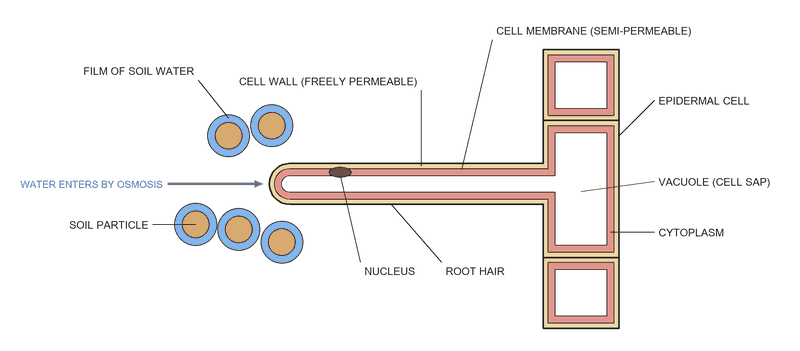
Watch out: Osmosis is about the movement of WATER; the mineral ions are taken in separately, mostly by active transport.
Therefore, root hairs absorb water from the soil by osmosis (endosmosis).
- 51 mark
Board paper question 5
Choose the correct answer from the four options given below:
Marine fish when placed in tap water bursts because of:
Solve with AIAnswer
- Correct
(A) Endosmosis
(B) Exosmosis
(C) Diffusion
(D) Plasmolysis
Answer: (A) Endosmosis
Concept: A marine fish lives in salty sea water, so its body fluids are concentrated. Tap water is far more dilute, so it is hypotonic to the fish's cells.
Step 1 — Find the direction of water.
Water moves from the tap water (more water molecules) into the body cells (fewer water molecules) through their semi-permeable cell membranes.
Step 2 — Name the process.
This inward movement of water through a semi-permeable membrane is endosmosis. It makes the cells swell.
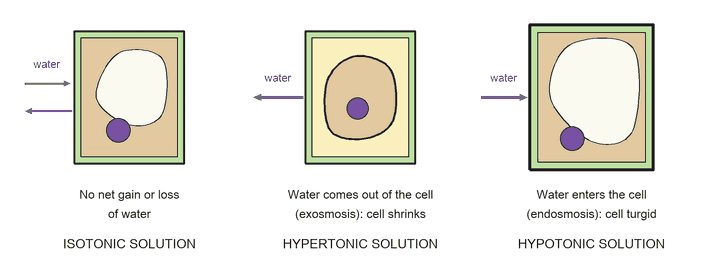
Step 3 — See why the cells burst.
Animal cells have no cell wall to resist the swelling, so they keep taking in water until they burst.
Watch out: The word 'bursts' points to water coming IN; exosmosis would make the cells shrink.
Why the other options are wrong:
- (B) Exosmosis: exosmosis is the outward movement of water, which happens in a hypertonic solution and makes cells shrink, not burst.
- (C) Diffusion: diffusion is the general movement of molecules in direct contact; the bursting is caused by water crossing the semi-permeable cell membranes into the cells, which is named more exactly as endosmosis.
- (D) Plasmolysis: plasmolysis is the shrinking of the protoplast of a plant cell away from its cell wall in a hypertonic solution, the opposite of swelling.
Therefore, the cells of a marine fish placed in tap water burst because of endosmosis, option (A).
- 61 mark
Board paper question 6
The statements given below are incorrect. Rewrite the correct statement by changing the underlined words of the statements.
Free movement of solutes in and out of the cell takes place across the cell membrane.
Solve with AIWritten solution
Solution:
Concept: A plant cell has two outer layers with different permeability: the cell wall is freely permeable; the cell membrane is semi-permeable (selectively permeable).
Step 1 — Check the underlined words.
The cell membrane does not allow free movement: it lets water through but controls which dissolved substances pass, so the statement is wrong as written.
Step 2 — Find the layer that allows free movement.
The cell wall is made of cellulose with large spaces in it. It lets water and dissolved substances (solutes) pass in and out freely.
Watch out: Free movement = cell wall (freely permeable); selective movement = cell membrane (semi-permeable).
Therefore, the correct statement is: Free movement of solutes in and out of the cell takes place across the cell wall.
All 38 board paper questions for this chapter, solved the same way.
Class 10 Biology Ch 4 questions students ask
How many questions are there in Class 10 Biology Ch 4?
50 questions. Every one is solved step by step on this page.
Are these Class 10 Biology solutions free?
Yes. Every question and its full working is free to read, with no account needed.
Can I download the Class 10 Biology Ch 4 solutions as a PDF?
There is no PDF to download. Every solution is on this page instead, which means it is searchable, always the current syllabus, and readable on a phone. Use your browser's print option if you want it on paper.