Solution:
Concept: The fall in the water level shows how much water the roots absorb, and the roots absorb faster when the leaves lose water faster.
Step 1 — (a) Name the process.
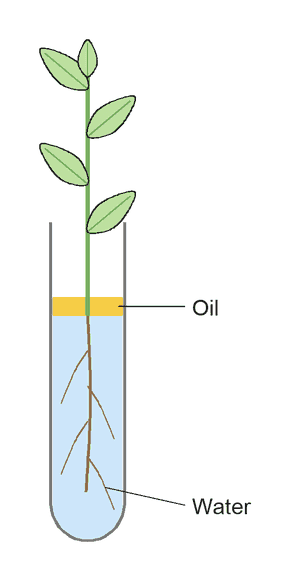
The experiment studies the absorption of water by the roots.
Step 2 — (b) Explain it.
The cell sap of the root hairs is more concentrated than the water outside, so water enters the root hairs by osmosis. It then passes from cell to cell across the cortex into the xylem and rises up the stem. As the leaves lose water by transpiration, the transpirational pull draws up more water, and the roots absorb more.
Step 3 — (c) Why oil is placed over the water.
The oil prevents evaporation of water from the surface, so the fall in level is due only to absorption by the roots.
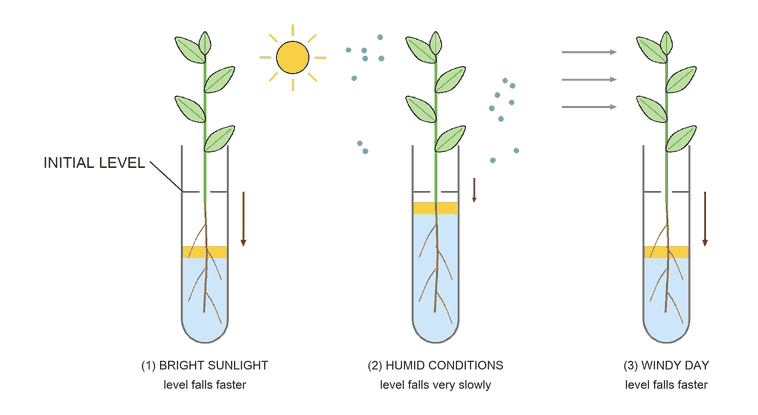
Step 4 — (d) The level in three conditions.
We link each condition to the rate of transpiration:
(1) Bright sunlight: transpiration is rapid, so the roots absorb more water and the level falls faster.
(2) Humid conditions: transpiration is low in humid air, so little water is absorbed and the level falls very slowly.
(3) Windy day: the wind carries away the water vapour, transpiration increases, and the level falls faster.
Step 5 — (e) Three adaptations of the roots.
- Huge surface area, from the numerous rootlets and root hairs.
- Cell sap of higher concentration in the root hairs than the soil water.
- Thin walls: a freely permeable cell wall and a thin, semi-permeable cell membrane.
Watch out: In (d) the roots respond to transpiration: more water lost by the leaves means more water absorbed.
Therefore, (a) absorption of water by roots; (c) oil prevents evaporation; (d) falls faster, falls very slowly, falls faster; (e) large surface area, concentrated cell sap, thin permeable walls.