
Opening your dashboard
Class 10 Biology Chapter 4 Absorption by Roots – The Processes Involved: Previous Year Questions
38 questions on Chapter 4, each solved step by step. Class 10 Biology, ICSE 2026-27.
38 questions with solutions
1–5 marks · Mixed difficulty
- 11 mark
Question 1
Choose the correct answer from the four options given below:
A plant cell may burst when:
Solve with AIAnswer
(A) Turgor pressure equalises wall pressure.
- Correct
(B) Turgor pressure exceeds wall pressure.
(C) Wall pressure exceeds turgor pressure.
(D) None of the above
Answer: (B) Turgor pressure exceeds wall pressure.
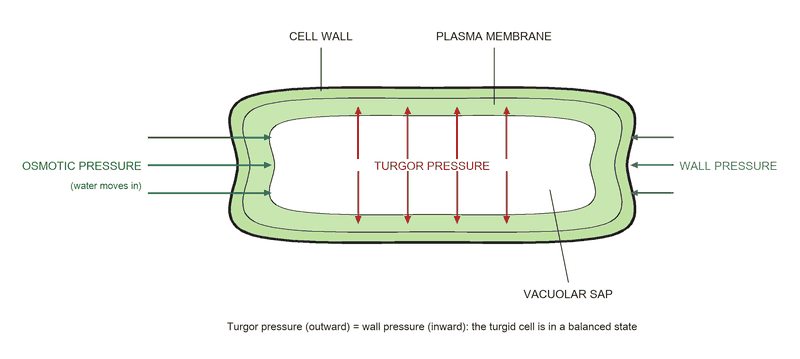
Concept: Turgor pressure is the pressure of the swollen cell contents on the cell wall (outward). Wall pressure is the equal and opposite pressure of the cell wall on the contents (inward). A cell stays whole only while the wall can push back as hard as the contents push out.
Step 1 — Follow the water into the cell.
In a dilute (hypotonic) solution water keeps entering the cell by endosmosis. The vacuole swells and the contents press harder and harder on the cell wall, so the turgor pressure rises.
Step 2 — Compare the two pressures.
The wall can stretch only a little. While it can press back with an equal wall pressure, the cell is simply turgid. If the turgor pressure becomes greater than the pressure the wall can exert back, the wall gives way and the cell bursts.
Step 3 — Match with the options.
Only option (B) describes turgor pressure exceeding wall pressure.
Watch out: A turgid cell (pressures equal) is the normal, healthy state of a plant cell; it is not about to burst.
Why the other options are wrong:
- (A) Turgor pressure equalises wall pressure: when turgor pressure equals wall pressure the cell is turgid and balanced; no more water enters, so it does not burst.
- (C) Wall pressure exceeds turgor pressure: if the wall pressure were greater, the wall would push the contents inward; nothing pushes the wall outward, so the cell cannot burst.
- (D) None of the above: option (B) correctly describes when a plant cell may burst, so 'None of the above' is wrong.
Therefore, a plant cell may burst when turgor pressure exceeds wall pressure, option (B).
- 25 marks
Question 2
The figure given below is a diagrammatic representation of a part of the cross section of the root in the root hair zone. Study the same and then answer the questions that follow:
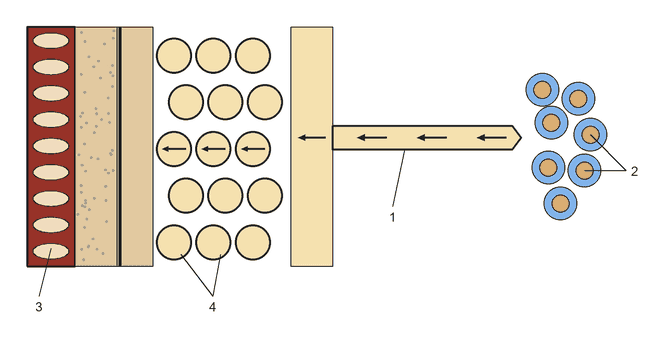
(i) Name the parts indicated by the guidelines 1 to 4.
(ii) Which is the process that enables the passage of water from the soil into the root hair?
(iii) Name the pressure that is responsible for the movement of water in the direction indicated by the arrows. Define it.
(iv) Due to an excess of this pressure sometimes drops of water are found along the leaf margins of some plants especially in the early mornings. What is the phenomenon called?
(v) Draw a well labelled diagram of the root hair cell as it would appear if an excess of fertiliser is added to the soil close to it.
Solve with AIWritten solution
Solution:
Concept: Water moves from the soil into the root hair by osmosis, then from cell to cell across the cortex into the xylem. The continued inward flow of water builds up root pressure, which pushes water up the xylem.
Step 1 — (i) Parts 1 to 4.
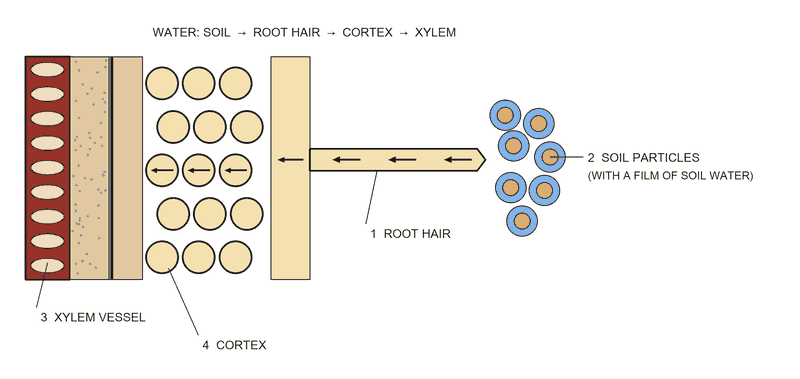
Read each guideline in the figure: 1 is the long outgrowth reaching into the soil, 2 marks the particles outside the root, 3 is the vessel at the centre and 4 marks the round cells between the epidermis and the stele.
- 1 — Root hair
- 2 — Soil particles (each surrounded by a film of soil water)
- 3 — Xylem (xylem vessel)
- 4 — Cortex (cortical cells)
Step 2 — (ii) Passage of water from the soil into the root hair.
The process is osmosis. The cell sap of the root hair is more concentrated than the soil water, so water molecules pass from the soil water into the root hair through its semi-permeable cell membrane.
Step 3 — (iii) Pressure that moves water in the direction of the arrows.
The pressure is root pressure. Root pressure is the pressure developed in the roots by the continued inward movement of water by cell-to-cell osmosis; it helps the ascent of sap up the stem.
As each cell takes in water it passes water on to the next cell inward, so the push of the inward flow builds up until water is forced into the xylem vessels.
Step 4 — (iv) Drops of water along the leaf margins in the early morning.
The phenomenon is guttation. When root pressure is high (warm, moist soil and humid nights, so that little water is lost by transpiration), water is forced out as droplets through hydathodes, the water pores at the ends of the veins along the leaf margins. It is seen in plants such as grasses, tomato and Colocasia.
Step 5 — (v) The root hair cell after excess fertiliser is added close to it.
The fertiliser dissolves in the soil water and makes it hypertonic (more concentrated than the cell sap). Water leaves the root hair cell by exosmosis and the cytoplasm shrinks away from the cell wall: the cell is plasmolysed.
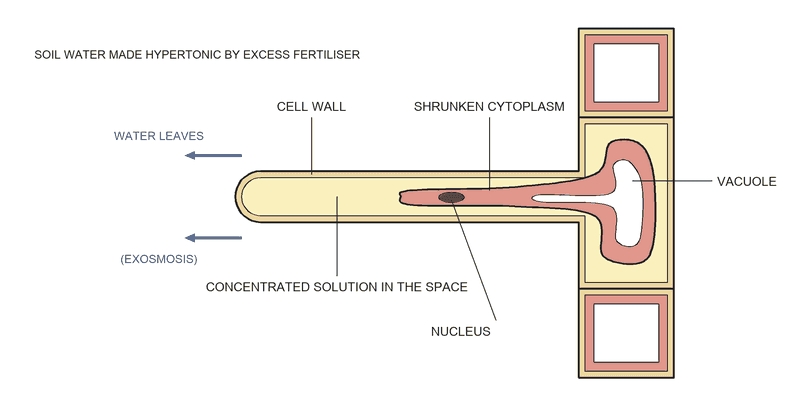
The diagram shows the cell wall keeping its shape, the shrunken cytoplasm pulled away from it, and the concentrated (fertiliser) solution filling the space between the two.
Watch out: The cell wall of a plasmolysed cell keeps its shape; only the protoplast (cytoplasm with the vacuole) shrinks.
Therefore, 1 = root hair, 2 = soil particles, 3 = xylem, 4 = cortex; water enters by osmosis; root pressure moves it inward and up; excess root pressure causes guttation; excess fertiliser plasmolyses the root hair.
- 31 mark
Question 3
Give the Biological / technical term for the following:
The process of uptake of mineral ions against the concentration gradient using energy from the cell.
Solve with AIWritten solution
Solution:
Concept: Active transport is the movement of a substance (usually ions of mineral salts) across a living cell membrane from the region of its lower concentration to the region of its higher concentration, using energy (ATP) from the cell.
Step 1 — Read what the definition describes.
The ions are taken up against the concentration gradient, that is, from where they are fewer (soil water) to where they are more (root cells).
Step 2 — Name the process.
Such uphill movement cannot happen on its own; the cell must spend energy (ATP) on it. Movement against the gradient using the cell's energy is active transport.

Root hair cells take in mineral ions such as nitrates and potassium in this way, because these ions are already more concentrated inside the root cells than in the soil water.
Watch out: Diffusion and osmosis go down a concentration gradient and need no energy, so neither fits.
Therefore, the term is active transport.
- 41 mark
Question 4
Name the following:
The process by which root hairs absorb water from the soil.
Solve with AIWritten solution
Solution:
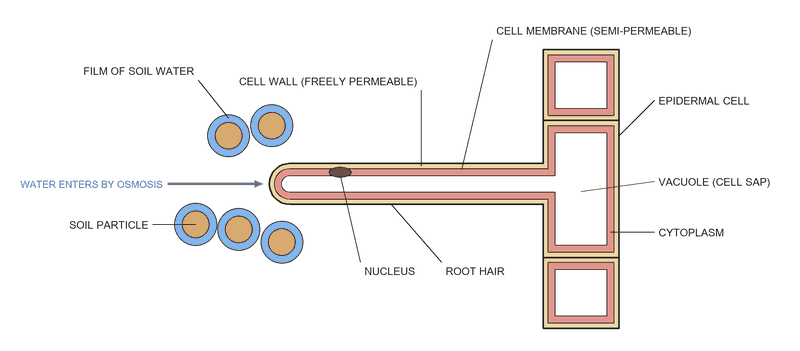
Concept: A root hair is a long, thin outgrowth of one epidermal cell of the root. Its cell sap is more concentrated than the soil water around it, so water enters it by osmosis.
Step 1 — Compare the two solutions.
The cell sap of the root hair contains dissolved salts and sugars, so it is more concentrated than the dilute soil water outside.
Step 2 — Name the process.
Water molecules therefore move from the soil water (more water molecules) into the root hair (fewer water molecules) through the semi-permeable cell membrane. This is osmosis; because the water moves into the cell, it is also called endosmosis.
Watch out: Osmosis is about the movement of WATER; the mineral ions are taken in separately, mostly by active transport.
Therefore, root hairs absorb water from the soil by osmosis (endosmosis).
- 51 mark
Question 5
Choose the correct answer from the four options given below:
Marine fish when placed in tap water bursts because of:
Solve with AIAnswer
- Correct
(A) Endosmosis
(B) Exosmosis
(C) Diffusion
(D) Plasmolysis
Answer: (A) Endosmosis
Concept: A marine fish lives in salty sea water, so its body fluids are concentrated. Tap water is far more dilute, so it is hypotonic to the fish's cells.
Step 1 — Find the direction of water.
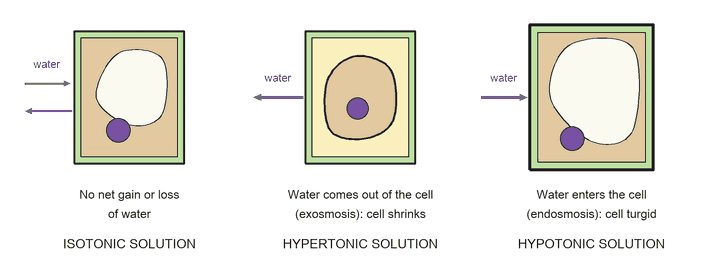
Water moves from the tap water (more water molecules) into the body cells (fewer water molecules) through their semi-permeable cell membranes.
Step 2 — Name the process.
This inward movement of water through a semi-permeable membrane is endosmosis. It makes the cells swell.
Step 3 — See why the cells burst.
Animal cells have no cell wall to resist the swelling, so they keep taking in water until they burst.
Watch out: The word 'bursts' points to water coming IN; exosmosis would make the cells shrink.
Why the other options are wrong:
- (B) Exosmosis: exosmosis is the outward movement of water, which happens in a hypertonic solution and makes cells shrink, not burst.
- (C) Diffusion: diffusion is the general movement of molecules in direct contact; the bursting is caused by water crossing the semi-permeable cell membranes into the cells, which is named more exactly as endosmosis.
- (D) Plasmolysis: plasmolysis is the shrinking of the protoplast of a plant cell away from its cell wall in a hypertonic solution, the opposite of swelling.
Therefore, the cells of a marine fish placed in tap water burst because of endosmosis, option (A).
- 61 mark
Question 6
The statements given below are incorrect. Rewrite the correct statement by changing the underlined words of the statements.
Free movement of solutes in and out of the cell takes place across the cell membrane.
Solve with AIWritten solution
Solution:
Concept: A plant cell has two outer layers with different permeability: the cell wall is freely permeable; the cell membrane is semi-permeable (selectively permeable).
Step 1 — Check the underlined words.
The cell membrane does not allow free movement: it lets water through but controls which dissolved substances pass, so the statement is wrong as written.
Step 2 — Find the layer that allows free movement.
The cell wall is made of cellulose with large spaces in it. It lets water and dissolved substances (solutes) pass in and out freely.
Watch out: Free movement = cell wall (freely permeable); selective movement = cell membrane (semi-permeable).
Therefore, the correct statement is: Free movement of solutes in and out of the cell takes place across the cell wall.
- 71 mark
Question 7
Differentiate between the following pairs on the basis of what is mentioned in brackets:
Active Transport and Diffusion [significance in plants]
Solve with AIWritten solution
Solution:
Concept: Active transport is the movement of a substance (usually ions of mineral salts) across a living cell membrane from the region of its lower concentration to the region of its higher concentration, using energy (ATP) from the cell. Diffusion is the free movement of the molecules of a substance from the region of their higher concentration to the region of their lower concentration when the two are in direct contact. It needs no energy from the cell.
Step 1 — Recall what active transport does in plants.
Root hair cells already hold mineral ions at a higher concentration than the soil water, so these ions can enter only by active transport.
Step 2 — Recall what diffusion does in plants.
Gases and water vapour move down their concentration gradients by diffusion, with no energy spent.
Step 3 — Write the difference.
Set the significance of each process side by side.
Active transport Diffusion Allows the uptake of mineral ions (such as nitrates and potassium) by the root hairs from the soil, even when they are more concentrated inside the root cells. Allows the exchange of gases (oxygen and carbon dioxide) through the stomata, and the escape of water vapour during transpiration. Watch out: The brackets ask for the SIGNIFICANCE in plants, so write what each process does for the plant, not only its definition.
Therefore, active transport lets roots take up mineral ions against the gradient, while diffusion lets gases and water vapour move in and out of the plant.
- 85 marks
Question 8
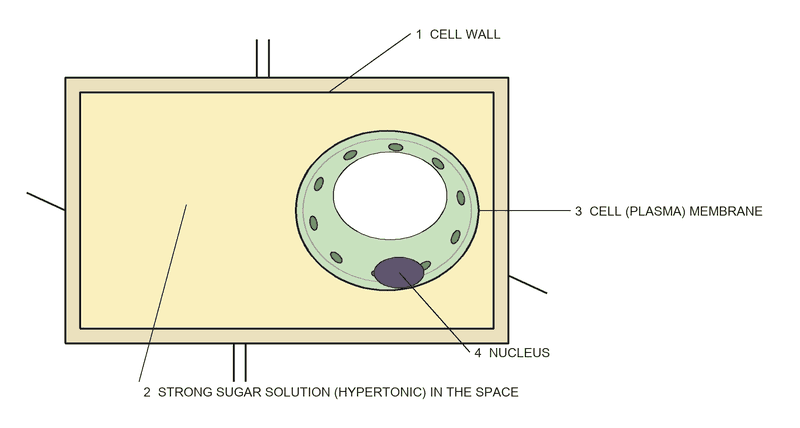
The diagram given below represents a plant cell after being placed in a strong sugar solution. Study the diagram and answer the questions that follow:

(i) What is the state of the cell shown in the diagram?
(ii) Name the structure that acts as a selectively permeable membrane.
(iii) Label the parts numbered 1 to 4 in the diagram.
(iv) How can the above cell be brought back to its original condition? Mention the scientific term for the recovery of the cell.
(v) State any two features of the above plant cell which is not present in animal cells.
Solve with AIWritten solution
Solution:
Concept: In a strong sugar solution (hypertonic) water leaves the cell by exosmosis. The protoplast shrinks away from the cell wall, and the sugar solution passes through the freely permeable wall into the space left between them.
Step 1 — (i) State of the cell.
The protoplast has pulled away from the cell wall, so the cell is plasmolysed (it has become flaccid).
Step 2 — (ii) The selectively permeable membrane.
The selectively permeable membrane is the cell membrane (plasma membrane). It lets water molecules pass but holds back the larger sugar molecules. (The membrane round the vacuole behaves in the same way.)
Step 3 — (iii) Parts 1 to 4.
Follow each guideline: 1 is the outer layer, 2 the space between the wall and the shrunken protoplast, 3 the outer boundary of the protoplast and 4 the dark body inside it.
- 1 — Cell wall
- 2 — Strong sugar solution (hypertonic solution) filling the space between the wall and the shrunken protoplast
- 3 — Cell membrane (plasma membrane)
- 4 — Nucleus
Step 4 — (iv) Bringing the cell back.
Place the cell in pure water (a hypotonic solution) before it dies. Water re-enters the cell by endosmosis, so the protoplast swells and presses against the cell wall again.
The recovery of a plasmolysed cell is called deplasmolysis.
Step 5 — (v) Two features of this plant cell not found in animal cells.
This plant cell has two features that an animal cell does not have:
- A cell wall around the cell membrane.
- A large central vacuole filled with cell sap.
- (The chloroplasts in the cytoplasm are also absent from animal cells.)
Watch out: Plasmolysis can be reversed only while the cell is alive; a cell left too long in the strong solution dies.
Therefore, the cell is plasmolysed; the cell membrane is selectively permeable; 1 = cell wall, 2 = strong sugar solution, 3 = cell membrane, 4 = nucleus; it recovers in pure water by deplasmolysis; a cell wall and a large central vacuole are found only in the plant cell.
- 91 mark
Question 9
Correct the following statements by changing the underlined words:
The cell sap of root hair is Hypotonic.
Solve with AIWritten solution
Solution:
Concept: A root hair is a long, thin outgrowth of one epidermal cell of the root. Its cell sap is more concentrated than the soil water around it, so water enters it by osmosis.
Step 1 — Check the underlined word.
If the cell sap were hypotonic (more dilute than the soil water), water would flow out of the root hair, and the plant could not absorb water. So the word is wrong.
Step 2 — Choose the right word.
The root hair holds salts and sugars dissolved in its cell sap at a higher concentration than the soil water, so its cell sap is hypertonic to the soil water. Water therefore enters it by osmosis.
Watch out: Hypertonic means MORE concentrated; the cell sap must be the more concentrated solution for water to enter.
Therefore, the correct statement is: The cell sap of root hair is Hypertonic (to the soil water).
- 101 mark
Question 10
Correct the following statements by changing the underlined words:
Xylem transports starch from the leaves to all parts of the plant body.
Solve with AIWritten solution
Solution:
Concept: A plant has two conducting tissues: xylem carries water and mineral salts up from the roots; phloem carries the food made in the leaves to all parts of the plant.
Step 1 — Check the underlined word.
Xylem carries water and minerals upward only; it does not carry food from the leaves, so the word is wrong.
Step 2 — Choose the right tissue.
Food made in the leaves is carried by the phloem, both up and down, to every part of the plant.

Step 3 — Note the form in which food moves.
Starch does not dissolve in water, so it cannot travel. The food moves in the phloem as soluble sugar (mainly sucrose) and is changed back into starch where it is stored.
Watch out: The statement as printed says 'starch'; strictly the phloem carries the food as sugar, and starch is the stored form.
Therefore, the correct statement is: Phloem transports starch (food, as soluble sugar) from the leaves to all parts of the plant body.
- 111 mark
Question 11
Give appropriate biological or technical terms for the following:
Movement of molecules of a substance from their higher concentration to lower concentration when they are in direct contact.
Solve with AIWritten solution
Solution:
Concept: Diffusion is the free movement of the molecules of a substance from the region of their higher concentration to the region of their lower concentration when the two are in direct contact. It needs no energy from the cell.
Step 1 — Pick out the key words.
The molecules move from their higher to their lower concentration, and the two regions are in direct contact; no membrane is mentioned.
Step 2 — Name the process.
Free movement of molecules down their concentration gradient, with no membrane in between and no energy used, is diffusion.
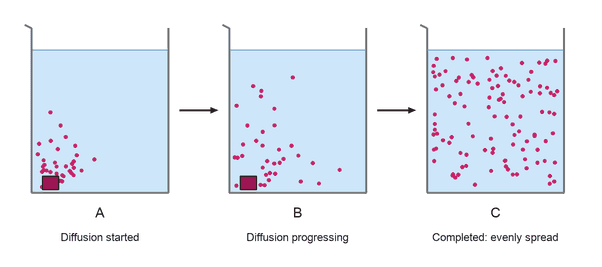
For example, a crystal of potassium permanganate dropped in water slowly colours all the water evenly.
Watch out: Osmosis needs a semi-permeable membrane and refers to water only; here the regions are in direct contact.
Therefore, the term is diffusion.
- 121 mark
Question 12
Differentiate between the following pairs on the basis of what is indicated in the brackets.
Hypotonic solution and Hypertonic solution [condition of a plant cell when placed in them]
Solve with AIWritten solution
Solution:
Concept: Compared with the cell sap, an outside solution is hypotonic if it is more dilute (water enters the cell), isotonic if it has the same concentration (no net movement) and hypertonic if it is more concentrated (water leaves the cell).
Step 1 — Follow the water in each solution.
In a hypotonic solution water enters the cell by endosmosis; in a hypertonic solution water leaves the cell by exosmosis.
Step 2 — State the condition of the plant cell.
Write the result for a plant cell in each.
Hypotonic solution Hypertonic solution Water enters the cell by endosmosis; the plant cell swells and becomes turgid (its wall stops it from bursting). Water leaves the cell by exosmosis; the protoplast shrinks away from the cell wall and the cell becomes plasmolysed (flaccid). Watch out: The prefixes describe the OUTSIDE solution compared with the cell sap: hypo = more dilute, hyper = more concentrated.
Therefore, a plant cell becomes turgid in a hypotonic solution and plasmolysed (flaccid) in a hypertonic solution.
- 131 mark
Question 13
Give biological explanations for the following:
Plants growing in fertilized soil are often found to wilt if the soil is not adequately watered.
Solve with AIWritten solution
Solution:
Concept: Fertiliser dissolves in the soil water. Too much of it makes the soil water more concentrated (hypertonic) than the cell sap of the root hairs.
Step 1 — See what too little water does.
When the soil is not watered enough, the fertiliser dissolves in very little water, so the soil water becomes hypertonic to the root hair cells.
Step 2 — Follow the water.
Water can no longer enter the root hairs by osmosis. Instead water moves out of the root cells by exosmosis, and the cells become plasmolysed.
Step 3 — See the effect on the shoot.
The roots cannot supply water to the shoot, while the leaves keep losing water by transpiration. The leaf cells lose turgidity, so the plant wilts.
Watch out: The fertiliser itself is not a poison here; the harm comes from the soil water becoming too concentrated.
Therefore, plants in fertilised soil that is not watered enough wilt because the soil water becomes hypertonic and draws water out of the roots by exosmosis.
- 141 mark
Question 14
Give suitable biological reasons for the following statements :
Root hairs become flaccid and droop when excess fertilizers are added to the moist soil around them.
Solve with AIWritten solution
Solution:
Concept: Fertiliser dissolves in the soil water. Too much of it makes the soil water more concentrated (hypertonic) than the cell sap of the root hairs.
Step 1 — Compare the solutions.
Excess fertiliser makes the soil water around the root hairs more concentrated than their cell sap, that is, hypertonic.
Step 2 — Follow the water.
Water therefore moves out of the root hairs into the soil water by exosmosis.
Step 3 — See the result.
The cytoplasm shrinks away from the cell wall, so the root hair cells are plasmolysed. They lose their turgidity, become flaccid and droop.
Watch out: The soil is moist, so the cause is not a lack of water but the high concentration of the soil water.
Therefore, the root hairs become flaccid and droop because excess fertiliser makes the soil water hypertonic, so they lose water by exosmosis and are plasmolysed.
- 151 mark
Question 15
Explain the following terms:
(ii) Diffusion
Solve with AIWritten solution
Solution:
Concept: Molecules are always moving about at random, so they spread out on their own from where they are crowded to where they are fewer.
Step 1 — State the definition.
Diffusion is the free movement of the molecules of a substance from the region of their higher concentration to the region of their lower concentration when the two are in direct contact. It needs no energy from the cell.
Step 2 — Give examples in plants.
In plants, water vapour escapes from the leaves during transpiration and oxygen and carbon dioxide are exchanged with the air by diffusion through the stomata.
Watch out: Diffusion needs no membrane and no energy; it stops when the concentration is the same everywhere.
Therefore, diffusion is the free movement of molecules from their higher to their lower concentration when the two regions are in direct contact.
- 161 mark
Question 16
Given below are sets of five terms each. Rewrite the terms in correct order in a logical sequence beginning with the first word that is underlined:
(ii) Root hair, Endodermis, Epidermis, Xylem, Cortex.
Solve with AIWritten solution
Solution:
Concept: Follow a water molecule from outside the root towards its centre, layer by layer.
Step 1 — Start at the underlined term.
Water first enters the root hair, which is an outgrowth of an epidermis cell, so the epidermis comes next.
Step 2 — Cross the root.
From the epidermis the water passes from cell to cell across the cortex, then crosses the endodermis (the innermost layer of the cortex).
Step 3 — End in the conducting tissue.
Finally the water enters the xylem vessels, which carry it up the stem.

Watch out: The endodermis lies INSIDE the cortex, just outside the xylem; do not put it before the cortex.
Therefore, the sequence is Root hair → Epidermis → Cortex → Endodermis → Xylem.
- 171 mark
Question 17
Differentiate between the following pairs on the basis of what is mentioned in the brackets:
(iv) Osmosis and Active Transport (Substances undergoing movement)
Solve with AIWritten solution
Solution:
Concept: Osmosis is the movement of water molecules from the region of their higher concentration (a dilute solution) to the region of their lower concentration (a concentrated solution) through a semi-permeable membrane. Active transport is the movement of a substance (usually ions of mineral salts) across a living cell membrane from the region of its lower concentration to the region of its higher concentration, using energy (ATP) from the cell.
Step 1 — Ask what moves in each process.
Osmosis moves the solvent; active transport moves dissolved ions.
Step 2 — Write the difference.
Set the substances side by side.
Osmosis Active transport Water molecules move (from a dilute solution to a concentrated solution through a semi-permeable membrane). Ions of mineral salts (such as nitrates, sulphates and potassium) move, from their lower to their higher concentration, using energy. Watch out: The brackets ask WHICH SUBSTANCES move, so name them; the direction and energy are extra detail.
Therefore, osmosis moves water molecules, while active transport moves ions of mineral salts.
- 181 mark
Question 18
Deplasmolysis occurs when a plasmolysed cell is placed in:
Solve with AIAnswer
(A) Concentrated salt solution
- Correct
(B) Tap water
(C) Concentrated sugar solution
(D) Hypertonic salt solution
Answer: (B) Tap water
Concept: Plasmolysis is the shrinking of the protoplast (cytoplasm with its vacuole) away from the cell wall when a plant cell loses water by exosmosis in a hypertonic solution. Deplasmolysis is its recovery when water re-enters. For water to re-enter, the outside solution must be more dilute than the cell sap (hypotonic).
Step 1 — Judge each liquid.
Tap water is almost pure water, so it is hypotonic to the cell sap. The other three liquids are concentrated (hypertonic).
Step 2 — Follow the water.
In tap water, water enters the cell by endosmosis. The shrunken protoplast swells and presses against the cell wall again, and the cell becomes turgid.
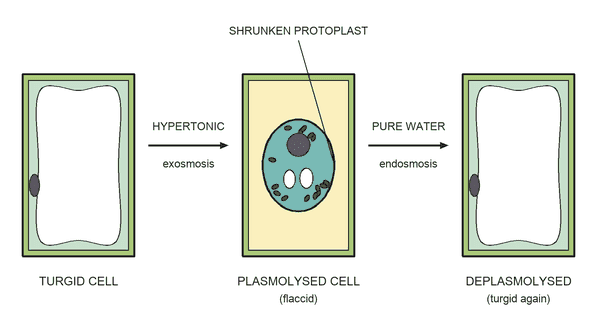
Watch out: Deplasmolysis needs a HYPOTONIC liquid; every concentrated solution keeps the cell plasmolysed.
Why the other options are wrong:
- (A) Concentrated salt solution: a concentrated salt solution is hypertonic; it draws more water out and keeps the cell plasmolysed.
- (C) Concentrated sugar solution: a concentrated sugar solution is also hypertonic and causes plasmolysis, not recovery.
- (D) Hypertonic salt solution: a hypertonic salt solution is the kind of solution that causes plasmolysis in the first place.
Therefore, deplasmolysis occurs when a plasmolysed cell is placed in tap water, option (B).
- 191 mark
Question 19
Arrange and rewrite the terms in each group in correct order to be in a logical sequence beginning with the term that is underlined:
(b) Xylem, Soil water, Cortical cells, Root hair.
Solve with AIWritten solution
Solution:
Concept: Water travels from outside the root inward and ends in the xylem, which carries it up the plant.
Step 1 — Start at the underlined term.
The water starts as soil water around the soil particles.
Step 2 — Follow it into the root.
It enters the root hair by osmosis and then passes from cell to cell through the cortical cells.
Step 3 — End in the conducting tissue.
Finally it enters the xylem, which conducts it up the stem.
Therefore, the sequence is Soil water → Root hair → Cortical cells → Xylem.
- 202 marks
Question 20
Excessive use of fertilizers in agricultural fields reduces the yield of crops. Justify the statement.
Solve with AIWritten solution
Solution:
Concept: Fertiliser dissolves in the soil water. Too much of it makes the soil water more concentrated (hypertonic) than the cell sap of the root hairs.
Step 1 — See what excess fertiliser does to the soil water.
It dissolves in the soil water and makes it more concentrated than the cell sap of the root hairs, that is, hypertonic.
Step 2 — Follow the water.
Water now moves out of the root hair cells by exosmosis. The cells become plasmolysed, and the roots cannot absorb water.
Step 3 — See the effect on the crop.
The plants wilt and their growth suffers. If the condition lasts, the root cells die (the roots are 'burnt'), so the yield of the crop falls.
Watch out: Fertiliser helps only in the right amount; the harm here comes from making the soil water too concentrated.
Therefore, excessive fertiliser reduces crop yield because the hypertonic soil water draws water out of the roots by exosmosis, plasmolysing and damaging them.
- 212 marks
Question 21
What is Active transport?
Solve with AIWritten solution
Solution:
Concept: Some substances must be taken into a cell even though they are already more concentrated inside it; this uphill movement needs energy.
Step 1 — State the definition.
Active transport is the movement of a substance (usually ions of mineral salts) across a living cell membrane from the region of its lower concentration to the region of its higher concentration, using energy (ATP) from the cell.
Step 2 — Give the example from roots.
Root hair cells hold ions of nitrates, sulphates and potassium at a higher concentration than the soil water. To take in more of them, the cell carries them inward from the lower concentration outside, using energy supplied as ATP. This is the opposite direction to diffusion.
Watch out: Without energy (for example, if the roots lack oxygen for respiration) active transport stops.
Therefore, active transport is the movement of ions across a living cell membrane from their lower to their higher concentration, using energy from the cell.
- 222 marks
Question 22
What is a semi permeable membrane? Name the semi permeable membrane present in a plant cell.
Solve with AIWritten solution
Solution:
Concept: A membrane can be impermeable (lets nothing through), freely permeable (lets everything through) or semi-permeable (lets some molecules through and stops others).
Step 1 — Define a semi-permeable membrane.
A semi-permeable membrane is a membrane that allows the solvent (water molecules) to pass through it but stops the solute molecules (such as sugar or salt dissolved in it).
Step 2 — Name it in a plant cell.
In a plant cell the cell membrane (plasma membrane) is the semi-permeable membrane. The membrane round the vacuole (tonoplast) behaves in the same way, while the cell wall is freely permeable.

Watch out: Do not name the cell wall: it is freely permeable.
Therefore, a semi-permeable membrane lets water pass but not the solute, and in a plant cell it is the cell (plasma) membrane.
- 231 mark
Question 23
Osmosis takes place when there is:
Solve with AIAnswer
(A) A freely permeable membrane
(B) A cell wall
- Correct
(C) A selectively permeable membrane
(D) An impermeable membrane
Answer: (C) A selectively permeable membrane
Concept: Osmosis is the movement of water molecules from the region of their higher concentration (a dilute solution) to the region of their lower concentration (a concentrated solution) through a semi-permeable membrane.
Step 1 — Ask what the membrane must let through.
The membrane must let water molecules pass.
Step 2 — Ask what it must hold back.
It must also stop the solute molecules. If the solute could pass too, the two solutions would simply mix by diffusion, and there would be no osmosis.
Step 3 — Match with the options.
A membrane that lets water through but not the solute is a selectively (semi-) permeable membrane, option (C).
Why the other options are wrong:
- (A) A freely permeable membrane: a freely permeable membrane lets both water and solute through, so the solutions simply mix (as through a muslin cloth).
- (B) A cell wall: the cell wall is freely permeable; it does not control which molecules pass.
- (D) An impermeable membrane: an impermeable membrane (such as a rubber sheet) lets nothing through, not even water.
Therefore, osmosis takes place when there is a selectively permeable membrane, option (C).
- 241 mark
Question 24
Name the following:
(a) Unicellular outgrowths from the epidermis of roots.
Solve with AIWritten solution
Solution:
Concept: A root hair is a long, thin outgrowth of one epidermal cell of the root. Its cell sap is more concentrated than the soil water around it, so water enters it by osmosis.
Step 1 — Read the clues.
The structures are outgrowths of the epidermis of roots, and each is unicellular, that is, part of a single epidermal cell.
Step 2 — Name them.
These are the root hairs. Their enormous number gives the root a huge surface area for absorbing water and minerals from the soil.
Therefore, the unicellular outgrowths from the epidermis of roots are root hairs.
- 252 marks
Question 25
Mention two adaptations in roots for absorption of water from the soil.
Solve with AIWritten solution
Solution:
Concept: Roots absorb water well because they offer a very large surface to the soil water and keep the conditions right for osmosis.
Step 1 — First adaptation: a huge surface area.
Each rootlet bears thousands of root hairs, so the total surface in contact with the soil water is enormous.
Step 2 — Second adaptation: concentrated cell sap.
The root hairs hold cell sap at a higher concentration than the surrounding soil water, so water enters them by osmosis.
Step 3 — A further adaptation.
The root hairs have thin walls: a freely permeable cell wall and a thin semi-permeable cell membrane, so water passes in easily.
Therefore, two adaptations are the large surface area given by numerous root hairs and the concentrated cell sap of the root hairs (thin walls are a third).
- 261 mark
Question 26
Assertion (A): A turgid plant cell is in a balanced state.
Reason (R): In a turgid cell, turgor pressure and wall pressure are equal and in the same direction.
Solve with AIAnswer
- Correct
(A) A is True and R is False
(B) A is False and R is True
(C) Both A and R are True
(D) Both A and R are False
Answer: (A) A is True and R is False
Concept: In an assertion–reason item, judge the Assertion (A) and the Reason (R) separately as true or false; only when both are true do we ask whether R correctly explains A. Turgor pressure is the pressure of the swollen cell contents on the cell wall (outward). Wall pressure is the equal and opposite pressure of the cell wall on the contents (inward).
Step 1 — Judge the Assertion.
A is true. A turgid cell cannot take in any more water: the outward turgor pressure is exactly matched by the inward wall pressure, so the cell is in a balanced state.
Step 2 — Judge the Reason.
R is false. The two pressures are equal, but they act in opposite directions: turgor pressure outward, wall pressure inward. Two equal pressures in the same direction could not balance each other.
Step 3 — Decide the option.
A is true and R is false, which is option (A).
Watch out: 'Equal and opposite' is what makes a balance; the word 'same' makes R false.
Why the other options are wrong:
- (B) A is False and R is True: A is true, not false: the turgid cell is in a balanced state.
- (C) Both A and R are True: R is false because the two pressures act in opposite directions, so 'both true' is wrong.
- (D) Both A and R are False: A is true, so 'both false' is wrong.
Therefore, A is true and R is false, option (A).
- 273 marks
Question 27
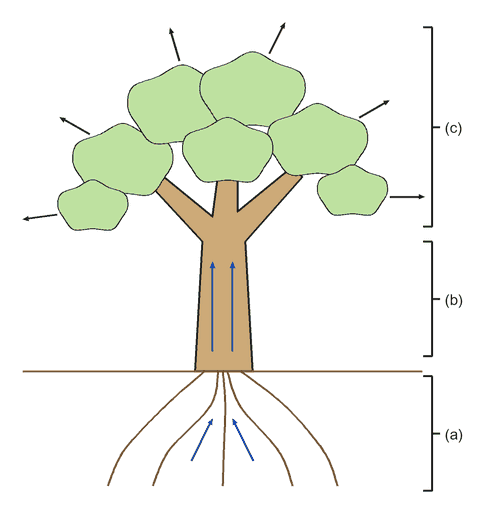
Given below is a picture of a tree. Mention the scientific phenomena occurring in the parts labelled (a), (b) and (c).
 Solve with AI
Written solution
Solution:
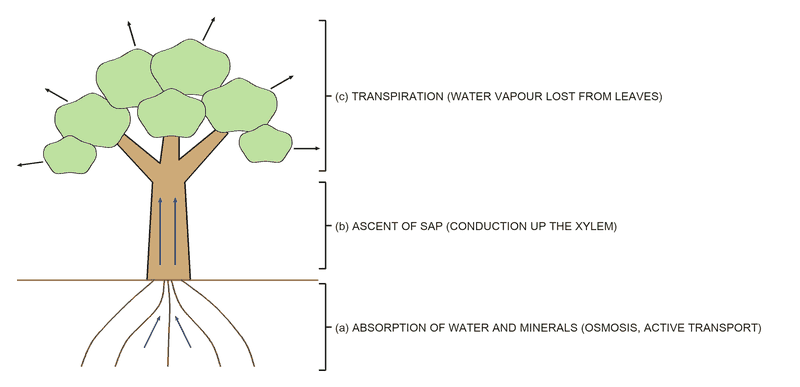
Concept: Water enters at the roots, rises through the trunk and leaves as vapour from the leaves; each part carries out a different phenomenon.
Step 1 — (a) Roots — absorption of water and minerals.
Root hairs absorb water from the soil by osmosis (and mineral ions by active transport). The water passes across the cortex into the xylem, and the inward flow builds up root pressure.
Step 2 — (b) Trunk (stem) — ascent of sap.
Water with dissolved minerals rises through the xylem of the trunk. This upward movement is the ascent of sap (conduction), pulled mainly by transpiration from above and helped by root pressure from below.
Step 3 — (c) Leaves — transpiration.
Water is lost as water vapour from the leaves, mainly through the stomata. This is transpiration, shown by the arrows leaving the crown.
Watch out: (b) is the ascent of sap (conduction), not absorption; absorption happens only at the roots.
Therefore, (a) is absorption of water by the roots (osmosis), (b) is the ascent of sap up the xylem and (c) is transpiration from the leaves.
- 283 marks
Question 28
Given below is the diagram of a plasmolysed cortical cell of a root.
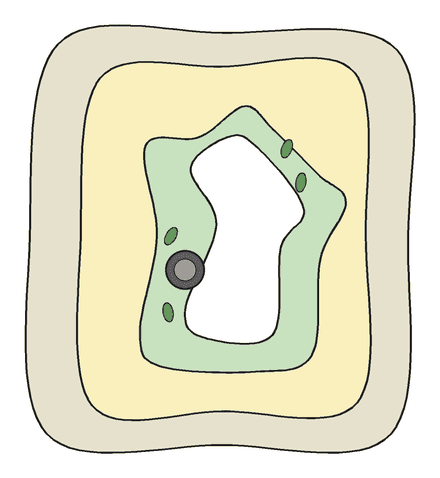
Copy the diagram and label the following parts in the diagram:
(a) Cytoplasm
(b) Hypertonic solution
(c) Plasma membrane
Solve with AIWritten solution
Solution:
Concept: In a plasmolysed cell the protoplast has shrunk away from the cell wall. Its outer boundary is the plasma membrane, and the outside (hypertonic) solution has entered the space between the protoplast and the wall through the freely permeable wall.
Step 1 — Label the cytoplasm.
(a) Cytoplasm is the shrunken living layer round the vacuole; it holds the nucleus and the small plastids.
Step 2 — Label the hypertonic solution.
(b) Hypertonic solution fills the space between the cell wall and the shrunken protoplast.
Step 3 — Label the plasma membrane.
(c) Plasma membrane is the outer boundary of the shrunken protoplast, now pulled away from the cell wall.
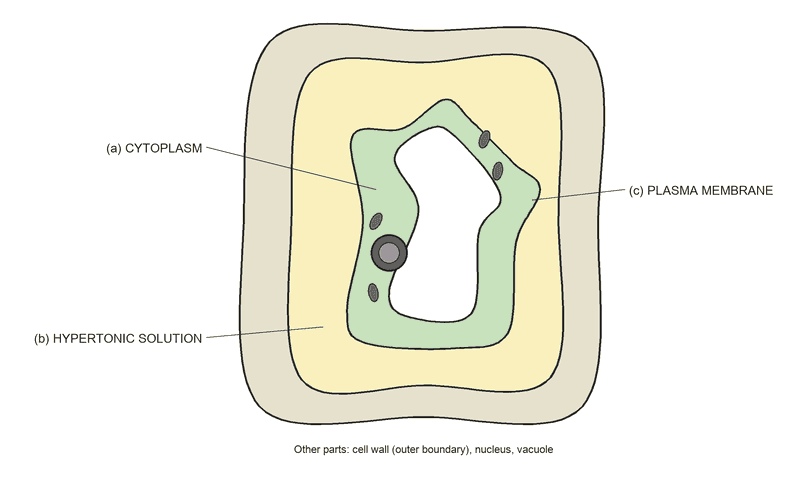
Watch out: The plasma membrane goes WITH the shrunken protoplast; it is not the line along the cell wall.
Therefore, the labels are (a) cytoplasm round the vacuole, (b) hypertonic solution in the space inside the wall and (c) plasma membrane at the edge of the shrunken protoplast.
- 291 mark
Question 29
............... is the result of inward movement of water molecules.
Solve with AIAnswer
(A) Plasmolysis
(B) Flaccidity
(C) Exosmosis
- Correct
(D) Deplasmolysis
Answer: (D) Deplasmolysis
Concept: Plasmolysis is the shrinking of the protoplast (cytoplasm with its vacuole) away from the cell wall when a plant cell loses water by exosmosis in a hypertonic solution. Deplasmolysis is its recovery when water re-enters.
Step 1 — Sort the options by the direction of water.
Plasmolysis, flaccidity and exosmosis all come from water moving out of a cell. Deplasmolysis comes from water moving in.
Step 2 — Confirm the answer.
When a plasmolysed cell is put back in water, water molecules move inward by endosmosis. The protoplast swells and presses against the cell wall again: this recovery is deplasmolysis.
Why the other options are wrong:
- (A) Plasmolysis: plasmolysis is the result of the outward movement of water in a hypertonic solution.
- (B) Flaccidity: flaccidity is the limp state of a cell that has lost water.
- (C) Exosmosis: exosmosis is itself an outward movement of water, not an inward one.
Therefore, deplasmolysis is the result of the inward movement of water molecules, option (D).
- 302 marks
Question 30
A basement godown is stocked with bags of food grains. It is observed that the walls of the godown cracked after being flooded with rain water. Explain the phenomenon.
Solve with AIWritten solution
Solution:
Concept: Imbibition is the absorption of water by solid materials such as dry seeds, wood or starch, which have a strong attraction for water; they swell and can push with great force (imbibitional pressure).
Step 1 — Name the process.
When the rain water floods the godown, the dry grains absorb water by imbibition. Water also enters the living cells of the grains by endosmosis.
Step 2 — Follow the swelling.
The grains swell, so the bags full of swollen grains take up much more space.
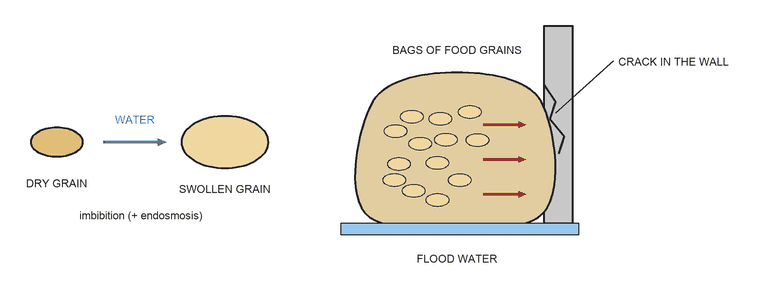
Step 3 — See why the walls crack.
The godown is fully stocked, so the swelling grains have no room to expand. The imbibitional pressure they develop presses on the walls strongly enough to crack them.
Watch out: The water itself does not crack the walls; the swelling grains do.
Therefore, the walls cracked because the grains absorbed the flood water by imbibition, swelled, and pushed on the walls with imbibitional pressure.
- 311 mark
Question 31
Varun's mother added plenty of salt to the mango pickle she made. This is to:
A. enhance the colour of the pickle.
B. inhibit the growth of microorganisms.
C. increase the nutritional value.
D. create a hypertonic solution.
Solve with AIAnswer
(A) A and C
(B) B and C
(C) C and D
- Correct
(D) B and D
Answer: (D) B and D
Concept: A lot of salt makes the pickle a hypertonic solution, and microorganisms in a hypertonic solution lose water by exosmosis and cannot grow.
Step 1 — Judge statement D.
The salt dissolves in the juice and makes it far more concentrated than the cell contents of bacteria and fungi, so the pickle is a hypertonic solution. D is true.
Step 2 — Judge statement B.
Water is drawn out of the microbial cells by exosmosis; they are plasmolysed and cannot grow. So the salt inhibits the growth of microorganisms and the pickle keeps longer. B is true.
Step 3 — Judge statements A and C.
Salt does not improve the colour, and it adds no useful nutrients (too much salt is unhealthy). A and C are false. The pair B and D is option (D).
Why the other options are wrong:
- (A) A and C: A (colour) and C (nutrition) are both false: the salt is added to preserve the pickle.
- (B) B and C: B is true but C is false: salt does not increase the nutritional value.
- (C) C and D: D is true but C is false.
Therefore, the salt is added to create a hypertonic solution and so inhibit the growth of microorganisms, option (D).
- 322 marks
Question 32
Differentiate between Plasmolysis and Deplasmolysis.
Solve with AIWritten solution
Solution:
Concept: Plasmolysis is the shrinking of the protoplast (cytoplasm with its vacuole) away from the cell wall when a plant cell loses water by exosmosis in a hypertonic solution. Deplasmolysis is its recovery when water re-enters.
Step 1 — Compare what happens.
Plasmolysis is water leaving the cell; deplasmolysis is water coming back in.
Step 2 — Write the differences.
Set the two processes side by side.
Plasmolysis Deplasmolysis The shrinking of the protoplast away from the cell wall. The recovery of a plasmolysed cell: the protoplast swells and presses against the cell wall again. Caused by the outflow of water (exosmosis) when the cell is in a hypertonic solution. Caused by the re-entry of water (endosmosis) when the cell is placed in water (hypotonic). The cell becomes flaccid. The cell becomes turgid again. Watch out: Deplasmolysis is possible only if the plasmolysed cell is still alive.
Therefore, plasmolysis is the shrinking of the protoplast by exosmosis in a hypertonic solution, and deplasmolysis is its recovery by endosmosis in water.
- 331 mark
Question 33
Write the term for the pressure exerted by the cell contents on the cell wall.
Solve with AIWritten solution
Solution:
Concept: A cell full of water presses outward on its cell wall, and the wall presses back.
Step 1 — Name the pressure asked for.
The pressure exerted by the cell contents on the cell wall is turgor pressure.
Step 2 — Name its partner.
The wall presses back on the contents with an equal and opposite pressure, the wall pressure.
Watch out: The pressure of the WALL on the contents is wall pressure; the pressure of the CONTENTS on the wall is turgor pressure.
Therefore, the term is turgor pressure.
- 342 marks
Question 34
Given below is the diagram of a turgid plant cell:
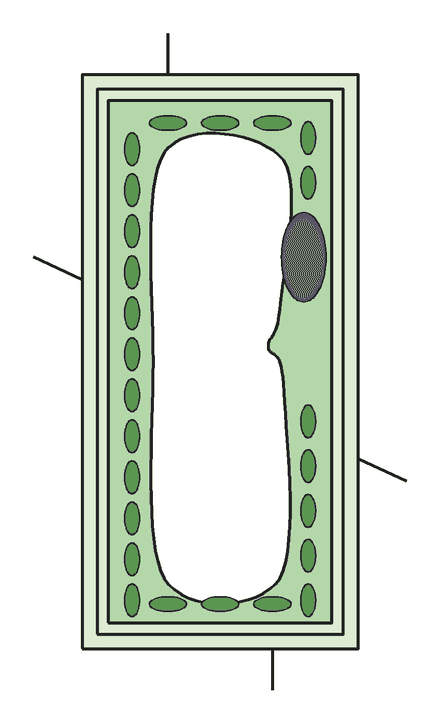
Copy the diagram and label Vacuole and Plasma membrane.
Solve with AIWritten solution
Solution:
Concept: In a turgid cell the large central vacuole presses the thin layer of cytoplasm against the cell wall, so the plasma membrane lies close against the inside of the wall.
Step 1 — Label the vacuole.
Vacuole is the large, clear central space filled with cell sap.
Step 2 — Label the plasma membrane.
Plasma membrane is the thin boundary of the cytoplasm, pressed against the inner side of the cell wall.
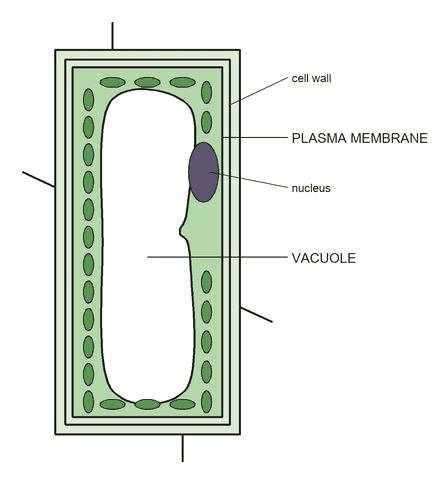
The cell wall (outermost) and the nucleus are also marked in small letters for reference.
Watch out: The plasma membrane is the line just INSIDE the cell wall, not the outer boundary of the cell.
Therefore, the vacuole is the large central space and the plasma membrane is the boundary of the cytoplasm just inside the cell wall.
- 351 mark
Question 35
Some raisins were added to a rice pudding. After a while, it was observed that the raisins had swollen up. What is the scientific phenomenon behind the swelling of these raisins?
Solve with AIAnswer
(A) Isotonic, Endosmosis
(B) Hypotonic, Exosmosis
(C) Hypertonic, Exosmosis
- Correct
(D) Hypotonic, Endosmosis
Answer: (D) Hypotonic, Endosmosis
Concept: Raisins are dried grapes, so their cells contain very concentrated cell sap. Compared with the cell sap, an outside solution is hypotonic if it is more dilute (water enters the cell), isotonic if it has the same concentration (no net movement) and hypertonic if it is more concentrated (water leaves the cell).
Step 1 — Judge the tonicity.
The liquid of the pudding has a lower solute concentration than the raisin cells, so it is hypotonic to them.
Step 2 — Name the process.
Water moves from the pudding into the raisin cells through their membranes. This inward movement of water is endosmosis.
Step 3 — See the result.
The cells fill with water and the raisins swell up. The option that pairs hypotonic with endosmosis is (D).
Watch out: The solution is named by comparing the OUTSIDE (pudding) with the cell sap of the raisins.
Why the other options are wrong:
- (A) Isotonic, Endosmosis: in an isotonic solution there is no net movement of water, so the raisins would not swell.
- (B) Hypotonic, Exosmosis: in a hypotonic solution water moves in, not out; exosmosis would make the raisins shrink.
- (C) Hypertonic, Exosmosis: a hypertonic solution would draw water out by exosmosis and shrivel the raisins further.
Therefore, the raisins swell because the pudding is hypotonic and water enters by endosmosis, option (D).
- 361 mark
Question 36
Choose the ODD one out from the following terms and name the category to which the others belong:
(d) Oxygen, Hydrogen, Glucose, Starch
Solve with AIWritten solution
Solution:
Concept: In this chapter substances are grouped by whether their molecules can pass through a cell membrane: small molecules can, very large molecules cannot.
Step 1 — Compare the sizes.
Oxygen and hydrogen are tiny gas molecules, and glucose is a small sugar molecule. Starch is a huge molecule made of hundreds of glucose units joined together, and it does not dissolve in water.
Step 2 — Pick the odd one out.
Starch cannot pass through a cell membrane, so it is the odd one out. This is why plants change starch into soluble sugar before moving it from cell to cell.
Step 3 — Name the category.
Oxygen, hydrogen and glucose are all small molecules that can pass through cell membranes (diffusible substances).
Therefore, the odd one out is starch; the others are small molecules that can pass through cell membranes.
- 372 marks
Question 37
The experiment below shows the thistle funnel containing sugar solution.

Define the phenomenon taking place in the above experiment.
Solve with AIWritten solution
Solution:
Concept: Osmosis is the movement of water molecules from the region of their higher concentration (a dilute solution) to the region of their lower concentration (a concentrated solution) through a semi-permeable membrane.
Step 1 — Read the set-up.
The thistle funnel holds sugar solution, its mouth is tied with cellophane paper, and it stands in a beaker of water. The cellophane acts as a semi-permeable membrane.
Step 2 — Follow the water.
Water moves from the beaker (more water molecules) through the cellophane into the sugar solution (fewer water molecules), while the sugar molecules cannot pass out. So the level of the solution in the stem rises.

Step 3 — Name and define the phenomenon.
This is osmosis. Osmosis is the movement of water molecules from the region of their higher concentration (a dilute solution) to the region of their lower concentration (a concentrated solution) through a semi-permeable membrane.
Watch out: The question says DEFINE, so give the full definition, not just the name.
Therefore, the phenomenon is osmosis: the movement of water molecules from their higher to their lower concentration through a semi-permeable membrane.
- 382 marks
Question 38
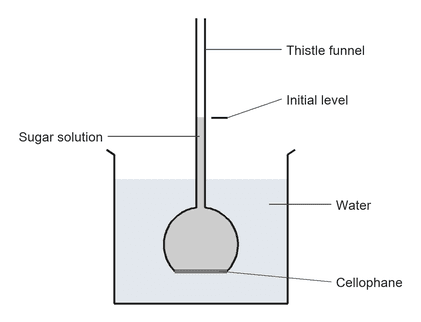
What would happen if the cellophane was replaced by the following in the above experiment?
(a) A rubber sheet
(b) A muslin cloth
Solve with AIWritten solution
Solution:
Concept: Osmosis needs a membrane that lets water through but holds back the sugar. The set-up is the thistle funnel of the previous part: sugar solution in the funnel, its mouth tied with cellophane, dipped in a beaker of water.
Step 1 — (a) A rubber sheet.
There is no change in the level of the sugar solution. A rubber sheet is impermeable: it does not let even water molecules from the beaker cross over, so no osmosis takes place.
Step 2 — (b) A muslin cloth.
The level of the sugar solution falls. The pores of the muslin cloth are so large that they hold back neither water nor sugar: the cloth is freely permeable. The sugar solution flows out and mixes with the water until the level in the funnel is the same as the level in the beaker, so no osmosis takes place.
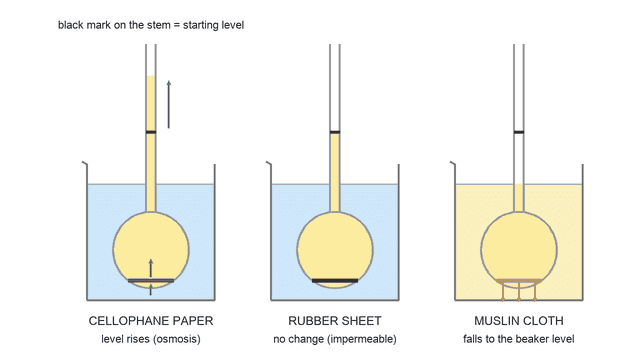
Watch out: A rubber sheet stops everything and a muslin cloth stops nothing; only a semi-permeable membrane gives osmosis.
Therefore, with a rubber sheet the level stays the same, and with a muslin cloth the level falls to the beaker level; neither gives osmosis.