
Question 351 markMCQAsked 2026Easy
Some raisins were added to a rice pudding. After a while, it was observed that the raisins had swollen up. What is the scientific phenomenon behind the swelling of these raisins?
Confirming your payment
Sign up now and get 250 free tokens.
Previous Year Questions · Question 35 of 38
Some raisins were added to a rice pudding. After a while, it was observed that the raisins had swollen up. What is the scientific phenomenon behind the swelling of these raisins?
(A) Isotonic, Endosmosis
(B) Hypotonic, Exosmosis
(C) Hypertonic, Exosmosis
(D) Hypotonic, Endosmosis
Answer: (D) Hypotonic, Endosmosis
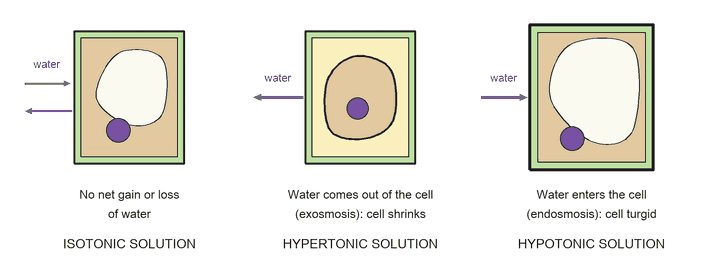
Concept: Raisins are dried grapes, so their cells contain very concentrated cell sap. Compared with the cell sap, an outside solution is hypotonic if it is more dilute (water enters the cell), isotonic if it has the same concentration (no net movement) and hypertonic if it is more concentrated (water leaves the cell).
Step 1 — Judge the tonicity.
The liquid of the pudding has a lower solute concentration than the raisin cells, so it is hypotonic to them.
Step 2 — Name the process.
Water moves from the pudding into the raisin cells through their membranes. This inward movement of water is endosmosis.
Step 3 — See the result.
The cells fill with water and the raisins swell up. The option that pairs hypotonic with endosmosis is (D).
Watch out: The solution is named by comparing the OUTSIDE (pudding) with the cell sap of the raisins.
Why the other options are wrong:
Therefore, the raisins swell because the pudding is hypotonic and water enters by endosmosis, option (D).