Solution:
Concept: Water moves from the soil into the root hair by osmosis, then from cell to cell across the cortex into the xylem. The continued inward flow of water builds up root pressure, which pushes water up the xylem.
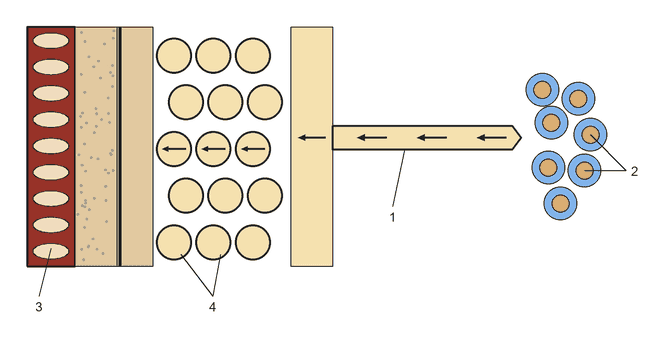
Step 1 — (i) Parts 1 to 4.
Read each guideline in the figure: 1 is the long outgrowth reaching into the soil, 2 marks the particles outside the root, 3 is the vessel at the centre and 4 marks the round cells between the epidermis and the stele.
- 1 — Root hair
- 2 — Soil particles (each surrounded by a film of soil water)
- 3 — Xylem (xylem vessel)
- 4 — Cortex (cortical cells)
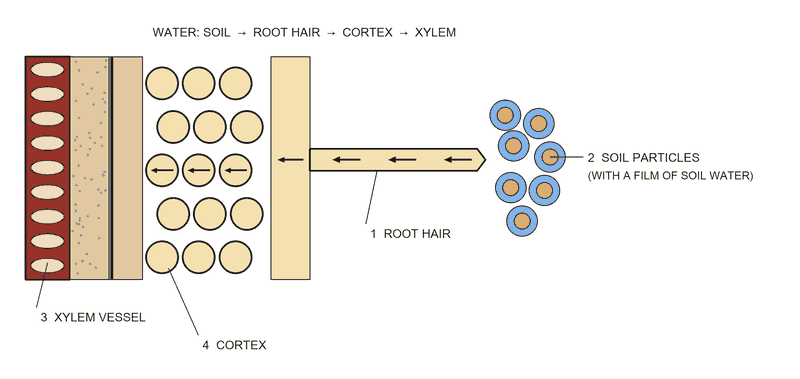
Step 2 — (ii) Passage of water from the soil into the root hair.
The process is osmosis. The cell sap of the root hair is more concentrated than the soil water, so water molecules pass from the soil water into the root hair through its semi-permeable cell membrane.
Step 3 — (iii) Pressure that moves water in the direction of the arrows.
The pressure is root pressure. Root pressure is the pressure developed in the roots by the continued inward movement of water by cell-to-cell osmosis; it helps the ascent of sap up the stem.
As each cell takes in water it passes water on to the next cell inward, so the push of the inward flow builds up until water is forced into the xylem vessels.
Step 4 — (iv) Drops of water along the leaf margins in the early morning.
The phenomenon is guttation. When root pressure is high (warm, moist soil and humid nights, so that little water is lost by transpiration), water is forced out as droplets through hydathodes, the water pores at the ends of the veins along the leaf margins. It is seen in plants such as grasses, tomato and Colocasia.
Step 5 — (v) The root hair cell after excess fertiliser is added close to it.
The fertiliser dissolves in the soil water and makes it hypertonic (more concentrated than the cell sap). Water leaves the root hair cell by exosmosis and the cytoplasm shrinks away from the cell wall: the cell is plasmolysed.
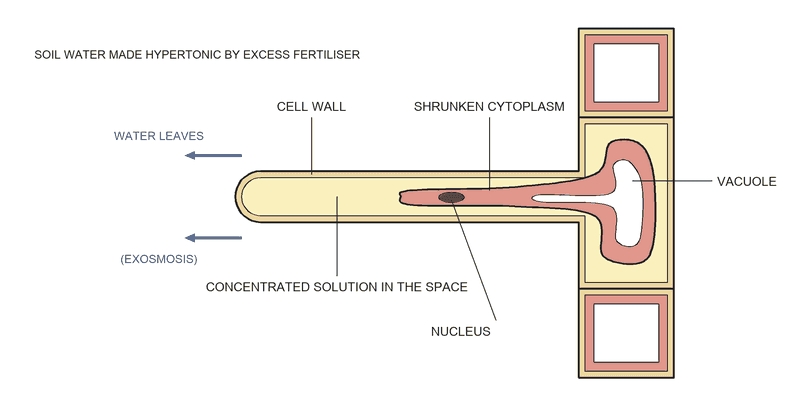
The diagram shows the cell wall keeping its shape, the shrunken cytoplasm pulled away from it, and the concentrated (fertiliser) solution filling the space between the two.
Watch out: The cell wall of a plasmolysed cell keeps its shape; only the protoplast (cytoplasm with the vacuole) shrinks.
Therefore, 1 = root hair, 2 = soil particles, 3 = xylem, 4 = cortex; water enters by osmosis; root pressure moves it inward and up; excess root pressure causes guttation; excess fertiliser plasmolyses the root hair.