
Question 11 markMCQAsked 2016Easy
Choose the correct answer from the four options given below:
A plant cell may burst when:
Confirming your payment
Sign up now and get 250 free tokens.
Previous Year Questions · Question 1 of 38
Choose the correct answer from the four options given below:
A plant cell may burst when:
(A) Turgor pressure equalises wall pressure.
(B) Turgor pressure exceeds wall pressure.
(C) Wall pressure exceeds turgor pressure.
(D) None of the above
Answer: (B) Turgor pressure exceeds wall pressure.
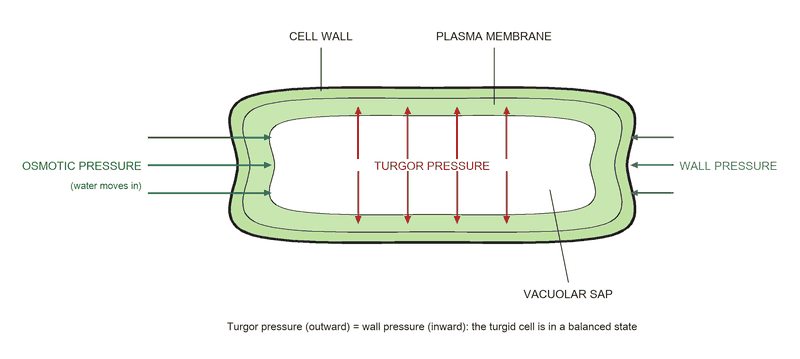
Concept: Turgor pressure is the pressure of the swollen cell contents on the cell wall (outward). Wall pressure is the equal and opposite pressure of the cell wall on the contents (inward). A cell stays whole only while the wall can push back as hard as the contents push out.
Step 1 — Follow the water into the cell.
In a dilute (hypotonic) solution water keeps entering the cell by endosmosis. The vacuole swells and the contents press harder and harder on the cell wall, so the turgor pressure rises.
Step 2 — Compare the two pressures.
The wall can stretch only a little. While it can press back with an equal wall pressure, the cell is simply turgid. If the turgor pressure becomes greater than the pressure the wall can exert back, the wall gives way and the cell bursts.
Step 3 — Match with the options.
Only option (B) describes turgor pressure exceeding wall pressure.
Watch out: A turgid cell (pressures equal) is the normal, healthy state of a plant cell; it is not about to burst.
Why the other options are wrong:
Therefore, a plant cell may burst when turgor pressure exceeds wall pressure, option (B).