
Question 131 markAsked 2018Easy
Give biological explanations for the following:
Plants growing in fertilized soil are often found to wilt if the soil is not adequately watered.
Confirming your payment
Sign up now and get 250 free tokens.
Previous Year Questions · Question 13 of 38
Give biological explanations for the following:
Plants growing in fertilized soil are often found to wilt if the soil is not adequately watered.
Solution:
Concept: Fertiliser dissolves in the soil water. Too much of it makes the soil water more concentrated (hypertonic) than the cell sap of the root hairs.
Step 1 — See what too little water does.
When the soil is not watered enough, the fertiliser dissolves in very little water, so the soil water becomes hypertonic to the root hair cells.
Step 2 — Follow the water.
Water can no longer enter the root hairs by osmosis. Instead water moves out of the root cells by exosmosis, and the cells become plasmolysed.
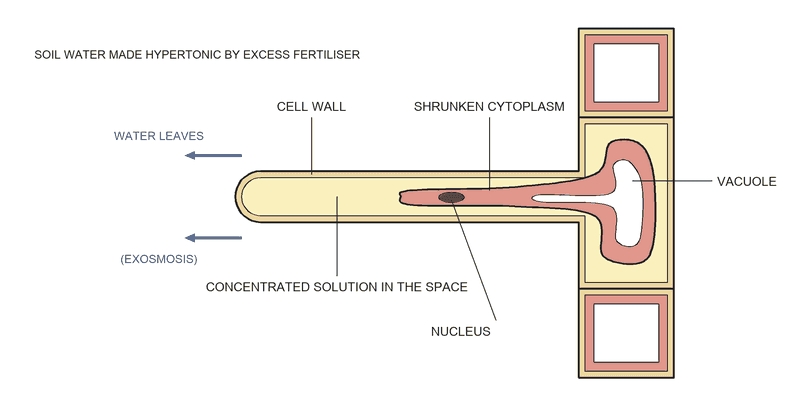
Step 3 — See the effect on the shoot.
The roots cannot supply water to the shoot, while the leaves keep losing water by transpiration. The leaf cells lose turgidity, so the plant wilts.
Watch out: The fertiliser itself is not a poison here; the harm comes from the soil water becoming too concentrated.
Therefore, plants in fertilised soil that is not watered enough wilt because the soil water becomes hypertonic and draws water out of the roots by exosmosis.