Solution:
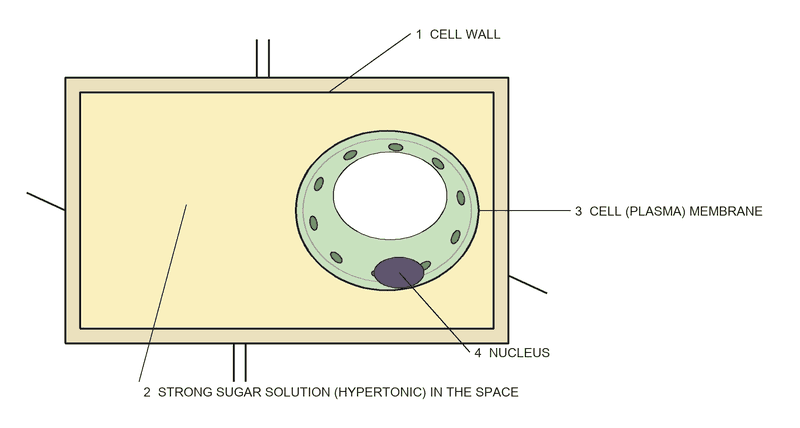
Concept: In a strong sugar solution (hypertonic) water leaves the cell by exosmosis. The protoplast shrinks away from the cell wall, and the sugar solution passes through the freely permeable wall into the space left between them.
Step 1 — (i) State of the cell.
The protoplast has pulled away from the cell wall, so the cell is plasmolysed (it has become flaccid).
Step 2 — (ii) The selectively permeable membrane.
The selectively permeable membrane is the cell membrane (plasma membrane). It lets water molecules pass but holds back the larger sugar molecules. (The membrane round the vacuole behaves in the same way.)
Step 3 — (iii) Parts 1 to 4.
Follow each guideline: 1 is the outer layer, 2 the space between the wall and the shrunken protoplast, 3 the outer boundary of the protoplast and 4 the dark body inside it.
- 1 — Cell wall
- 2 — Strong sugar solution (hypertonic solution) filling the space between the wall and the shrunken protoplast
- 3 — Cell membrane (plasma membrane)
- 4 — Nucleus
Step 4 — (iv) Bringing the cell back.
Place the cell in pure water (a hypotonic solution) before it dies. Water re-enters the cell by endosmosis, so the protoplast swells and presses against the cell wall again.
The recovery of a plasmolysed cell is called deplasmolysis.
Step 5 — (v) Two features of this plant cell not found in animal cells.
This plant cell has two features that an animal cell does not have:
- A cell wall around the cell membrane.
- A large central vacuole filled with cell sap.
- (The chloroplasts in the cytoplasm are also absent from animal cells.)
Watch out: Plasmolysis can be reversed only while the cell is alive; a cell left too long in the strong solution dies.
Therefore, the cell is plasmolysed; the cell membrane is selectively permeable; 1 = cell wall, 2 = strong sugar solution, 3 = cell membrane, 4 = nucleus; it recovers in pure water by deplasmolysis; a cell wall and a large central vacuole are found only in the plant cell.

