
Question 283 marksAsked 2025Easy
Given below is the diagram of a plasmolysed cortical cell of a root.
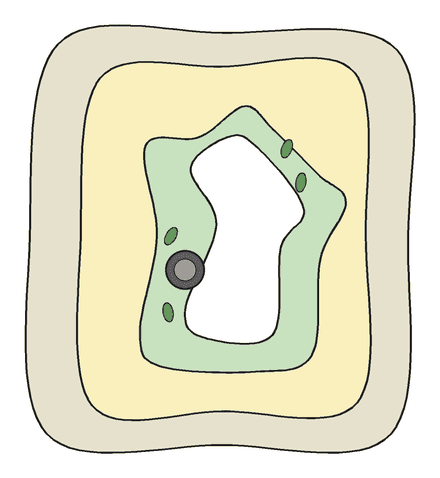
Copy the diagram and label the following parts in the diagram:
(a) Cytoplasm
(b) Hypertonic solution
(c) Plasma membrane
Confirming your payment
Sign up now and get 250 free tokens.
Previous Year Questions · Question 28 of 38
Given below is the diagram of a plasmolysed cortical cell of a root.
Copy the diagram and label the following parts in the diagram:
(a) Cytoplasm
(b) Hypertonic solution
(c) Plasma membrane
Solution:
Concept: In a plasmolysed cell the protoplast has shrunk away from the cell wall. Its outer boundary is the plasma membrane, and the outside (hypertonic) solution has entered the space between the protoplast and the wall through the freely permeable wall.
Step 1 — Label the cytoplasm.
(a) Cytoplasm is the shrunken living layer round the vacuole; it holds the nucleus and the small plastids.
Step 2 — Label the hypertonic solution.
(b) Hypertonic solution fills the space between the cell wall and the shrunken protoplast.
Step 3 — Label the plasma membrane.
(c) Plasma membrane is the outer boundary of the shrunken protoplast, now pulled away from the cell wall.
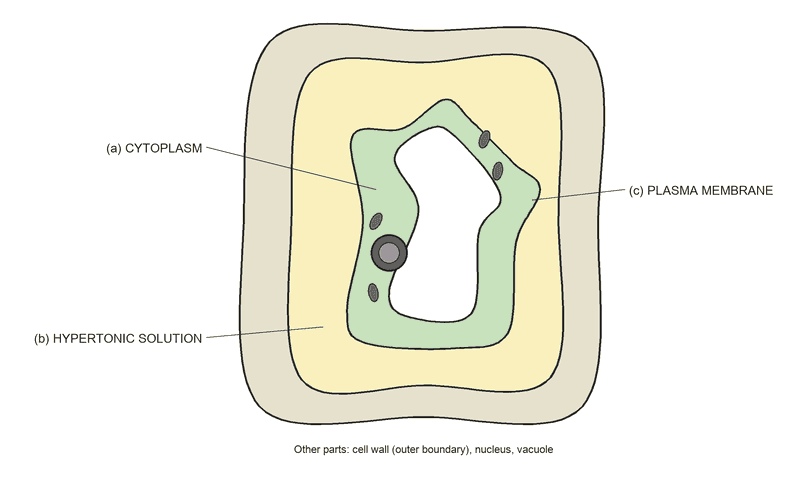
Watch out: The plasma membrane goes WITH the shrunken protoplast; it is not the line along the cell wall.
Therefore, the labels are (a) cytoplasm round the vacuole, (b) hypertonic solution in the space inside the wall and (c) plasma membrane at the edge of the shrunken protoplast.