
Question 181 markMCQAsked 2023Easy
Deplasmolysis occurs when a plasmolysed cell is placed in:
Confirming your payment
Sign up now and get 250 free tokens.
Previous Year Questions · Question 18 of 38
Deplasmolysis occurs when a plasmolysed cell is placed in:
(A) Concentrated salt solution
(B) Tap water
(C) Concentrated sugar solution
(D) Hypertonic salt solution
Answer: (B) Tap water
Concept: Plasmolysis is the shrinking of the protoplast (cytoplasm with its vacuole) away from the cell wall when a plant cell loses water by exosmosis in a hypertonic solution. Deplasmolysis is its recovery when water re-enters. For water to re-enter, the outside solution must be more dilute than the cell sap (hypotonic).
Step 1 — Judge each liquid.
Tap water is almost pure water, so it is hypotonic to the cell sap. The other three liquids are concentrated (hypertonic).
Step 2 — Follow the water.
In tap water, water enters the cell by endosmosis. The shrunken protoplast swells and presses against the cell wall again, and the cell becomes turgid.
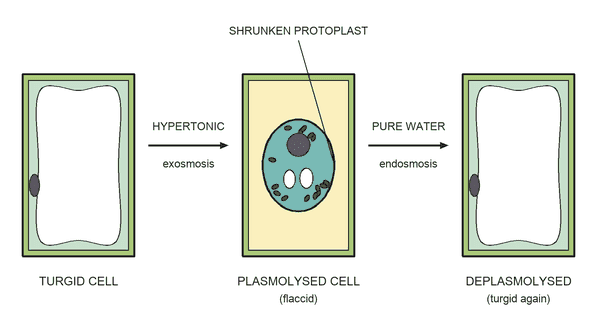
Watch out: Deplasmolysis needs a HYPOTONIC liquid; every concentrated solution keeps the cell plasmolysed.
Why the other options are wrong:
Therefore, deplasmolysis occurs when a plasmolysed cell is placed in tap water, option (B).