Solution:
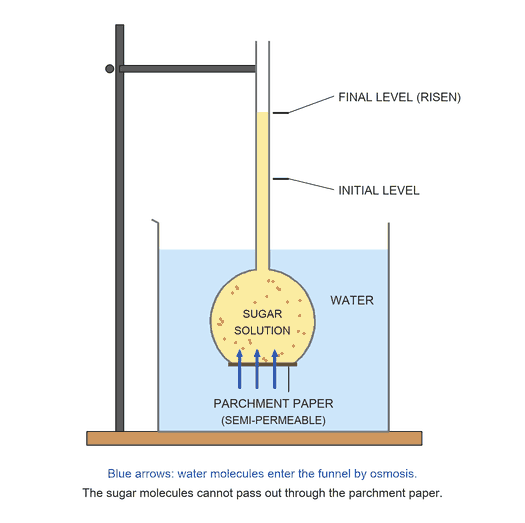
Concept: The parchment paper is a semi-permeable membrane. Water molecules pass from the beaker through it into the sugar solution, but the sugar molecules cannot pass out.
Step 1 — (a) Name the process.
Water passes through a semi-permeable membrane into a stronger solution, so the process is osmosis.
Step 2 — (b) Define it.
Osmosis is the movement of water molecules from the region of their higher concentration (dilute solution) to the region of their lower concentration (concentrated solution) through a semi-permeable membrane.
Step 3 — (c) The observation.
Water enters the funnel, so the level of the sugar solution in the stem of the thistle funnel rises, and the water level in the beaker falls slightly. The water in the beaker does not turn sweet, because the sugar cannot cross the parchment paper.
Step 4 — (d) The control.
Set up an identical apparatus in which the thistle funnel holds plain water instead of sugar solution. Its level does not change, which shows that the rise is due to the sugar solution.
Step 5 — (e) Match with the root hair.
The set-up is a model of a root hair in the soil:
| In the experiment | In the root hair and its surroundings |
|---|
| (1) Concentrated sugar solution | Cell sap of the root hair (in its vacuole) |
| (2) Parchment paper | Cell membrane (plasma membrane) of the root hair |
| (3) Water in the beaker | Soil water around the root hair |
Step 6 — (f) Another membrane.
Cellophane paper works in the same way. (An egg membrane or an animal bladder can also be used.)
Step 7 — (g) Two advantages to plants.
Any two:
- The roots absorb water from the soil by osmosis, and the water passes from cell to cell to the xylem.
- Osmosis keeps the cells turgid, which gives stiffness to soft parts such as leaves.
- It brings about the opening and closing of stomata through the turgidity of the guard cells.
Watch out: In (e) parchment paper matches the cell membrane, not the cell wall, because the cell wall is freely permeable.
Therefore, (a) osmosis; (c) the level in the funnel stem rises; (d) a funnel with plain water as control; (e) cell sap, cell membrane, soil water; (f) cellophane paper; (g) absorption of water and turgidity (or stomatal movement).

