Solution:
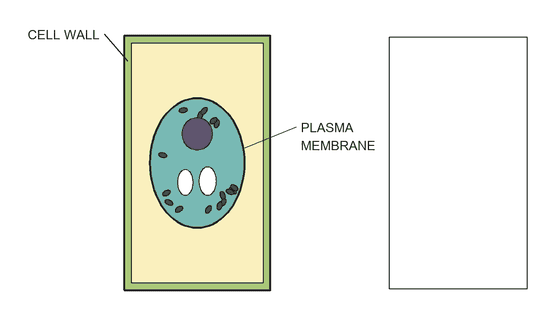
Concept: In the figure the protoplasm has shrunk away from the cell wall, so the cell has lost water by exosmosis. This happens only in a solution stronger than the cell sap.
Step 1 — (a) Name the state.
A cell whose protoplasm has shrunk away from the wall is plasmolysed (it is flaccid; the process is plasmolysis).
Step 2 — (b) Name the selectively permeable membrane.
The plasma membrane (cell membrane) lets water molecules pass but not the larger solute molecules.
Step 3 — (c) Judge the liquid.
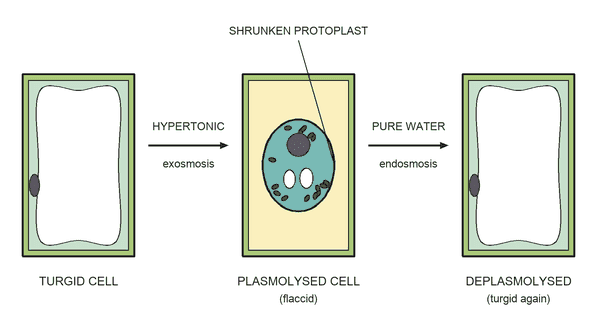
Water left the cell, so the liquid outside was hypertonic: its solute concentration was higher than that of the cell sap (for example, a strong salt or sugar solution).
Step 4 — (d) A plant-only feature.
The cell wall is not present in an animal cell. (A large central vacuole and chloroplasts are other such features.)
Step 5 — (e) The cell put back in ordinary water.
Ordinary water is hypotonic to the cell sap. Water re-enters by endosmosis, the protoplasm swells and presses against the cell wall again, and the cell is deplasmolysed (turgid). The redrawn cell, labelled cell wall, plasma membrane, cytoplasm, vacuole (cell sap) and nucleus:

Watch out: The cell wall is freely permeable; the selectively permeable layer is the plasma membrane inside it.
Therefore, (a) plasmolysed, (b) plasma membrane, (c) hypertonic, (d) cell wall, (e) the cell becomes deplasmolysed (turgid) as drawn.