
Opening your dashboard
Class 10 Biology Chapter 4 Absorption by Roots – The Processes Involved: Competency-Based Questions (CBQ)
40 questions on Chapter 4, each worked through on its own page with the AI tutor. Class 10 Biology, ICSE 2026-27.
40 questions
1–5 marks · Mixed difficulty
- 11 mark
Question 1
Cognitive domain: Application
While shifting a marigold seedling to a new pot, Sana pulled it out of the soil roughly, and most of its fine rootlets broke off. She watered the new pot well, yet the seedling remained wilted for several days. What is the most likely reason ?
- 21 mark
Question 2
Cognitive domain: Analysis
A U-tube is divided at the bottom by a semi-permeable membrane. Arm X is filled with a sugar solution and arm Y with a sugar solution, up to the same level, as shown.
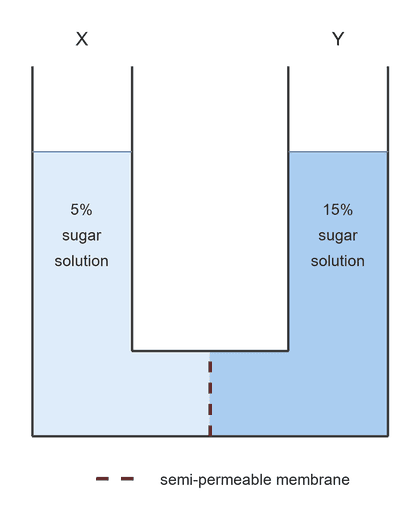
What will be observed after a few hours, and why ?
- 31 mark
Question 3
Cognitive domain: Application
A teak tree sheds all its leaves in the dry season. In the leafless tree, which of the forces contributing to the ascent of sap is reduced the most, and why ?
- 41 mark
Question 4
Cognitive domain: Analysis
Two similar, well-watered potted balsam plants were cut a few centimetres above the soil, and a mercury manometer was fixed to each stump with a rubber connection. Then some more liquid was poured on the soil of each pot.

Pot Liquid poured on the soil Rise of mercury after 3 hours P Plain water 14 mm Q Strong salt solution 0 mm Which statement best explains the result in pot Q ?
- 51 mark
Question 5
Cognitive domain: Understanding
Assertion (A): Ions such as nitrates and potassium enter the root cells from the soil water by osmosis.
Reason (R): The cell membrane of a root hair is semi-permeable; it lets water molecules pass through but not the larger molecules of the dissolved salts.
- 61 mark
Question 6
Cognitive domain: Understanding
Assertion (A): In the experiment to show that roots absorb water, a second test tube with the same level of water but without a plant is also set up.
Reason (R): A few drops of oil put on the water prevent the loss of water by evaporation.
- 71 mark
Question 7
Cognitive domain: Application
In an old method of splitting rocks, dry wooden wedges were hammered into the cracks of a rock and then soaked with water. The wedges swelled with great force and widened the cracks.
The dry wood took in water by the process of ______, which, unlike osmosis, can take place even in ______ cells.
- 81 mark
Question 8
Cognitive domain: Analysis
Strips of the lower epidermis of the same leaf were kept in three sugar solutions for some time and then seen under a microscope. In the solution the cells were turgid. In the solution the cells showed no change. In the solution the cytoplasm had shrunk away from the cell wall.
So the cell sap of these cells is isotonic to the ______ sugar solution, and the solution is ______ to the cell sap.
- 91 mark
Question 9
Cognitive domain: Understanding
In a mango tree, the sugar made in the leaves can reach the growing fruits only when it is dissolved in water. In a balsam plant, the soft stem stands upright only as long as its cells are fully distended with water.
Of the four purposes for which a plant needs water, the first is an example of ______ and the second of ______.
- 102 marks
Question 10
Cognitive domain: Application
After a long dry spell, it rained heavily for three days on Mr. Patil's farm. He then found that many of the ripe tomatoes still on the plants had split open.
Explain why the tomatoes split, using the terms endosmosis and turgor pressure.
- 112 marks
Question 11
Cognitive domain: Evaluation
Ravi says: "A wide pipe carries more water than a narrow one. So the xylem vessels of a tall tree would lift water to a greater height if they were much wider."
Evaluate Ravi's statement with reference to one force that contributes to the ascent of sap. Suggest a simple way to show him the fact with glass tubes.
- 122 marks
Question 12
Cognitive domain: Evaluation
Two years ago a wire was tied tightly round the trunk of a young tree to hold a clothes line. The wire has now cut deep into the bark, and the trunk has become swollen just above the wire, as shown. The leaves of the tree are still fresh and green.

The owner says, "The swelling proves that water coming up from the roots is collecting there because it cannot get past the wire." Evaluate his explanation, using both observations.
- 135 marks
Question 13
Cognitive domain: Analysis
Case: Three visking bags (semi-permeable) were each filled with sugar solution and tied firmly to a capillary tube, so that the solution stood at a marked level in each tube. Each bag was immersed in a beaker containing a different liquid. The change in the level in the capillary tube was noted after one hour.
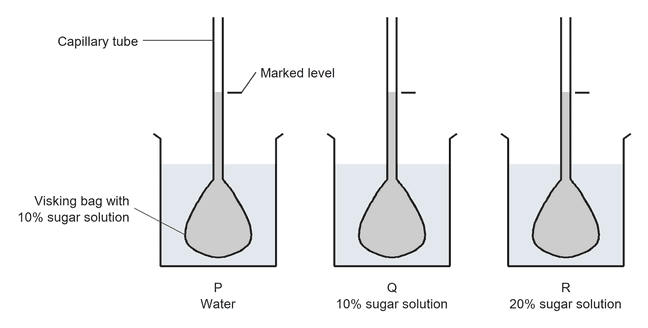
Set-up Liquid in the beaker Change in level in one hour P Water Rose by 24 mm Q sugar solution No change R sugar solution Fell by 15 mm (a) Explain the rise in set-up P. Name the process.
(b) Why was there no change in set-up Q ? What term describes the two solutions in Q in relation to each other ?
(c) Explain the fall in set-up R. If the bag were a living cell, what would this outward movement of water be called ?
(d) Set-up P was left for many hours. The level stopped rising, although the liquid in the bag was still a sugar solution and the beaker still had water. Explain why.
- 144 marks
Question 14
Cognitive domain: Application
Case: On a nature walk, students find a small plant with feathery leaves growing along the path. When Tara lightly touches one leaf, its leaflets fold up and, within 2 to 3 seconds, the whole leaf droops. After some time the leaf slowly stands erect again. The teacher says the plant is Mimosa pudica.
(a) What is this kind of movement called ? Name the swollen part at the base of the petiole that brings it about.
(b) Explain, in terms of water and turgor, what happens in this part to make the leaf droop.
(c) Suggest what must happen in the same cells for the leaf to stand erect again.
(d) Tara now touches a leaf somewhat strongly. Predict what she will observe. Also give one other example of this kind of movement in plants.
- 155 marks
Question 15
Cognitive domain: Creativity
Case: Your class has seen the experiment in which a young balsam plant, kept with its roots in a test tube of water covered with oil, lowers the water level in a day or two. Aditi now asks a new question: "Does a plant with more leaves absorb more water ?" You have several similar young balsam plants with intact roots, test tubes of the same size, a stand, water, oil, a marker and a scale.
(a) Design the set-ups you would use to answer Aditi's question. State clearly what is different between them.
(b) State three things that must be kept the same in all the set-ups, and describe the control.
(c) Draw the table for recording the results. State the result you expect, with a reason.
(d) Mention one thing that could make your result unreliable, and how you would reduce it.
- 161 mark
Question 16
CISCE Competency-Focused Practice Questions (2024) · Cognitive domain: Understanding & Analysis
Mary sprinkled 5 kg of common salt on the grass growing on her lawn. After a couple of days, she observed that the grass had wilted and died. This was due to which of the following conditions?
- 171 mark
Question 17
CISCE Competency-Focused Practice Questions (2024) · Cognitive domain: Application
A cell of a leaf of an aquatic plant is kept in a 5% salt solution for some time. The phenomenon which will take place is/are:
- 181 mark
Question 18
CISCE Competency-Focused Practice Questions (2024) · Cognitive domain: Analysis
Osmosis is controlled by the concentration of ______ molecules.
- 191 mark
Question 19
CISCE Competency-Focused Practice Questions (2024) · Cognitive domain: Application
An animal cell is kept in a lower solute concentration fluid. The cell will ______. (Enlarge / Shrink)
- 201 mark
Question 20
CISCE Competency-Focused Practice Questions (2024) · Cognitive domain: Analysis
Plants absorb water from the roots because the cell sap is ______ (more, less) concentrated than the surrounding fluids.
- 211 mark
Question 21
CISCE Competency-Focused Practice Questions (2024) · Cognitive domain: Application
Human red blood cells, when kept in a hypertonic solution, ______ occurs. (Osmosis, endosmosis, exosmosis)
- 221 mark
Question 22
CISCE Competency-Focused Practice Questions (2024) · Cognitive domain: Recall
Given below is an experimental setup. Read the information given below the diagram and answer the questions from 26-30.
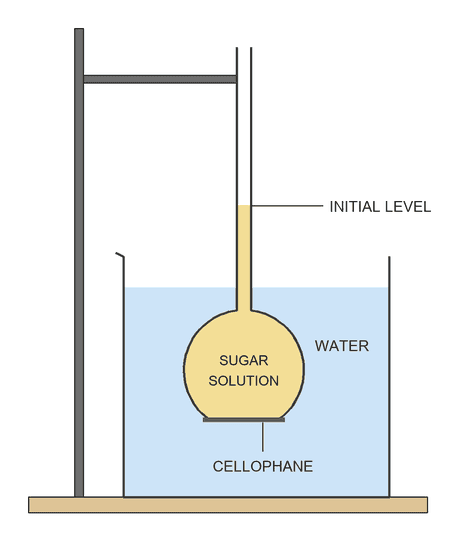
Concentrated sugar solution is taken in the thistle funnel. The mouth of the thistle funnel is covered with cellophane paper. The thistle funnel is inverted in a beaker containing water.
The above experiment demonstrates ______.
- 231 mark
Question 23
CISCE Competency-Focused Practice Questions (2024) · Cognitive domain: Understanding
Given below is an experimental setup. Read the information given below the diagram and answer the question.
Concentrated sugar solution is taken in the thistle funnel. The mouth of the thistle funnel is covered with cellophane paper. The thistle funnel is inverted in a beaker containing water.
After a few hours, the level of the sugar solution ______ in the thistle funnel.
- 241 mark
Question 24
CISCE Competency-Focused Practice Questions (2024) · Cognitive domain: Application
Given below is an experimental setup. Read the information given below the diagram and answer the question.
Concentrated sugar solution is taken in the thistle funnel. The mouth of the thistle funnel is covered with cellophane paper. The thistle funnel is inverted in a beaker containing water.
It allows only ______ molecules to pass through it freely.
- 251 mark
Question 25
CISCE Competency-Focused Practice Questions (2024) · Cognitive domain: Application
Given below is an experimental setup. Read the information given below the diagram and answer the question.
Concentrated sugar solution is taken in the thistle funnel. The mouth of the thistle funnel is covered with cellophane paper. The thistle funnel is inverted in a beaker containing water.
It prevents the passage of ______ molecules.
- 261 mark
Question 26
CISCE Competency-Focused Practice Questions (2024) · Cognitive domain: Application
Given below is an experimental setup. Read the information given below the diagram and answer the question.
Concentrated sugar solution is taken in the thistle funnel. The mouth of the thistle funnel is covered with cellophane paper. The thistle funnel is inverted in a beaker containing water.
A control experiment can be set up by taking plain ______ in the thistle funnel and placing it in another beaker containing water.
- 271 mark
Question 27
Cognitive domain: Analysis
Two sets of maize seedlings with their roots dipping in the same nutrient solution were kept for 24 hours. The roots use oxygen to release the energy they need. Air was bubbled through the solution of set X, but not through that of set Y, in which the dissolved oxygen was soon used up. (Hypothetical data.)
Set Potassium in the solution Potassium in the root sap at the start Potassium in the root sap after 24 hours X units units units Y units units units Which conclusion do these readings support best ?
- 281 mark
Question 28
Cognitive domain: Application
A banyan seedling grew in a crack of the compound wall of an old school. After some years the crack had become wider and a few bricks had loosened. Which of the following explains best the force that widened the crack ?
- 291 mark
Question 29
Cognitive domain: Evaluation
In early spring, before its new leaves had opened, a grapevine was pruned. Drops of clear sap kept oozing from the cut ends of the stems that remained on the vine, but none came from the cut ends of the pruned stems lying on the ground. Four students gave reasons. Which one is correct ?
- 301 mark
Question 30
Cognitive domain: Understanding
Assertion (A): A root does not have to take in the potassium and the nitrate of dissolved potassium nitrate in equal amounts; it may take in more of one than of the other.
Reason (R): Mineral elements are absorbed from the soil water by the root cells as separate ions rather than as whole salts.
- 311 mark
Question 31
Cognitive domain: Analysis
Assertion (A): A leaf cell of a water plant that is plasmolysed in a strong salt solution for a few minutes becomes turgid again when it is put back in pure water, but a cell that is left in the salt solution until it dies does not.
Reason (R): In a strong salt solution the cell wall shrinks along with the protoplast, and a shrunken cell wall cannot stretch back again.
- 321 mark
Question 32
Cognitive domain: Application
From a sample under the microscope, a student estimates that a young wheat seedling has about root hairs, each about long. (Hypothetical data.) The student imagines all the root hairs laid end to end and wants to state the total length and what it shows. Which statement is correct ?
- 332 marks
Question 33
Cognitive domain: Analysis
Four events are described below.
(i) The smell of an incense stick lit in one corner of a room slowly reaches the opposite corner.
(ii) Dry gram seeds soaked overnight in water swell and become soft.
(iii) Root hairs of a plant growing in a soil poor in nitrate gather nitrate ions in their cell sap.
(iv) A strip cut from a raw potato and kept in plain water becomes stiff and slightly longer.
Name the process (diffusion, imbibition, osmosis or active transport) responsible for each event. Which one of the four needs energy from the cell, and why ?
- 342 marks
Question 34
Cognitive domain: Evaluation
Meena kept a young balsam plant with its roots in eosin solution for four hours, as in the class experiment. She then cut a thin cross-section of its stem and saw red patches arranged in a ring. In each vascular bundle only the inner part, the part facing the centre of the stem, was red; the outer part of each bundle was unstained.
She wrote: "The dye has coloured the phloem, so the phloem carries water and minerals up the stem."
Evaluate her conclusion, and name the tissue that really took up the dye.
- 352 marks
Question 35
Cognitive domain: Analysis
Two leafy twigs of the same plant were cut under water and stood, in two identical tubes holding the same amount of water, under the same light and air. A layer of oil on the water stopped evaporation from the tubes. Twig P was left with all its leaves. Twig Q had all its leaves removed. After 6 hours, the water level had fallen by in the tube of P and by in the tube of Q. (Hypothetical data.)
Name the force that accounts for the larger fall in the tube of P, and explain why root pressure cannot be the reason.
- 363 marks
Question 36
Cognitive domain: Evaluation
Jaya's aunt stirred two heaped spoonfuls of common salt into the glass of water (about ) in a vase holding freshly cut roses. She said: "Salt is a mineral, so it will feed the flowers and keep them fresh for a longer time." By the next morning the roses were drooping, and they were worse than the roses in a vase of plain water.
Evaluate the aunt's statement. Explain why the roses drooped, using the terms exosmosis and turgidity.
- 373 marks
Question 37
Cognitive domain: Analysis
The width of the pore of the stomata on a leaf was measured four times in a day for two potted plants of the same kind. Plant 1 was watered well. Plant 2 had been kept without water for 10 days. (Hypothetical data.)
Time Pore width, plant 1 Pore width, plant 2 7 a.m. 11 a.m. 2 p.m. 7 p.m. (a) At what time were the guard cells of plant 1 most turgid ? Give a reason.
(b) Explain the narrow pore of plant 2 at 2 p.m.
(c) Why does the pore of plant 1 become narrower by 7 p.m. ?
- 383 marks
Question 38
Cognitive domain: Creativity
Imbibition is said to take place in living as well as in dead plant material. You have dry gram seeds, small pieces of dry wood, two beakers of water, a glass rod, a balance, a tissue paper to blot the surface, and a marker.
Design a simple experiment to test this statement. In your answer, describe (a) the set-ups, (b) what you would measure and what you expect, and (c) how you would use the result for the conclusion.
- 394 marks
Question 39
Cognitive domain: Application
Case: Riya studied how fast molecules spread on their own. (Hypothetical data.)
- Activity 1: She dropped a crystal of potassium permanganate into a tall jar of still water. After minutes the pink colour had reached only above the bottom.
- Activity 2: She repeated Activity 1 in another jar and stirred the water gently with a glass rod. The whole of the water became evenly pink within a few seconds.
- Activity 3: Her teacher put a cotton plug soaked in ammonia solution at one end of a long glass tube closed at both ends, with strips of moist red litmus paper placed along the tube. The strip from the cotton turned blue after minutes.
(a) Name the process by which the colour spread in Activity 1 and the ammonia spread in Activity 3. In Activity 1, do only the permanganate molecules move, or do the water molecules move as well ?
(b) Work out the distance moved per minute in Activity 1 and in Activity 3. In which state of matter is this process faster ?
(c) Why did the colour spread so quickly in Activity 2, and why did Riya keep the water still in Activity 1 ?
- 405 marks
Question 40
Cognitive domain: Analysis
Case: In a diagram of a root, the concentration of dissolved solutes in the soil water, in a root hair and in three cells (P, Q and R) lying between the root hair and a xylem vessel is shown below. (Hypothetical data.)
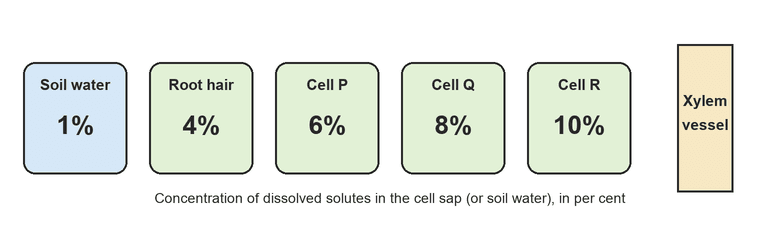
(a) In which direction does water move along this row of cells ? Give the reason.
(b) In a dry spell the soil water becomes a solution. State what happens to the water in the root hair, and what the plant will look like after some time.
(c) A poison kills cells P, Q and R, and their membranes become freely permeable. State what happens to the water movement in this row of cells, and the effect on root pressure.