
Opening your dashboard
Class 10 Biology Chapter 4 Absorption by Roots – The Processes Involved: Practice Questions
45 questions on Chapter 4, each worked through on its own page with the AI tutor. Class 10 Biology, ICSE 2026-27.
45 questions
1–5 marks · Mixed difficulty
- 11 mark
Question 1
Bloom's level: Remember
The branch of biology that deals with the life functions (metabolism) of the plant is called :
- 21 mark
Question 2
Bloom's level: Remember
In a living root hair, the layer that lets water pass but stops the larger molecules of dissolved salts is the :
- 31 mark
Question 3
Bloom's level: Remember
Wooden doors swell and become hard to close in the rainy season. This is due to :
- 41 mark
Question 4
Bloom's level: Understand
Root cells go on taking in nitrate ions even though the ions are already more concentrated inside the cells than in the soil water. This is possible because the cells :
- 51 mark
Question 5
Bloom's level: Apply
The chapter's introduction notes that processes like osmosis matter in the life of all organisms, not only plants. A drop of human blood is mixed with distilled water. The red blood cells will most likely :
- 61 mark
Question 6
Bloom's level: Apply
The leafy shoot of a well-watered balsam plant is cut off a few centimetres above the soil. Sap oozes from the cut stump. This shows :
- 71 mark
Question 7
Bloom's level: Understand
Which force helps to keep an unbroken column of water in the xylem from the roots to the top of a tall tree?
- 81 mark
Question 8
Bloom's level: Analyse
Two leafy twigs are kept with their cut ends in water. In twig X, a ring of bark (phloem) is removed; in twig Y, the central xylem is cut through, leaving the bark intact. After two days :
- 91 mark
Question 9
Bloom's level: Apply
Leaves of many plants droop in the hot afternoon sun even when the soil is moist, and stand up again by evening. The best explanation is :
- 101 mark
Question 10
Bloom's level: Understand
Assertion (A): Water from the soil enters the root hair.
Reason (R): The cell sap of a root hair usually has a higher concentration than the surrounding soil water.
- 111 mark
Question 11
Bloom's level: Evaluate
Assertion (A): Excess fertiliser around the roots of a crop can make the plants wilt and lower the yield.
Reason (R): Fertilisers make the soil water hypotonic to the cell sap of the root hairs.
- 121 mark
Question 12
Bloom's level: Analyse
Assertion (A): When the leaf of the sensitive plant (Mimosa pudica) is touched, its leaflets fold and the leaf droops within a few seconds.
Reason (R): Cell membranes of plant cells are semi-permeable.
- 131 mark
Question 13
Bloom's level: Remember
Name the three forces that, according to the chapter's summary, contribute to the ascent of sap up to the topmost regions of a plant.
- 142 marks
Question 14
Bloom's level: Understand
A fully grown root hair and the neighbouring epidermal cell from which no hair has grown are both parts of the same layer. Explain why the root hair absorbs far more water than its neighbour, giving two reasons.
- 152 marks
Question 15
Bloom's level: Understand
A potted plant has not been watered for many days. Explain how a shortage of water would affect each of these : (a) its food-making, (b) the carrying of minerals to its leaves, (c) the stiffness of its leaves, (d) keeping its leaves cool.
- 162 marks
Question 16
Bloom's level: Apply
In 1937, H.J. Dittmer found that a single four-month-old rye plant had about 14 billion root hairs with a total length of about 10,000 km. (a) Find the average length of one root hair in millimetres. (b) How many times does the total length of the root hairs exceed the distance of about 3000 km from Kashmir to Kanyakumari?
- 172 marks
Question 17
Bloom's level: Apply
A housewife adds plenty of salt to raw mango pieces while making pickle. After a day, the mango pieces have shrunk and a lot of liquid has collected in the jar. Explain both observations and the reason the pickle keeps for months.
- 182 marks
Question 18
Bloom's level: Understand
Explain how cell-to-cell osmosis in the root builds up root pressure. Why do drops of water appear at the tips of grass blades early in the morning?
- 192 marks
Question 19
Bloom's level: Analyse
Arrange the following in the correct order in which water passes from the soil to the leaf, and name the process by which it moves from cell to cell in the root : cortex, xylem of stem, root hair, endodermis, soil water, pericycle, xylem of root, leaf.
- 202 marks
Question 20
Bloom's level: Evaluate
Neha says, "Root pressure alone is enough to lift water to the top of a 60-metre-tall pine tree." Is she right? Justify, naming the force that is especially important in tall trees.
- 212 marks
Question 21
Bloom's level: Apply
A girdle (ring of bark) is removed from the stem of a healthy potted plant just above the soil. Predict what will happen, after some weeks, to (a) the leaves and (b) the roots, with a reason for each.
- 221 mark
Question 22
Bloom's level: Understand
Why do plants need mineral nutrients, and from where do they get them?
- 233 marks
Question 23
Bloom's level: Apply
Case: Rohit's grandfather filled a large tin with dry chickpeas, added water to the brim and shut the lid tightly before going to bed. In the morning the lid had been forced open and the tin had bulged.
(a) Name the process by which the dry seeds first took up the water. What property of the seed materials makes this possible?
(b) Once the seed cells were living and moist, which process continued to draw water into them? Explain the force that developed.
(c) Give one other everyday example where this kind of force causes damage.
- 244 marks
Question 24
Bloom's level: Apply
Case: At a school fair, a student showed how cut celery stalks with leaves, kept in glasses of water with red food colour, turned their leaf veins red after a few hours.
(a) Which tissue carried the coloured water? How would you prove it by cutting the stalk?
(b) Explain the main force that pulled the water up the leafy stalk, even though it had no roots.
(c) Predict the result if the leaves were first coated with vaseline on both surfaces. Give a reason.
- 254 marks
Question 25
Bloom's level: Analyse
Four equal cylinders of potato, each of mass 5.0 g, were placed in sugar solutions of different strengths. After 2 hours they were dried and weighed again :
Beaker Solution Final mass P Distilled water 5.6 g Q Weak sugar solution 5.2 g R Medium sugar solution 5.0 g S Strong sugar solution 4.4 g (a) Calculate the percentage change in mass for each cylinder.
(b) In which beaker was the solution isotonic, and in which hypertonic, to the potato cells? Explain.
(c) Describe the state of the cells in P and in S.
- 264 marks
Question 26
Bloom's level: Analyse
Two test tubes, A and B, each contain 20 mL of water with a layer of oil on top. A young balsam plant with intact roots is placed in tube B; tube A has no plant. Both are kept in a sunny place.
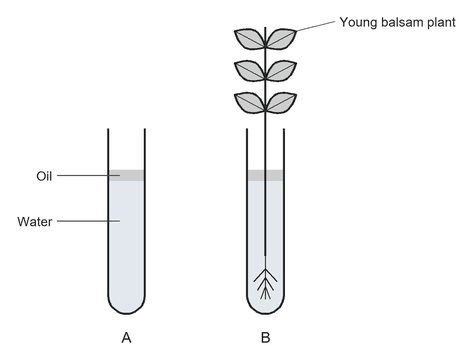
Time Water in A Water in B Start 20 mL 20 mL After 1 day 20 mL 16 mL After 2 days 20 mL 12 mL (a) What does this experiment show? Which tube is the control?
(b) Why is a layer of oil added in both tubes?
(c) Calculate the average volume of water absorbed by the plant per hour over the two days. Would you expect the rate to be the same in the day and at night? Explain.
- 274 marks
Question 27
Bloom's level: Evaluate
A student wrote the following three statements in a test :
Statement 1: "Diffusion can occur only in liquids."
Statement 2: "In osmosis, both water and sugar molecules pass through the membrane."
Statement 3: "Active transport moves ions from a region of their higher concentration to a region of lower concentration."
(a) Judge each statement and correct it.
(b) Which of the three processes can occur through a non-living membrane, and which needs a living membrane? Justify.
- 285 marks
Question 28
Bloom's level: Create
Design an experiment to demonstrate osmosis using a raw egg whose shell has been dissolved away in vinegar, so that only its membrane surrounds the contents.
(a) Write the procedure for the experimental set-up and a control.
(b) State the result you expect in each set-up, and explain it.
(c) Suggest how you would change the experiment to show exosmosis, and the result you would expect.
- 295 marks
Question 29
Bloom's level: Create
Plan an experiment to show that water is conducted upwards through the xylem and not through the phloem, using two leafy shoots of a balsam plant.
(a) Describe how you will prepare the two shoots, and why they should be cut under water.
(b) Describe the set-up and the expected result after two days.
(c) Construct a results table and write the conclusion.
- 303 marks
Question 30
Bloom's level: Apply
Follow a molecule of water on its way from the moist soil to a leaf at the top of a 15-metre-tall mango tree on a sunny day. Name the process or force mainly responsible at each stage, and explain briefly :
(a) from the soil water into the root hair;
(b) from the root hair, across the cortex, into the xylem of the root;
(c) from the root up the xylem of the trunk to the leaf.
- 311 mark
Question 31
A well-watered balsam plant has a soft, non-woody stem, yet its stem and leaves stand out firmly. Which one of the purposes for which a plant needs water is seen here ?
- 321 mark
Question 32
Which one of the following is true of osmosis but not of diffusion ?
- 331 mark
Question 33
Assertion (A): In the experiment to show that roots absorb water, a few drops of oil are put on the water of the test tube without a plant as well as on the water of the test tube with the plant.
Reason (R): A layer of oil prevents the loss of water from the test tube by evaporation.
- 342 marks
Question 34
(i) What is meant by the term sap ? Name the tissue through which it flows upwards in a plant.
(ii) Name the process by which the cells of the root take in mineral ions from the soil water. Why does this process need energy ?
- 352 marks
Question 35
The shoot of a well-watered potted balsam plant is cut off a few centimetres above the soil. A glass tube is at once fixed to the stump with a rubber connection.
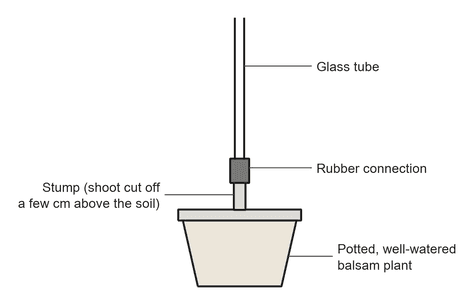
(i) State what is seen in the glass tube after some time, and name the pressure that causes it.
(ii) What is the loss of sap through a cut stem called ? Why can the pressure named in (i) not raise water to the top of a tall tree ?
- 362 marks
Question 36
The figure shows two cells, A and B, taken from the same leaf of a water plant. One of them had been kept in pond water and the other in 5% salt solution for a few minutes.

(i) Which cell had been kept in the salt solution ? Name the condition of this cell.
(ii) Name the layer numbered 2. What fills the space numbered 1 ?
- 372 marks
Question 37
(i) How does the diameter of a xylem vessel affect the height to which water rises in it by capillarity ? What creates the vacuum that this water rises to fill ?
(ii) Distinguish between cohesion and adhesion of water molecules in the xylem.
- 384 marks
Question 38
The figure shows a cell from the outermost layer of a young root, with parts of the two cells next to it.
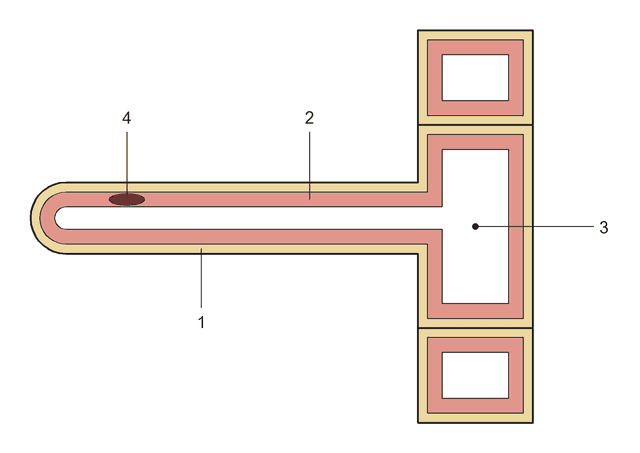
(i) Write the names of the parts 1, 2, 3 and 4.
(ii) Name the solution that fills part 3. How does its concentration compare with that of the soil water, and why is this important ?
(iii) State the nature of part 1 with regard to the passage of substances through it. Name the very thin layer that lies just inside part 1, and state its nature in the same regard.
- 394 marks
Question 39
A thistle funnel containing concentrated sugar solution has its mouth covered with cellophane paper and is dipped in a beaker of water. From the very beginning, an airtight piston bearing a suitable weight rests on the solution in the stem, as shown in the figure.
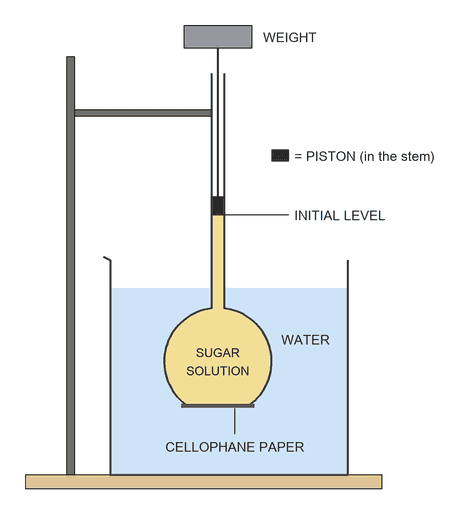
(i) Name the property of the sugar solution that this set-up is meant to demonstrate, and define it.
(ii) What is observed at the mark of the initial level after a few hours ? What does this observation show ?
(iii) The piston and the weight are now taken off. State and explain what happens to the level of the solution in the stem.
- 403 marks
Question 40
A young balsam plant is uprooted, washed and placed in a beaker with its roots completely dipped in a pink solution of eosin in water. After 3 to 4 hours it is taken out and washed in tap water. Thin transverse sections of its root, stem and leaf are then examined under a microscope.
(i) Which tissue is found stained in all the three sections ? What does this prove ?
(ii) Only the roots were dipped in the stain. Explain how the stain could reach this tissue in the leaf as well.
(iii) In a second plant, a ring of the outer part of the stem (the phloem) is removed all round, leaving the central part intact, before the roots are dipped in the eosin solution. Will the leaves above the ring still receive the stain ? Give a reason.
- 411 mark
Question 41
Class 10 Sample Paper 1 · Section A
A cell is plasmolysed when it is placed in
- 421 mark
Question 42
Class 10 Sample Paper 1 · Section A
Name the following:
The uptake of mineral ions against the concentration gradient.
- 431 mark
Question 43
Class 10 Sample Paper 2 · Section A
Name the following:
The outward movement of water molecules causing the cells to become 'flaccid'.
- 445 marks
Question 44
Class 10 Sample Paper 2 · Section B
Give reasons for the following:
(i) A closed can of dried seeds bursts open if water somehow enters the can.
(ii) Fish living in fresh water cannot survive in sea water.
(iii) On a rainy day there is no transpiration.
(iv) Microorganisms like bacteria and fungi do not grow in pickles, jams and squashes.
(v) Urine is slightly thicker in summer than in winter.
- 455 marks
Question 45
Class 10 Sample Paper 2 · Section B
Write the functions of the given structures.
(i) Root hairs
(ii) Xylem
(iii) Ethylene
(iv) Urethra
(v) Plasma