Solution:
Concept: Test each statement against three ideas: plasmolysis (water lost in a strong solution), tonicity (which way water moves) and permeability (cell wall freely permeable, cell membrane semi-permeable). Only the last word may be changed.
Step 1 — (a) Salt in pickles: F.
Salt makes the pickle hypertonic, so water leaves the bacterial cells and they shrink; turgid cells would be full of water.
Corrected: Addition of salt to pickles prevents growth of bacteria because they turn plasmolysed.
Step 2 — (b) Cells that have lost water: F.
Deplasmolysed cells are those that have got their water back.
Corrected: Cells that have lost their water content are said to be plasmolysed.
Step 3 — (c) Xylem: T.
Xylem does conduct water and dissolved minerals upwards from the roots, so the statement is true.
Step 4 — (d) Protoplasm shrinks: F.
In a hypotonic solution water enters the cell and the protoplasm swells. The statement ends with "hypotonic solution", so the word to alter is "hypotonic".
Corrected: The protoplasm shrinks, when a cell is kept in hypertonic solution.
Step 5 — (e) Cell wall of the root cell: F.
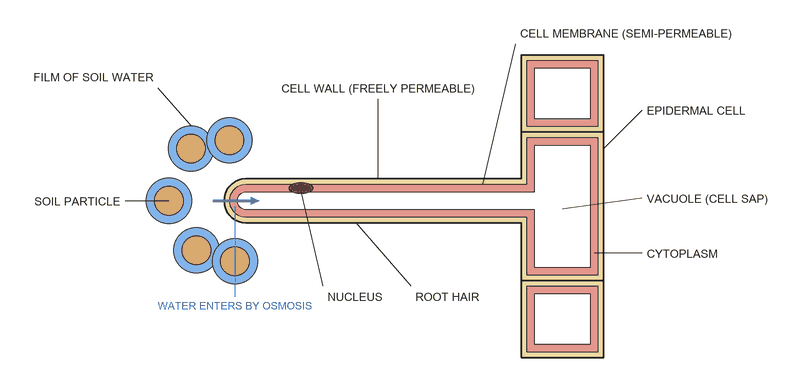
The cell wall lets water and dissolved substances pass freely. It is the cell membrane, just inside the wall, that is differentially permeable.
Corrected: The cell wall of the root cell is a freely permeable membrane.
Watch out: Change only the last word; changing the subject (for example 'cell wall' to 'cell membrane') is not what the question allows.
Therefore, (a) F – plasmolysed, (b) F – plasmolysed, (c) T, (d) F – hypertonic, (e) F – freely permeable.
