Solution:
Concept: Decide each statement from the process behind it: root pressure (guttation, bleeding), imbibition, conduction through xylem and phloem, and osmosis.
Step 1 — (a) Guttation and bleeding: False.
Guttation is the loss of water as drops from the margins of the leaves of an uninjured plant. Bleeding is the flow of sap from a cut or injured part of a plant. Both are due to root pressure, but they are two different things.

Step 2 — (b) Soaked seeds: True.
Dry seeds absorb water by imbibition and swell up. The imbibition pressure that builds up is strong enough to rupture the seed coat.

Step 3 — (c) Phloem removed: False.
Water rises to the leaves through the xylem, which is still intact, so the leaves keep getting water and stay turgid. Removing the phloem only stops the downward flow of food. The leaves would wilt only if the xylem were removed.
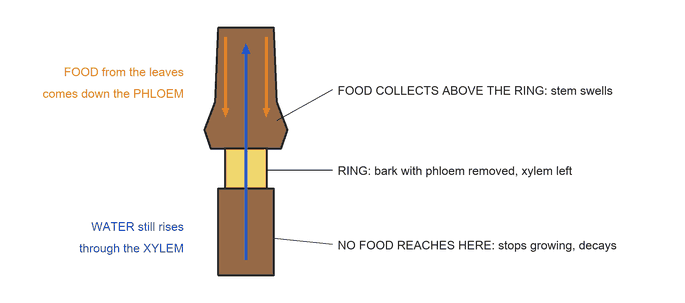
Step 4 — (d) Guttation at mid-day: False.
Guttation is greatest in the early morning or at night. Then the air is humid and transpiration is low, while the roots go on absorbing water, so root pressure forces the extra water out. At mid-day transpiration is high and guttation does not occur.
Step 5 — (e) Raisins in water: True.
The cell sap of raisins is far more concentrated than water. Water therefore enters the cells of the raisins by endosmosis, and they swell up.
Watch out: In (c), wilting is caused by a lack of water (xylem), not a lack of food (phloem).
Therefore, (a) False, (b) True, (c) False, (d) False, (e) True.
