Solution:
Concept: diffusion is the free movement of molecules from the region of their higher concentration to the region of their lower concentration. Osmosis is a special kind of diffusion: only water molecules move, and they move through a semi-permeable membrane.
Step 1 — (i) False.
Diffusion goes from the region of higher concentration of the molecules to the region of their lower concentration, not the other way round.
Step 2 — (ii) True.
Osmosis is itself diffusion (of water molecules through a semi-permeable membrane). But diffusion needs no membrane at all, so not every diffusion is osmosis.
Step 3 — (iii) True.
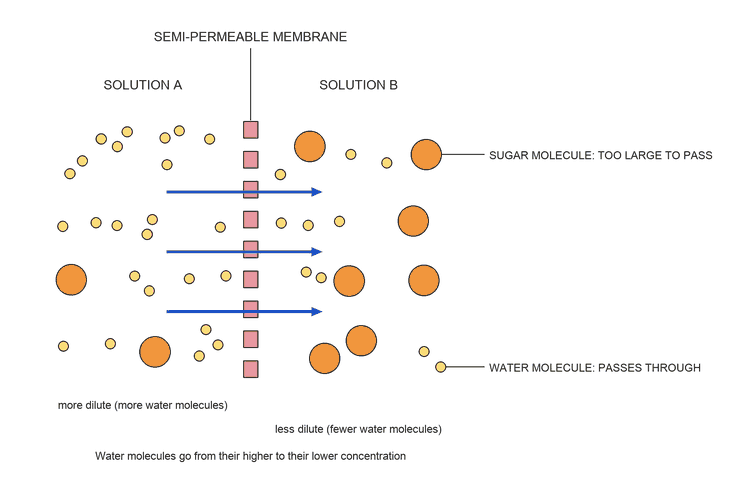
In osmosis only the water molecules cross the membrane, and their net movement is in one direction: from the dilute solution to the concentrated solution.
Step 4 — (iv) False.
Exosmosis is the outward movement of water, which makes a cell shrink. It is endosmosis, the inward movement of water, that may make a cell swell and burst.
Step 5 — (v) True.
A semi-permeable membrane lets the water (solvent) molecules through but prevents the passage of the solute molecules, such as sugar or salt.
Step 6 — (vi) False.
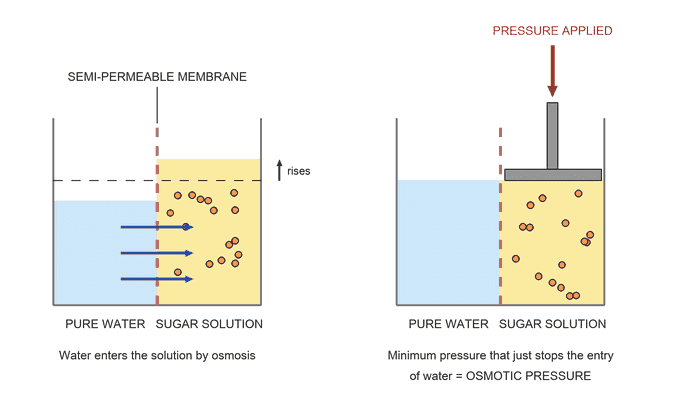
Pressure applied on the dilute solution (or pure water) pushes its water across the membrane, so more water passes into the concentrated solution. Less water passes only when the pressure is applied on the concentrated solution; the minimum pressure that just stops the entry of water is the osmotic pressure.
Watch out: In (iv) do not mix up the prefixes: exo- means out (cell shrinks), endo- means in (cell swells).
Therefore, (i) False, (ii) True, (iii) True, (iv) False, (v) True, (vi) False.
