
Question 41 markEasy
List three main characteristics of the roots that enable them to draw water from the soil.
Confirming your payment
Sign up now and get 250 free tokens.
Absorption by Roots – The Processes Involved · Question 4 of 50
List three main characteristics of the roots that enable them to draw water from the soil.
Solution:
Concept: A root draws water from the soil by osmosis. Osmosis works best through a large, thin surface with a stronger solution inside than outside, and the root hairs provide exactly this.
Step 1 — Huge surface area.
The numerous rootlets and root hairs give an enormous surface in contact with the soil water. Each rootlet bears hundreds of root hairs. For example, a four-month-old rye plant was found to have more than 14 billion root hairs, with a total length of over 10,000 km.
Step 2 — Cell sap of higher concentration.
The cell sap of a root hair is more concentrated than the surrounding soil water. So water molecules move from the soil water, where they are more concentrated, into the root hair.
Step 3 — Thin walls.
A root hair has a thin, freely permeable cell wall and, just inside it, a very thin, semi-permeable cell membrane. Water passes easily through both, while the larger molecules of the dissolved salts in the cell sap are held back.
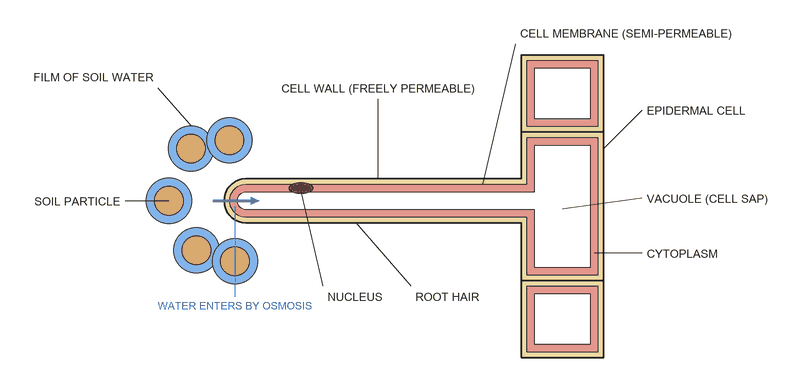
Watch out: It is the cell membrane, not the cell wall, that is semi-permeable; the wall lets almost everything through.
Therefore, the roots draw water because of their huge surface area, their more concentrated cell sap and their thin, permeable walls with a semi-permeable cell membrane.