
Question 191 markMCQEasy
When the cells of a plant are fully distended, the condition is called :
Confirming your payment
Sign up now and get 250 free tokens.
Absorption by Roots – The Processes Involved · Question 19 of 50
When the cells of a plant are fully distended, the condition is called :
(A) Flaccidity
(B) Shrinkage
(C) Plasmolysis
(D) Deplasmolysis
Answer: (D) Deplasmolysis
Concept: A cell fully distended with water is turgid; the exact name of the condition is turgidity. Turgidity is not among the options, so we choose the option that ends in a fully distended cell.
Step 1 — Recall deplasmolysis.
Deplasmolysis is the recovery of a plasmolysed cell: water re-enters the cell by endosmosis.
Step 2 — See where it ends.
The shrunken protoplasm swells and presses against the cell wall again, so the cell becomes fully distended (turgid) once more. Of the four options, only deplasmolysis gives this state.
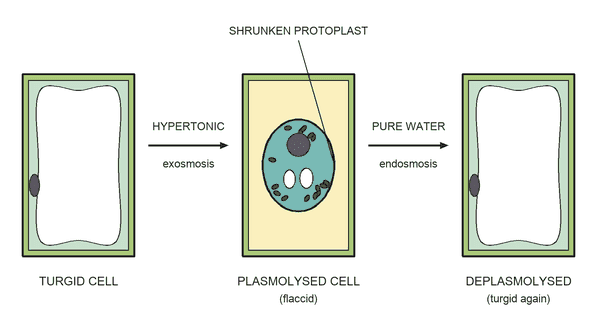
Watch out: The best one-word answer is turgidity; deplasmolysis is the process that restores it, and it is the printed key.
Why the other options are wrong:
Therefore, of the options given, the fully distended condition is reached by deplasmolysis, option (D).