Solution:
Concept: Each description points to one term of the water relations of a plant. Find the process or structure first, then give its exact name.
Step 1 — (a) A cell in a hypotonic solution.
A hypotonic solution is more dilute than the cell sap, so water enters the cell by endosmosis until it is fully distended. The condition is turgidity (the cell is turgid).
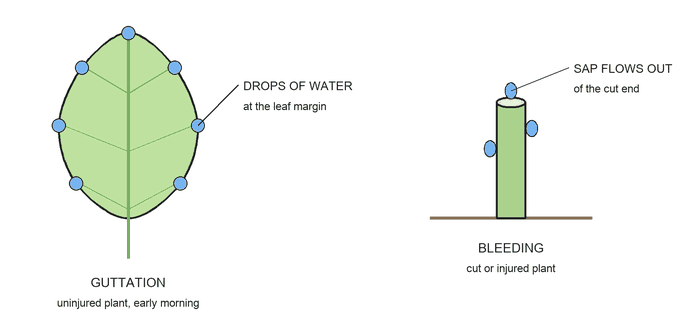
Step 2 — (b) Drops of water from leaf margins of an intact plant.
In the early morning root pressure forces water out as drops along the margins of the leaves of an uninjured plant. This is guttation.
Step 3 — (c) Entry of water into root hairs.
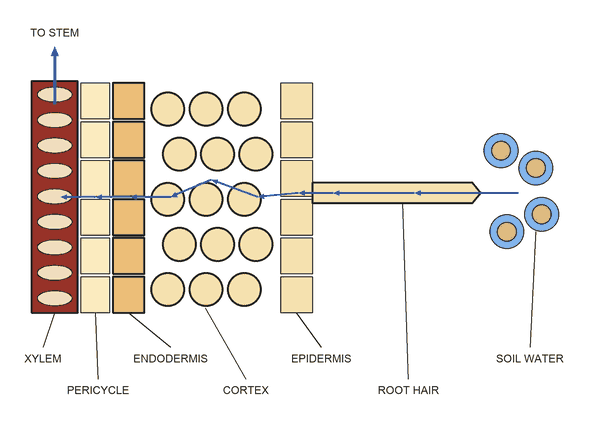
The cell sap of a root hair is more concentrated than the soil water, so water passes in through its semi-permeable cell membrane by osmosis (endosmosis).
Step 4 — (d) Tissue for upward conduction of water.
The vessels of the xylem carry water and dissolved minerals up from the roots to the leaves.
Step 5 — (e) Inward movement of solvent through the plasma membrane.
Water entering a cell through its semi-permeable membrane from a less concentrated solution is endosmosis; the outward movement is exosmosis.
Step 6 — (f) Molecules spreading evenly through a space.
Molecules move freely from their higher to their lower concentration until they are evenly spread. This is diffusion.
Step 7 — (g) Pressure moving water across the cortex.
Continued cell-to-cell osmosis across the cortical cells builds up root pressure, which drives the water on into the xylem.
Watch out: In (a) the answer is a condition (turgidity), not a process such as endosmosis.
Therefore, (a) turgidity, (b) guttation, (c) osmosis, (d) xylem, (e) endosmosis, (f) diffusion, (g) root pressure.
