Solution:
Concept: Each case depends on which way water moves by osmosis, or on the balance between the water a plant absorbs and the water it loses.
Step 1 — (a) Salt kills the grass at that spot.
Cause: the salt dissolves in the soil water and makes it hypertonic to the cell sap of the root hairs.
Effect: water moves out of the root cells by exosmosis. The cells are plasmolysed, the roots cannot absorb water, and the grass there dries up and dies.

Step 2 — (b) An uprooted plant soon wilts.
Cause: on uprooting, the root hairs are torn off and the roots are out of the soil, so they cannot absorb water, while the leaves go on losing water by transpiration.
Effect: the leaf cells lose their turgidity and the leaves wilt.
Step 3 — (c) Seedlings are transplanted in the evening.
Cause: transplanting damages some roots, so for a while the seedling absorbs little water. In the evening and at night it is cool and transpiration is low.
Effect: the seedling loses very little water and has the whole night to settle its roots and recover. Planted in the morning, it would face a hot day of rapid transpiration and would wilt.
Step 4 — (d) A cell in hypertonic salt solution is plasmolysed.
Cause: the salt solution outside is more concentrated than the cell sap, so water leaves the cell by exosmosis.
Effect: the protoplasm shrinks away from the cell wall, which is plasmolysis.
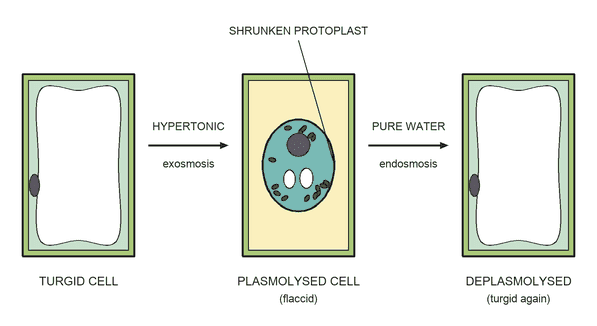
Step 5 — (e) Potato cubes in water become firm and larger.
Cause: the cell sap of the potato cells is more concentrated than the water outside, so water enters the cells by endosmosis.
Effect: the cells become turgid, so the cubes turn firm and increase in size.
Watch out: In (a) the grass is not 'burnt' by salt; it dies because it loses water by exosmosis.
Therefore, (a) exosmosis plasmolyses the root cells, (b) water lost by transpiration is not replaced, (c) low evening transpiration lets the seedling recover, (d) exosmosis shrinks the protoplasm, (e) endosmosis makes the potato cells turgid.
