
Question 231 markMCQEasy
Addition of salt to pickles is a method of killing the bacteria by :
Confirming your payment
Sign up now and get 250 free tokens.
Absorption by Roots – The Processes Involved · Question 23 of 50
Addition of salt to pickles is a method of killing the bacteria by :
(A) Imbibition
(B) Diffusion
(C) Deplasmolysis
(D) Plasmolysis
Answer: (D) Plasmolysis
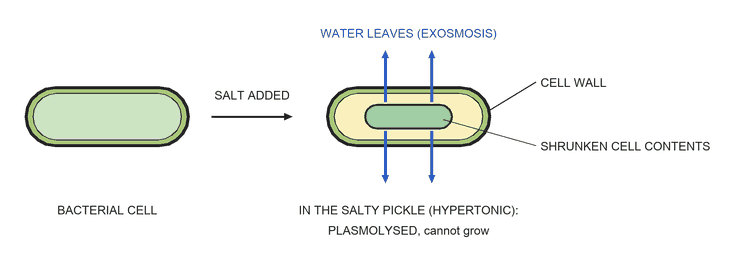
Concept: Plenty of salt makes the pickle a hypertonic solution, far more concentrated than the contents of a bacterial cell. Water then leaves the bacteria.
Step 1 — Water leaves the bacteria.
Water moves out of the bacterial cells into the salty surroundings by exosmosis.
Step 2 — The bacteria are plasmolysed.
The cell contents shrink away from the cell wall. The bacteria are plasmolysed, so they cannot grow and are killed. That is why salted pickles keep for a long time.
Why the other options are wrong:
Therefore, salt kills the bacteria in pickles by plasmolysis, option (D).