Solution:
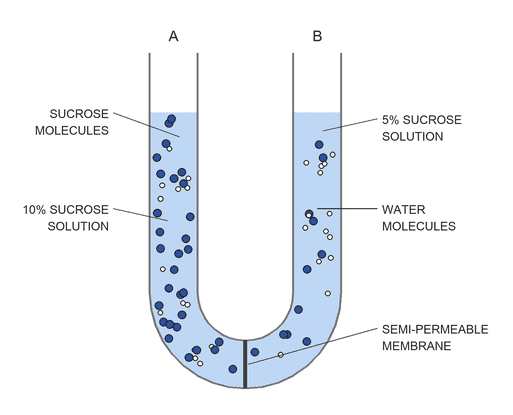
Concept: Arm A (10% sucrose) is more concentrated than arm B (5% sucrose). Only the water molecules can cross the membrane, and they move towards the stronger solution.
Step 1 — (a) Name the phenomenon.
Water moving through a semi-permeable membrane between two solutions is osmosis.
Step 2 — (b) Explain it.
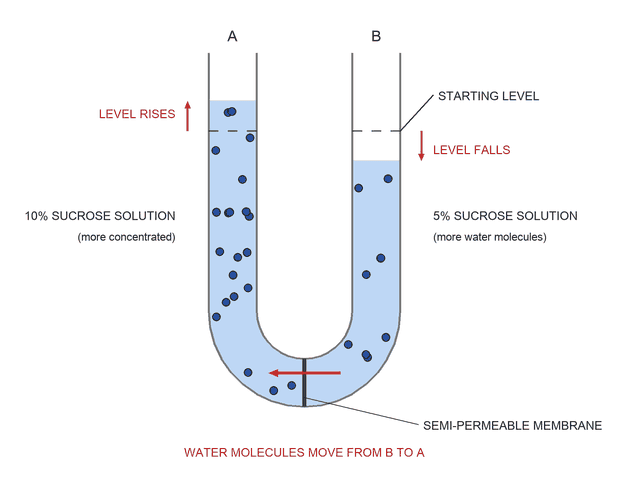
The 5% solution in arm B has more water molecules in a given volume than the 10% solution in arm A. So water molecules move from B to A through the semi-permeable membrane, from their higher to their lower concentration. The larger sucrose molecules cannot pass through the membrane.
Step 3 — (c) Semi-permeable membrane.
A semi-permeable membrane lets the solvent (water) molecules pass through freely but prevents the passage of the solute (sugar or salt) molecules.
Step 4 — (d) The observation and its reason.
Water keeps moving from B into A, so the level rises in arm A and falls in arm B. The reason is osmosis from the less concentrated solution (B) into the more concentrated solution (A).
Watch out: Water moves towards the more concentrated solution, not away from it.
Therefore, (a) osmosis; (d) after half an hour the level rises in arm A and falls in arm B, because water passes by osmosis from the 5% to the 10% sucrose solution.