
Question 122 marksEasy
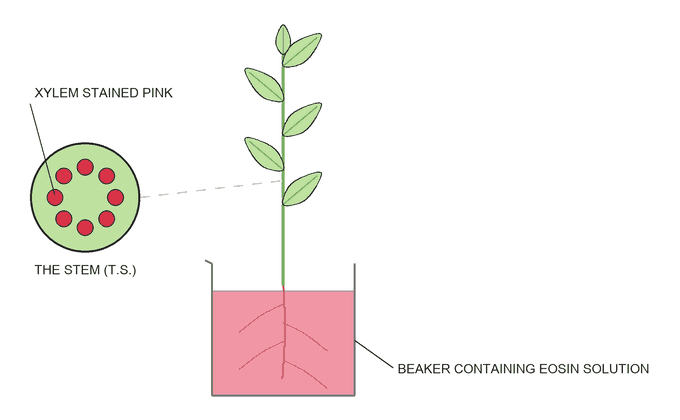
Look at the experiment shown in Fig. 4.16. Why was it necessary to take coloured eosin solution in water in the beaker?
Confirming your payment
Sign up now and get 250 free tokens.
Absorption by Roots – The Processes Involved · Question 12 of 50
Look at the experiment shown in Fig. 4.16. Why was it necessary to take coloured eosin solution in water in the beaker?
Solution:
Concept: Water itself leaves no mark on the tissues it passes through. A coloured solution leaves a stain, so it shows the path the water takes.
Step 1 — Say what eosin does.
Eosin is a red dye. As the coloured water rises in the plant, it stains the tissue through which it travels.
Step 2 — Say what is seen.
When thin sections of the root, stem and leaf are cut and examined, only the xylem is found stained pink.
Step 3 — Draw the conclusion.
So the water absorbed by the roots is conducted upwards through the xylem.

Therefore, coloured eosin was used so that the tissue carrying the water is stained and can be seen; it shows that water rises through the xylem.