
Opening your dashboard
Class 11 Physics Chapter 14: Fluid Pressure and Viscosity Solutions
78 textbook questions with step-by-step answers, free to read, for ISC 2026-27.
Get talked through Ch 14, not just shown the answer
Reading a finished solution is not the same as being able to do it. The AI tutor takes one question at a time and works it with you, in your own words, until you can.
- Ask it out loud, in your own words
- It gives you the next step, not the answer
- Stuck on part (ii)? Start there
78 questions with solutions
1–5 marks · Mixed difficulty
The first 46 solutions are on this page. This chapter is a long one, so the rest open on their own page to keep this one quick to load.
- 11 mark
Question 1
A piece of ice having a stone frozen in it floats in a glass vessel filled with water. How will the level of water in the vessel change when the ice melts?
Solve with AIAnswer
(A) the level will rise
(B) the level will not change
- Correct
(C) the level will drop
(D) some water will flow out
(E) the vessel will break
Answer: (C) The level will drop
Concept: A floating body displaces water whose mass equals its own mass, but a body that sinks displaces only its own volume of water.
Step 1 — Find the water displaced while the block floats. Let be the mass of the ice, the mass of the stone, the density of water and the density of the stone. The floating block displaces water of mass , a volume
Step 2 — Find the volume after melting. The ice becomes water of volume . The stone sinks and displaces only its own volume . The total is
Step 3 — Compare the two volumes. Stone is denser than water, so and therefore . The water now fills less room, so the level falls.
- (A) The level would rise only if the melted ice and the stone took up more room than the floating block displaced; they take up less.
- (B) The level stays the same for a block of pure ice; here the stone, which sinks once the ice has melted, makes the level fall.
- (D) The level falls, so no water flows out even if the vessel was filled to the brim.
- (E) The melted ice takes up less room than before, so nothing pushes harder on the vessel and it does not break.
Therefore, the level of water in the vessel will drop, option (C).
- 21 mark
Question 2
A body of volume 100 cc. is immersed completely in water contained in a jar. The weight of water and jar before immersion of the body was 700 g. After immersion, the weight of water and jar will be
Solve with AIAnswer
(A) 500 g
(B) 700 g
(C) 100 g
- Correct
(D) 800 g
Answer: (D) 800 g
Concept: By Archimedes' principle, the water pushes up on an immersed body with a force (upthrust) equal to the weight of the water displaced. By Newton's third law, the body pushes down on the water with an equal and opposite force.
Step 1 — Find the upthrust. The body displaces of water. Water has a density of , so the displaced water has a mass of and the upthrust is a weight of .
Step 2 — Find the new reading. The reaction to this upthrust presses down on the water, and through it on the jar. So the weight of water and jar shown by a balance increases by :
Note: this takes the body to be held from outside (for example by a thread) so that it does not rest on the jar; if it rested on the bottom, the reading would rise by the whole weight of the body.
- (A) The reading cannot fall: the body pushes the water down with a force equal to the upthrust, so the reading rises; 500 g would mean a loss of 200 g.
- (B) This leaves out the downward push of the body on the water, which is the reaction to the upthrust.
- (C) This is only the increase, equal to the upthrust, not the total reading.
Therefore, the weight of water and jar after immersion will be 800 g, option (D).
- 31 mark
Question 3
With increase in temperature, the viscosity of
Solve with AIAnswer
(A) gas decreases and liquid increases
- Correct
(B) gas increases and liquid decreases
(C) both gas and liquid increases
(D) both gas and liquid decreases
Answer: (B) Gas increases and liquid decreases
Concept: In a liquid, viscosity comes mainly from the attraction between molecules of neighbouring layers. In a gas, it comes from molecules moving across from one layer to another and carrying momentum with them.
Step 1 — Find the effect on a liquid. Heating a liquid makes its molecules move faster and weakens the effect of the forces between layers, so the viscosity of a liquid decreases.
Step 2 — Find the effect on a gas. Heating a gas makes its molecules move faster, so more momentum is carried between layers each second. The viscosity of a gas therefore increases with temperature.
- (A) This has both effects the wrong way round.
- (C) The viscosity of a gas does increase, but that of a liquid decreases.
- (D) The viscosity of a liquid does decrease, but that of a gas increases.
Therefore, with a rise in temperature the viscosity of a gas increases and that of a liquid decreases, option (B).
- 41 mark
Question 4
The viscous drag on a spherical body moving with a speed is proportional to
Solve with AIAnswer
(A)
- Correct
(B)
(C)
(D)
Answer: (B)
Concept: Stokes' law gives the viscous drag on a small sphere of radius moving slowly with speed through a fluid of viscosity :
Step 1 — Read off the dependence on speed. For a given sphere and fluid, is a constant, so the drag is directly proportional to .
- (A) No law of viscous drag makes it grow as ; doubling the speed doubles the viscous drag.
- (C) This would make the drag smaller at higher speed, but the viscous drag grows with speed.
- (D) A drag proportional to describes fast (turbulent) motion, not the viscous drag of Stokes' law.
Therefore, the viscous drag is proportional to , option (B).
- 51 mark
Question 5
Under a constant pressure head, the rate of flow of orderly volume flow of liquid through a capillary tube is . If the length of the capillary is doubled and the diameter of the bore is halved, the rate of flow would become
Solve with AIAnswer
(A)
(B)
(C)
- Correct
(D)
Answer: (D)
Concept: Poiseuille's formula gives the volume of liquid flowing per second through a capillary tube of radius and length under a pressure difference :
Step 1 — Find the effect of the radius. Halving the diameter halves the radius, and the rate depends on , so this alone multiplies the rate by
Step 2 — Find the effect of the length. The rate is inversely proportional to , so doubling the length multiplies it by .
Step 3 — Combine the two changes. The pressure head and the liquid stay the same, so
- (A) This takes the rate as proportional to and leaves out the doubled length: .
- (B) This multiplies by instead of dividing by it, and also leaves out the doubled length; a narrower bore lets less liquid through, not more.
- (C) This takes the rate as proportional to (the area of the bore) instead of : .
Therefore, the rate of flow would become , option (D).
- 61 mark
Question 6
The terminal velocity of a small steel ball of radius falling under gravity through a column of a viscous liquid of coefficient of viscosity depends on mass of the ball , acceleration due to gravity , coefficient of viscosity and radius . Which of the following relations is dimensionally correct?
Solve with AIAnswer
(A)
(B)
- Correct
(C)
(D)
Answer: (C)
Concept: A relation can be correct only if both sides have the same dimensions. Here , , and .
Step 1 — Find the dimensions of the product . Multiplying the dimensions of and :
Step 2 — Check option (C). Dividing the dimensions of by those of :
This is the dimension of velocity, so (C) is dimensionally correct. It also agrees with Stokes' law: when the drag balances the weight (upthrust neglected), .
- (A) has dimensions , a volume per second, not a velocity.
- (B) has dimensions .
- (D) has dimensions .
Therefore, the dimensionally correct relation is , option (C).
- 71 mark
Question 7
Bernoulli's principle is based on the law of conservation of
Solve with AIAnswer
(A) mass
(B) momentum
- Correct
(C) energy
(D) none of the above
Answer: (C) Energy
Concept: Bernoulli's theorem states that for the streamline flow of an ideal liquid, the total energy per unit volume, (pressure energy + kinetic energy + potential energy), is the same at every point of a streamline.
Step 1 — See how it is obtained. The theorem is derived by equating the work done by the pressure forces on a portion of liquid to the gain in its kinetic and potential energy. That is the work–energy principle.
Step 2 — Name the law. So Bernoulli's principle is a statement of the conservation of energy for a flowing liquid.
- (A) Conservation of mass gives the equation of continuity ( = constant), not Bernoulli's theorem.
- (B) Bernoulli's theorem adds up the pressure energy, kinetic energy and potential energy per unit volume, which are scalar energy terms; it is not a statement that the total momentum of the liquid stays constant.
- (D) This is wrong because option (C) names the law the theorem rests on.
Therefore, Bernoulli's principle is based on the law of conservation of energy, option (C).
- 81 mark
Question 8
The terminal velocity of small sized spherical body of radius falling vertically in a viscous liquid is given by a following proportionality
Solve with AIAnswer
(A)
(B)
(C)
- Correct
(D)
Answer: (D)
Concept: For a sphere of radius and density falling through a liquid of density and viscosity , the terminal velocity is
Step 1 — Read off the dependence on radius. For a given material and liquid, is constant, so . (The weight minus upthrust grows as , the drag per unit speed only as , so their ratio grows as .)
- (A) This would make bigger spheres fall more slowly, but bigger spheres fall faster.
- (B) The weight grows as and the drag per unit speed as , so grows as , not as .
- (C) This forgets that the weight grows as while the drag per unit speed grows only as ; their ratio grows as , not as .
Therefore, the terminal velocity is proportional to , option (D).
- 91 mark
Question 9
When a large bubble rises from the bottom of a lake to the surface, its radius doubles. The atmospheric pressure is equal to that of a column of water of height . The depth of the lake is
Solve with AIAnswer
(A)
(B)
- Correct
(C)
(D)
Answer: (C)
Concept: At constant temperature, the pressure and volume of a fixed mass of gas obey Boyle's law, . The pressure at depth in the lake is the atmospheric pressure plus that of a water column , that is, in units of a water column.
Step 1 — Write the pressures and volumes. Let the depth of the lake be and the radius of the bubble at the bottom be . At the bottom the pressure is and the volume is . At the surface the pressure is and the radius is , so the volume is .
Step 2 — Apply Boyle's law. We equate the products of pressure and volume:
Step 3 — Solve for x. The common factor cancels:
- (A) With the pressure at the bottom is , so the volume would only double and the radius would grow by , not 2.
- (B) With the pressure at the bottom is , so the radius would grow only by .
- (D) is the total pressure at the bottom (in metres of water), which includes the atmosphere's ; the depth is .
Therefore, the depth of the lake is , option (C).
- 101 mark
Question 10
Motion of a liquid in a tube is described by
Solve with AIAnswer
(A) Bernoulli's theorem
- Correct
(B) Poiseuille's equation
(C) Stokes' law
(D) Archimedes' principle
Answer: (B) Poiseuille's equation
Concept: Poiseuille's equation, , gives the volume of a viscous liquid flowing per second in steady (streamline) flow through a tube of radius and length under a pressure difference .
Step 1 — Match the situation. A real liquid moving steadily through a tube is held back by viscous forces between its layers. Poiseuille's equation describes exactly this flow: how the rate depends on the pressure difference, the radius and length of the tube and the viscosity.
Step 2 — Choose the option. So the motion of a liquid in a tube is described by Poiseuille's equation.
Note: Bernoulli's theorem also applies to the flow of an ideal (non-viscous) liquid through a tube; the key takes "motion of a liquid in a tube" to mean the steady viscous flow of a real liquid, which Poiseuille's equation describes.
- (A) Bernoulli's theorem relates pressure, speed and height for an ideal liquid; it leaves out the viscous forces that control the steady flow of a real liquid through a narrow tube.
- (C) Stokes' law gives the drag on a sphere moving through a fluid, not the flow of a liquid through a tube.
- (D) Archimedes' principle gives the upthrust on a body immersed in a fluid at rest.
Therefore, the motion of a liquid in a tube is described by Poiseuille's equation, option (B).
- 111 mark
Question 11
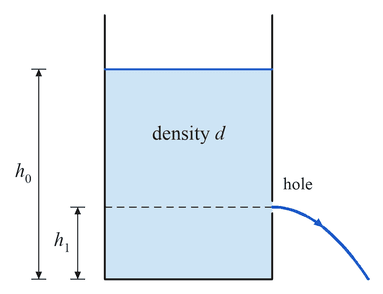
A cylinder is filled with non-viscous liquid of density to a height and a hole is made at a height from the bottom of the cylinder. The velocity of liquid issuing out of the hole is
 Solve with AI
Answer
(A)
- Correct
(B)
(C)
(D)
Answer: (B)
Concept: By Torricelli's theorem (from Bernoulli's theorem), liquid flows out of a small hole at depth below the free surface with the speed a body gains in falling freely through : .
Step 1 — Find the depth of the hole. The liquid stands at height and the hole is at height above the bottom, so the depth of the hole below the free surface is .
Step 2 — Apply Bernoulli's theorem between the surface and the hole. Both points are open to the atmosphere, so the pressure terms cancel, and the surface of a wide cylinder falls very slowly (speed about zero):
The density cancels, so the speed does not depend on the liquid.
- (A) This uses the full height of the liquid instead of the depth of the hole; it would apply only to a hole at the bottom ().
- (C) has the units of the square root of a pressure, not of a speed, and it uses the height of the hole above the bottom instead of its depth.
- (D) also has the units of the square root of a pressure; the speed of efflux does not depend on the density.
Therefore, the liquid issues out of the hole with velocity , option (B).
- 121 mark
Question 12
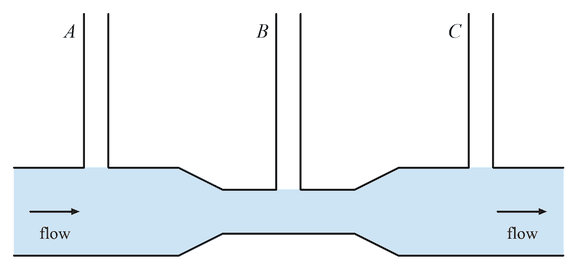
The given figure shows the flow of liquid through a horizontal pipe. Three tubes , and are connected to the pipe. The radii of the tube, , and at the junction are respectively 2 cm, 1 cm and 2 cm.
It can be said that the
Solve with AIAnswer
(A) height of the liquid in the tube is maximum
(B) height of the liquid in the tubes and is the same
(C) height of the liquid in all the three tubes is the same
- Correct
(D) height of the liquid in the tubes and is the same
Answer: (D) Height of the liquid in the tubes A and C is the same
Concept: For steady flow of an ideal liquid in a horizontal pipe, the equation of continuity gives = constant, and Bernoulli's theorem gives = constant. The height of liquid in a vertical tube joined to the pipe measures the pressure there.
Step 1 — Compare the speeds. The pipe is circular, so its cross-section is . The radii at A, B and C are 2 cm, 1 cm and 2 cm, so by continuity
So the liquid moves four times as fast at B as at A. The radii at A and C are equal, so .
Step 2 — Compare the pressures. Since is the same everywhere, equal speeds at A and C mean equal pressures there, and the much larger speed at B means a lower pressure at B.
Step 3 — Compare the heights. The liquid rises highest where the pressure is greatest. So the heights in A and C are equal, and the height in B is less, as the figure shows.
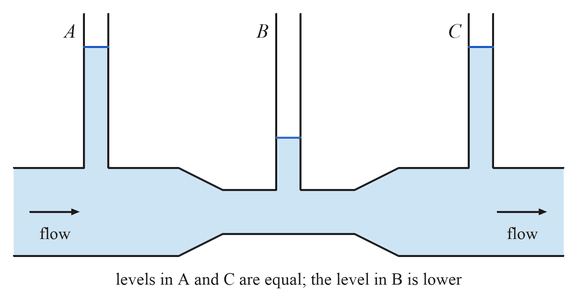
Note: this treats the liquid as non-viscous, as Bernoulli's theorem does; in a real liquid viscosity makes the pressure fall slowly along the pipe, so C would stand a little lower than A.
- (A) A is not higher than C: the two have equal pressures, so A only shares the greatest height with C.
- (B) The pressure at B is lower than at A because the liquid moves four times as fast there, so B stands lower.
- (C) The heights cannot all be equal, because the speed, and so the pressure, at B differs from that at A and C.
Therefore, the height of the liquid in the tubes A and C is the same, option (D).
- 131 mark
Question 13
A body floats in a liquid contained in a beaker. The whole system is shown in the given figure, falling under gravity. The upthrust on the body due to liquid is
 Solve with AI
Answer
- Correct
(A) zero
(B) equal to weight of liquid displaced
(C) equal to weight of the body in air
(D) equal to the weight of the immersed body
Answer: (A) Zero
Concept: Upthrust arises because the pressure in a liquid increases with depth, . The extra pressure on the lower surface of a body pushes it up.
Step 1 — Find the pressure in a freely falling liquid. When the beaker and its contents fall freely, every part of the liquid has the same acceleration , so no part of it needs to support the liquid above it. The effective value of in the falling system is zero, and the pressure is the same at every depth.
Step 2 — Find the upthrust. With no change of pressure with depth, the liquid pushes equally on the top and bottom of the body, so the net upward force is zero.
- (B) Archimedes' principle holds for a liquid at rest; in free fall the pressure does not change with depth, so there is no upthrust even though the displaced liquid still has weight.
- (C) The upthrust is zero, while the weight of the body is not zero.
- (D) The upthrust is zero, while the weight of the immersed body is not zero.
Therefore, the upthrust on the body due to the liquid is zero, option (A).
- 141 mark
Question 14
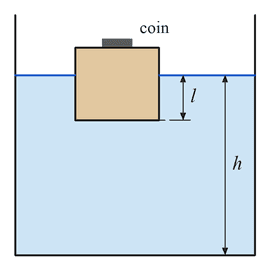
A wooden block, with a coin placed on its top, floats in water as shown in the given figure. The distance and are shown there. After some time, the coin falls into the water. Then
 Solve with AI
Answer
(A) decreases and increases
(B) increases and decreases
(C) both and increase
- Correct
(D) both and decrease
Answer: (D) Both l and h decrease
Concept: A floating body displaces water whose mass equals its own mass; a body that sinks displaces only its own volume.
Step 1 — Find what happens to l. Here is the depth of the block below the water surface. When the coin falls off, the block is lighter and needs to displace less water, so it rises and decreases.
Step 2 — Find the water displaced because of the coin. Let the coin have mass and density , and let water have density . While it rests on the floating block, the block displaces an extra volume to carry it. After it sinks, the coin displaces only its own volume .
Step 3 — Find what happens to h. A coin is much denser than water, so . The total volume of water displaced decreases, so the water level, and with it the depth , decreases.
- (A) The level falls, because the sunken coin displaces less water than it did while it was carried by the block.
- (B) The block becomes lighter when the coin falls off, so it rises and decreases.
- (C) Neither increases: the lighter block rises and the water level falls.
Therefore, both and decrease, option (D).
- 151 mark
Question 15
A large open tank has two holes in the wall. One is square hole of side at a depth from the top and the other is a circular hole of radius at a depth from the top. When the tank is completely filled with water, the quantities of water flowing out per second from both holes are the same. Then is equal to
 Solve with AI
Answer
- Correct
(A)
(B)
(C)
(D)
Answer: (A)
Concept: By Torricelli's theorem, water leaves a hole at depth below the free surface with speed . The volume flowing out per second is area × speed (equation of continuity).
Step 1 — Find the two speeds. The square hole is at depth and the circular hole at depth :
Step 2 — Equate the rates of flow. The square hole has area and the circular hole , and the two rates are equal:
Step 3 — Solve for R. We cancel :
- (B) With , the area of the circular hole is , about 124 times , so it would pass about 248 times as much water per second.
- (C) With the circular hole's area is and its water is twice as fast, so it would pass times as much water per second.
- (D) This forgets the square root: with the circular hole would pass only times as much water per second.
Therefore, , option (A).
- 161 mark
Question 16
“In scooters, more viscous mobile oil is used in summer than in winter”. Why?
Solve with AIWritten solution
Solution:
Concept: The viscosity of a liquid decreases as its temperature rises.
Step 1 — See what heat does to the oil. In summer the engine and the air are hotter, so the engine oil becomes thinner (less viscous) than it is at room temperature.
Step 2 — Choose the oil. To keep a film of oil thick enough to separate the moving parts in the heat, an oil that is more viscous to begin with is used in summer. In winter a thinner oil is used, so that it does not become too thick in the cold.
Therefore, a more viscous oil is used in summer because heat lowers the viscosity of the oil, and a thicker oil still lubricates properly at the higher temperature.
- 171 mark
Question 17
Why the size of the needle of a syringe controls flow rate better than the thumb pressure exerted by a doctor while administering an injection?
Solve with AIWritten solution
Solution:
Concept: Poiseuille's formula gives the volume of liquid flowing per second through a narrow tube of radius and length under a pressure difference :
Step 1 — Compare the two dependences. The rate of flow is proportional to but only to the first power of . Halving the radius of the needle reduces the flow 16 times, while halving the thumb pressure reduces it only 2 times.
Step 2 — Draw the conclusion. So a small change in the bore of the needle changes the flow far more than the doctor can change it by pressing harder or more gently.
Note: the book's hint explains this through the high pressure at the small tip of the needle; the deciding factor is the fourth-power dependence of the flow on the radius in Poiseuille's formula.
Therefore, the size of the needle controls the flow rate better, because the rate depends on the fourth power of the radius of the needle but only on the first power of the pressure.
- 181 mark
Question 18
Water flows faster than honey. Why?
Solve with AIWritten solution
Solution:
Concept: The rate at which a liquid flows is inversely proportional to its coefficient of viscosity (for example, in Poiseuille's formula ).
Step 1 — Compare the viscosities. Honey has a very large coefficient of viscosity, thousands of times that of water.
Step 2 — Apply the formula. Under the same conditions, a larger gives a smaller rate of flow, so honey flows much more slowly than water.
Therefore, water flows faster than honey because its coefficient of viscosity is much smaller.
- 191 mark
Question 19
What is an ideal liquid?
Solve with AIWritten solution
Solution:
Concept: Real liquids are slightly compressible and have viscosity; an ideal liquid is a simplified model that has neither property.
Step 1 — State the two conditions. An ideal liquid is incompressible (its density does not change with pressure) and non-viscous (it has no internal friction between its layers).
Step 2 — Say what this means. Being non-viscous, it cannot withstand any shearing stress, so its layers slide over one another freely.
Therefore, an ideal liquid is an incompressible, non-viscous liquid that cannot withstand any shearing stress.
- 201 mark
Question 20
“Cars and aeroplanes are streamlined”. Why?
Solve with AIWritten solution
Solution:
Concept: A body moving through air experiences a drag force. Part of it is viscous drag at the surface, and at high speeds most of it comes from the eddies (turbulence) formed behind a blunt body.
Step 1 — See what a streamlined shape does. A smooth, tapered (streamlined) shape lets the air flow round the body in smooth streamlines and close up behind it with few eddies.
Step 2 — State the benefit. This greatly reduces the drag force, so less fuel is needed to move at a given speed and a higher speed can be reached.
Note: for cars the book's hint also mentions lift; in fact cars are shaped to keep lift small so that the tyres grip the road, and the purpose of streamlining is to reduce drag.
Therefore, cars and aeroplanes are streamlined to reduce the drag of the air on them, which saves fuel and allows higher speeds.
- 211 mark
Question 21
“By blowing air into a funnel through the narrow end, the filter paper inside the funnel cannot be removed”. Why?
Solve with AIWritten solution
Solution:
Concept: By Bernoulli's theorem, where air moves faster its pressure is lower.
Step 1 — Follow the blown air. Air blown in through the stem passes between the filter paper and the wall of the funnel and escapes through this narrow gap at high speed. So the pressure in the gap falls below atmospheric pressure.
Step 2 — Find the force on the paper. On its open (inner) side the paper has atmospheric pressure acting on it, which is now greater than the pressure in the gap. This pressure difference presses the paper against the funnel wall.
Therefore, the filter paper cannot be blown out because the fast-moving air between it and the funnel has a lower pressure, and the atmospheric pressure inside the cone holds it against the wall.
- 221 mark
Question 22
Why do the machine parts get jammed in winter?
Solve with AIWritten solution
Solution:
Concept: The coefficient of viscosity of a liquid increases as its temperature falls.
Step 1 — See what cold does to the lubricant. In winter the low temperature makes the lubricating oil between the machine parts much more viscous (thicker).
Step 2 — Find the effect. The thick oil offers a large viscous force against the relative motion of the parts, so they move with difficulty and seem jammed.
Note: the book's hint says that the viscosity decreases with the fall in temperature; it actually increases, which is why the parts get jammed.
Therefore, machine parts get jammed in winter because the viscosity of the lubricant increases at low temperature.
- 231 mark
Question 23
“The fire fighters attach brass jets at the end of water pipes”. Why?
Solve with AIWritten solution
Solution:
Concept: By the equation of continuity, is constant along a pipe, so the speed of water is large where the area of cross-section is small.
Step 1 — Look at the jet. The brass jet (nozzle) at the end of the hose has a much smaller opening than the pipe.
Step 2 — Apply continuity. Along the flow from the hose into the jet, is constant, so the water leaves the small opening much faster than it moves along the wide hose. The supply pressure, acting on the water held back behind the narrow opening, is turned into this high speed (Bernoulli's theorem), so the jet can reach far-off and high places.
Therefore, fire fighters attach narrow brass jets to make the water come out at high speed, because the speed of flow is large where the area is small ( = constant).
- 241 mark
Question 24
What is an incompressible fluid?
Solve with AIWritten solution
Solution:
Concept: Compressibility measures how much the volume (and so the density) of a fluid changes when the pressure on it changes.
Step 1 — State the definition. If the density of a fluid does not change when pressure is applied to it, the fluid is called incompressible.
Step 2 — Give an example. Liquids such as water are very nearly incompressible, so they are usually treated as incompressible.
Therefore, an incompressible fluid is one whose density does not change when pressure is applied to it.
- 251 mark
Question 25
In a freely falling system, what is the terminal velocity of spherical body?
Solve with AIWritten solution
Solution:
Concept: The terminal velocity of a sphere in a fluid is , so it is proportional to .
Step 1 — Find the effective g. In a freely falling system, the effective acceleration due to gravity inside it is zero, .
Step 2 — Find the terminal velocity. With there is no apparent weight and no upthrust to drive the sphere through the fluid, so the formula gives .
Therefore, in a freely falling system the terminal velocity of the spherical body is zero.
- 261 mark
Question 26
What is the coefficient of viscosity of an ideal fluid?
Solve with AIWritten solution
Solution:
Concept: The coefficient of viscosity measures the internal friction between the layers of a fluid.
Step 1 — Recall the meaning of ideal. An ideal fluid is defined to be non-viscous: its layers slide over one another with no internal friction at all.
Step 2 — State the value. So its coefficient of viscosity is zero.
Therefore, the coefficient of viscosity of an ideal fluid is zero.
- 271 mark
Question 27
Why hotter liquids flow faster than colder liquids?
Solve with AIWritten solution
Solution:
Concept: The coefficient of viscosity of a liquid decreases with rise in temperature, and the rate of flow is inversely proportional to the viscosity.
Step 1 — Compare the viscosities. A hotter liquid has weaker effective forces between its layers, so its viscosity is lower than when it is cold.
Step 2 — Find the effect on flow. With less viscous resistance, the hot liquid flows faster under the same conditions.
Therefore, hotter liquids flow faster because their coefficient of viscosity is smaller.
- 281 mark
Question 28
“Bigger rain drop fall faster than smaller raindrops”. Why?
Solve with AIWritten solution
Solution:
Concept: A drop falling through air speeds up until the air resistance (with the very small upthrust of the air) balances its weight; after that it falls at a constant speed called its terminal velocity. For a very small drop, Stokes' law gives the terminal velocity as , where is the radius of the drop, the density of water, the density of air and the coefficient of viscosity of air.
Step 1 — Compare the weight and the air resistance of a bigger drop. The weight of a drop grows as the cube of its radius, . The air resistance at a given speed grows more slowly with size (as for small drops by Stokes' law, and roughly as for large drops). So a bigger drop has to fall faster before the air resistance can balance its weight.
Step 2 — Use Stokes' law to compare two small drops. Since in Stokes' law, a small drop with twice the radius reaches four times the terminal velocity.
Step 3 — Draw the conclusion. So bigger raindrops reach a larger terminal velocity and fall faster than smaller ones.
Note: Stokes' law holds only for very small droplets, of radius below about 0.03 mm, as in clouds and mist. Real raindrops are larger; bigger ones still fall faster, but their terminal velocity grows more slowly than and levels off at about for the largest drops.
Therefore, bigger raindrops fall faster because their weight grows faster with size than the air resistance does, so they reach a larger terminal velocity (proportional to for small drops, by Stokes' law).
- 291 mark
Question 29
What is the significance of Reynold's number?
Solve with AIWritten solution
Solution:
Concept: The Reynolds number (named after Osborne Reynolds) of a liquid flowing through a tube of diameter is , where is the density, the speed and the coefficient of viscosity of the liquid.
Step 1 — State what it decides. Its value tells whether the flow will be streamline or turbulent.
Step 2 — Give the ranges. If is less than about 2000 the flow is streamline; if it is more than about 3000 the flow is turbulent; in between the flow is unsteady and may change from one type to the other.
Therefore, the Reynolds number indicates whether the flow of a liquid through a tube is streamline or turbulent.
- 301 mark
Question 30
“Fluids exert pressure on the walls of the containing vessel”. Why?
Solve with AIWritten solution
Solution:
Concept: A fluid cannot resist a shearing force, so at rest it can push on a surface only at right angles to it. By Pascal's law, the pressure at a point in a fluid acts equally in all directions.
Step 1 — See where the push comes from. A fluid is pressed by its own weight (and by anything above it), and its molecules keep striking the walls. Because the pressure at a point acts in all directions, it also acts sideways on the walls, not only downwards.
Step 2 — See why the walls feel it. The walls stop the fluid from flowing out, so the fluid pushes on every part of them with a force at right angles to the wall.
Therefore, fluids exert pressure on the walls of their container because the pressure at a point in a fluid acts equally in all directions, so it pushes outwards on the walls that hold it in.
- 311 mark
Question 31
Give the S.I. unit and dimensional formula of pressure.
Solve with AIWritten solution
Solution:
Concept: Pressure is the normal force acting per unit area, .
Step 1 — Find the S.I. unit. Force is measured in newtons and area in square metres, so pressure is measured in , which is called the pascal (Pa).
Step 2 — Find the dimensional formula. Dividing the dimensions of force by those of area:
Therefore, the S.I. unit of pressure is (pascal) and its dimensional formula is .
- 321 mark
Question 32
“Suitcases and big bags are provided with broad handles”. Why?
Solve with AIWritten solution
Solution:
Concept: Pressure is force divided by the area over which it acts, .
Step 1 — Apply it to the handle. The weight of the suitcase acts on the hand through the handle. A broad handle spreads this force over a larger area of the hand.
Step 2 — Find the effect. A larger area means a smaller pressure on the hand, so the suitcase is less painful and easier to carry.
Therefore, suitcases have broad handles so that their weight acts on a larger area of the hand and the pressure on the hand is small.
- 332 marks
Question 33
Distinguish between thrust and pressure.
Solve with AIWritten solution
Solution:
Concept: A fluid at rest pushes on any surface in contact with it with a force at right angles to the surface.
Step 1 — Define thrust. Thrust is the total force acting normally (at right angles) on a surface. Being a force, it is measured in newtons and depends on the size of the surface.
Step 2 — Define pressure. Pressure is the thrust acting per unit area of the surface:
It is measured in (pascal). At a point in a fluid it has the same value in all directions, so it is a scalar.
Step 3 — State the difference. The same thrust spread over a larger area gives a smaller pressure, and over a smaller area a larger pressure.
Therefore, thrust is the total normal force on a surface (in N), while pressure is the normal force per unit area (in ).
- 342 marks
Question 34
What is upthrust or buoyancy?
Solve with AIWritten solution
Solution:
Concept: The pressure in a fluid increases with depth, so the fluid pushes harder on the lower surface of an immersed body than on its upper surface.
Step 1 — Define upthrust. The resultant upward force exerted by a fluid on a body wholly or partly immersed in it is called upthrust, or the buoyant force.
Step 2 — Name the property and give its size. This tendency of a fluid to push an immersed body upwards is called buoyancy. By Archimedes' principle, the upthrust equals the weight of the fluid displaced by the body.
Therefore, upthrust (buoyancy) is the resultant upward force that a fluid exerts on a body immersed in it; it equals the weight of the fluid displaced.
- 352 marks
Question 35
State Archimedes' principle.
Solve with AIWritten solution
Solution:
Concept: A body immersed in a fluid experiences an upward force (upthrust) because the pressure on its lower surface is greater than that on its upper surface.
Step 1 — State the principle. When a body is wholly or partially immersed in a fluid, it experiences an upthrust equal to the weight of the fluid displaced by it.
Step 2 — Say what it means for weight. So the body appears to lose weight in the fluid, and this apparent loss of weight equals the weight of the fluid displaced.
Therefore, Archimedes' principle states that a body wholly or partially immersed in a fluid experiences an upthrust (an apparent loss of weight) equal to the weight of the fluid it displaces.
- 362 marks
Question 36
What is drag force? Distinguish between viscous drag and high-speed drag.
Solve with AIWritten solution
Solution:
Concept: A fluid resists the motion of a body through it; the resisting force always acts opposite to the velocity of the body relative to the fluid.
Step 1 — Define drag force. When there is relative motion between a body and a fluid, the force exerted by the fluid on the body that opposes this relative motion is called the drag force.
Step 2 — Describe viscous drag. At low speeds the fluid flows round the body in smooth streamlines. The drag then arises from the viscosity of the fluid (the layers next to the body are dragged along) and is proportional to the speed; for a sphere, Stokes' law gives .
Step 3 — Describe high-speed drag. At high speeds the flow behind the body becomes turbulent and eddies form there. The pressure behind the body becomes lower than in front, and this pressure difference gives a drag that depends on the density of the fluid and grows roughly as the square of the speed, .
Therefore, drag is the force a fluid exerts against the relative motion of a body; viscous drag at low speeds comes from viscosity and is proportional to , while high-speed drag comes from turbulence and eddies and grows roughly as .
- 372 marks
Question 37
What is viscosity?
Solve with AIWritten solution
Solution:
Concept: When a liquid flows, its layers move with different speeds, so each layer slides over its neighbours.
Step 1 — Describe the force. A faster layer is pulled back by the slower layer next to it, and the slower layer is pulled forward. This tangential force within the liquid opposes the relative motion of one layer over another and is called the viscous force.
Step 2 — Name the property. The property of a fluid by which it opposes the relative motion between its layers is called viscosity. It behaves like internal friction in the fluid.
Therefore, viscosity is the property of a fluid by which it opposes the relative motion between its different layers (internal friction of the fluid).
- 382 marks
Question 38
Define coefficient of viscosity.
Solve with AIWritten solution
Solution:
Concept: By Newton's formula, the viscous force between two layers of area is proportional to and to the velocity gradient :
Step 1 — Write the coefficient. Making the subject:
Step 2 — Put it in words. If and , then . So the coefficient of viscosity is the tangential force per unit area of a layer needed to maintain unit velocity gradient normal to the direction of flow. Its S.I. unit is (pascal second) and its C.G.S. unit is the poise.
Therefore, the coefficient of viscosity is the tangential viscous force per unit area required to maintain unit velocity gradient between the layers, .
- 392 marks
Question 39
State and explain Stokes' formula.
Solve with AIWritten solution
Solution:
Concept: A small sphere moving slowly through a viscous fluid drags the layers of fluid next to it, so the fluid exerts a viscous force on it opposite to its motion.
Step 1 — State the formula. Stokes showed that the viscous force on a small, smooth, rigid sphere of radius moving slowly with velocity through a fluid of coefficient of viscosity is
It holds when the motion is streamline (no eddies) and the fluid extends far on all sides.
Step 2 — Explain its use. When such a sphere (density ) falls through a fluid (density ) and reaches its terminal velocity , the viscous force plus the upthrust balances its weight:
So measuring the terminal velocity gives the coefficient of viscosity.
Therefore, Stokes' formula gives the viscous drag on a small sphere moving slowly through a fluid; it is proportional to the viscosity, the radius and the speed.
- 402 marks
Question 40
Define terminal velocity. A steel ball is dropped in viscous oil. Draw a simple labelled diagram to show the forces acting on the ball as it falls through the oil.
Solve with AIWritten solution
Solution:
Concept: A body falling through a viscous fluid is acted on by its weight (down), the upthrust of the fluid (up) and the viscous drag (opposite to its motion, so up). The drag grows as the speed grows.
Step 1 — Define terminal velocity. As the ball speeds up, the viscous drag increases until the upthrust and the drag together balance the weight. The net force is then zero, and the ball falls on with a constant velocity, called the terminal velocity.
Step 2 — Name the forces. The three forces on the ball are: its weight acting downwards, the upthrust of the oil acting upwards, and the viscous drag acting upwards (opposite to the velocity ). The figure shows them.

Step 3 — Write the condition at terminal velocity. At the terminal velocity the forces balance:
Therefore, terminal velocity is the constant velocity reached by a body falling through a viscous fluid when the upthrust and viscous drag together balance its weight; the forces on the ball are its weight downwards and the upthrust and viscous drag upwards.
- 412 marks
Question 41
State Poiseuille's formula.
Solve with AIWritten solution
Solution:
Concept: In streamline flow of a liquid through a narrow (capillary) tube, the rate of flow depends on the pressure difference across the tube, the size of the tube and the viscosity of the liquid.
Step 1 — State the formula. The volume of liquid flowing in time through a tube of radius and length , under a pressure difference between its ends, is
Here is the coefficient of viscosity of the liquid.
Step 2 — Note the conditions. It holds for steady, streamline flow of a liquid through a narrow horizontal tube.
Note: the book's hint prints in the denominator; it should be , with the length of the tube.
Therefore, Poiseuille's formula is : the rate of flow is proportional to the pressure difference and to the fourth power of the radius, and inversely proportional to the viscosity and the length.
- 422 marks
Question 42
Mention two applications of Pascal's law.
Solve with AIWritten solution
Solution:
Concept: Pascal's law states that pressure applied to an enclosed liquid is transmitted equally and undiminished to every part of the liquid and to the walls of its container.
Step 1 — First application. The hydraulic lift: a small force on a small piston creates a pressure that is passed on to a large piston, where it gives a much larger force that can lift a car.
Step 2 — Second application. Hydraulic brakes: the brake pedal pushes the piston of a master cylinder, and the pressure this creates in the brake fluid is transmitted undiminished to the wheel cylinders at all the wheels, where it pushes out pistons that press the brake shoes against the drums (or, in disc brakes, the pads against the discs).
Therefore, two applications of Pascal's law are (i) the hydraulic lift and (ii) hydraulic brakes.
- 432 marks
Question 43
Distinguish between streamline flow and turbulent flow.
Solve with AIWritten solution
Solution:
Concept: The way a liquid flows depends on its speed. Below a certain speed (the critical velocity) the flow is orderly; above it, it becomes disorderly.
Step 1 — Describe streamline flow. In streamline flow, every particle passing a given point moves along the same path and with the same velocity as the particles that passed that point before it. The paths (streamlines) are smooth and never cross. This happens when the speed is below the critical velocity.
Step 2 — Describe turbulent flow. In turbulent flow, the velocity of the particles at a point changes continuously and haphazardly, in both magnitude and direction. Small whirlpools (eddies) form, and a lot of energy is lost. This happens when the speed is above the critical velocity.
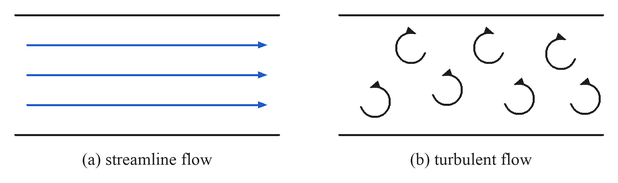
Therefore, in streamline flow the velocity at each point stays the same and the particles follow smooth paths, while in turbulent flow the velocity at each point changes irregularly and eddies form.
- 442 marks
Question 44
What is Reynold's number? Give its significance.
Solve with AIWritten solution
Solution:
Concept: Whether a flow stays streamline depends on how the inertia of the moving liquid compares with the viscous forces that keep it orderly.
Step 1 — Define the Reynolds number. For a liquid of density and coefficient of viscosity flowing with speed through a tube of diameter , the Reynolds number (named after Osborne Reynolds) is the pure number
It has no units, being the ratio of inertial to viscous forces.
Step 2 — Give its significance. Its value decides the type of flow. If is less than about 2000, the flow is streamline; if it is more than about 3000, the flow is turbulent; in between, the flow is unstable. The speed at which reaches this limit is the critical velocity.
Note: the book's hint calls the critical velocity; in , is the speed of the flow, and it equals the critical velocity only when has its critical value.
Therefore, the Reynolds number is a dimensionless number that tells whether the flow of a liquid through a tube is streamline (low ) or turbulent (high ).
- 452 marks
Question 45
Define critical velocity.
Solve with AIWritten solution
Solution:
Concept: A liquid flows in streamlines only up to a certain speed; beyond it, eddies form and the flow becomes turbulent.
Step 1 — State the definition. The critical velocity of a liquid is the velocity up to which its flow is streamline and above which the flow becomes turbulent.
Step 2 — Give its value. For flow through a tube of diameter , it is the speed at which the Reynolds number reaches its critical value (about 2000):
So it is larger for a more viscous liquid and smaller for a denser liquid or a wider tube.
Therefore, the critical velocity is the speed of a liquid up to which its flow remains streamline and above which it becomes turbulent.
- 462 marks
Question 46
Derive the equation of continuity.
Solve with AIWritten solution
Solution:
Concept: In steady flow of an incompressible liquid, liquid cannot pile up or disappear between two cross-sections, so the mass entering one cross-section per second equals the mass leaving the other.
Step 1 — Set up the tube of flow. The figure shows a liquid of density flowing steadily through a tube whose cross-section is at P and at Q, with speeds and there.

Step 2 — Find the mass entering at P. In a small time , the liquid at P moves a distance , so a volume enters the region between P and Q. Its mass is
Step 3 — Find the mass leaving at Q. In the same way, the mass leaving at Q in the time is
Step 4 — Equate the two. The flow is steady and the liquid is incompressible, so no liquid collects between P and Q, and :
Therefore, the equation of continuity is , that is, = constant: the speed of a liquid is greater where the tube is narrower.
- 472 marks
Question 47
What are the energies possessed by a liquid?
- 482 marks
Question 48
Show that the pressure energy per unit volume of a liquid is .
- 492 marks
Question 49
State Bernoulli's theorem.
- 502 marks
Question 50
Explain the working of a venturimeter.
- 512 marks
Question 51
Explain how an aeroplane gets ‘lift’.
- 522 marks
Question 52
What is Magnus effect?
- 532 marks
Question 53
Draw a labelled diagram of an atomiser.
- 542 marks
Question 54
Explain Torricelli's theorem.
- 552 marks
Question 55
Explain the working of a Pitot's tube.
- 562 marks
Question 56
What is the use of a filter pump? How does it work?
- 572 marks
Question 57
What is a Prandtl tube?
- 582 marks
Question 58
“Rain drops falling under gravity do not acquire very high velocity”. Why?
- 592 marks
Question 59
“In a closed room, dust generally settles down”. Why?
- 602 marks
Question 60
According to Bernoulli's theorem, the pressure of water should remain constant in a pipe of uniform radius. But in practice, it goes on decreasing. Why?
- 612 marks
Question 61
“Two streamlines cannot cross each other”. Why?
- 622 marks
Question 62
What is the effect of temperature on the viscosity of a liquid?
- 632 marks
Question 63
“When the water tap is closed with our fingers jets of water gush through the space between fingers with high speed”. Why?
- 642 marks
Question 64
Water is taken in one beaker and glycerine in another. Both are stirred well and kept on the table. Which will come to rest first?
- 652 marks
Question 65
Why does a flag flutter when there is wind?
- 662 marks
Question 66
“The upper surface of wings of an aeroplane are made convex upwards and lower concave downwards.” Why?
- 673 marks
Question 67
Derive an expression for pressure due to a fluid column. Explain the effect of gravity on fluid pressure.
- 683 marks
Question 68
What is buoyancy? State Archimedes' principle. Obtain an equation for the apparent loss of weight.
- 693 marks
Question 69
State Pascal's law. Mention the applications of Pascal's law. Explain the working of (i) hydraulic lift and (ii) hydraulic brake.
- 703 marks
Question 70
Explain Newton's formula for viscosity and hence define coefficient of viscosity. Give the S.I. unit and C.G.S unit of coefficient of viscosity.
- 713 marks
Question 71
Distinguish between streamline flow and turbulent flow. What is critical velocity and Reynold's number? What is the significance of Reynold's number?
- 723 marks
Question 72
Explain how an aeroplane gets dynamic uplift. Explain the working of an atomiser.
- 735 marks
Question 73
The viscous drag on a sphere of radius , moving through a fluid with velocity can be expressed as , where is the coefficient of viscosity of the fluid. A small sphere, of radius and density is released from the bottom of a column of liquid of density . If is larger than , describe the motion of the sphere. Deduce an expression for its terminal velocity.
- 745 marks
Question 74
(a) Explain Stokes' law.
(b) Define terminal velocity.
(c) Describe an experiment to determine the terminal velocity.
(d) How is the viscosity of a highly viscous liquid determined by measuring the terminal velocity?
- 755 marks
Question 75
(a) Define coefficient of viscosity and determine its dimensions. What is streamline flow?
(b) When a sphere of radius moves slowly with a speed through a fluid of viscosity , Stokes' law tells us that the force on the sphere due to viscous drag is given by the expression . In an experiment to compare the viscosities of two oils, smooth spheres are allowed to fall through long columns of the oils. State the necessary conditions and the measurements to be made to compare the viscosities.
- 765 marks
Question 76
Explain Poiseuille's formula for the volume of liquid flowing through a capillary tube. Describe an experiment to determine the coefficient of viscosity of a liquid by Poiseuille's formula.
- 775 marks
Question 77
State and prove Bernoulli's theorem.
- 785 marks
Question 78
Explain the working of a venturimeter. Obtain an expression for the volume of liquid flowing per second through pipe.
What Class 11 Physics Ch 14 covers
The sections of the chapter, in the order the book takes them. Every question above comes from one of these.
- 01Pressure in a Fluid
- 02Atmospheric Pressure and Manometers
- 03Pascal's Law and Its Applications
- 04Buoyancy and Archimedes' Principle
- 05Viscosity and Newton's Formula
- 06Stokes' Law and Terminal Velocity
More ways to study this chapter
The same chapter asked three other ways. Practise it, revise it, and see what the board has set on Ch 14 before.
Class 11 Physics Ch 14 questions students ask
How many questions are there in Class 11 Physics Ch 14?
78 questions. Every one is solved step by step on this page.
Are these Class 11 Physics solutions free?
Yes. Every question and its full working is free to read, with no account needed.
Can I download the Class 11 Physics Ch 14 solutions as a PDF?
There is no PDF to download. Every solution is on this page instead, which means it is searchable, always the current syllabus, and readable on a phone. Use your browser's print option if you want it on paper.