
Question 502 marksMedium
Explain the working of a venturimeter.
Confirming your payment
Sign up now and get 250 free tokens.
Fluid Pressure and Viscosity · Question 50 of 78
Explain the working of a venturimeter.
Solution:
Concept: A venturimeter measures the rate of flow of a liquid in a pipe. It uses the equation of continuity ( = constant) and Bernoulli's theorem ( = constant in a horizontal pipe).
Step 1 — Describe the instrument. It is a horizontal tube with a wide part of cross-section and a narrow throat of cross-section . Two vertical tubes are joined at the wide part and at the throat, as in the figure.
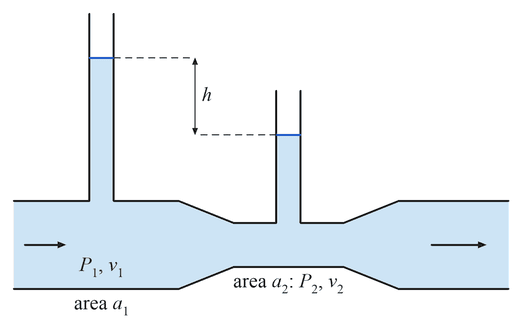
Step 2 — See why the levels differ. At the throat the liquid flows faster, so by Bernoulli's theorem its pressure is lower. The liquid in the throat tube therefore stands lower, by a height :
Step 3 — Use the equation of continuity. The same volume of liquid passes the wide part and the throat each second, so the speed at the throat is:
Step 4 — Use Bernoulli's theorem. The tube is horizontal, so the heights are equal and Bernoulli's theorem gives:
We put in and , then cancel and solve for :
Step 5 — Find the rate of flow. The volume flowing per second is :
Therefore, a venturimeter works because the liquid speeds up and its pressure falls at the narrow throat; measuring the difference in the two levels gives the rate of flow .