
Question 673 marksMedium
Derive an expression for pressure due to a fluid column. Explain the effect of gravity on fluid pressure.
Confirming your payment
Sign up now and get 250 free tokens.
Fluid Pressure and Viscosity · Question 67 of 78
Derive an expression for pressure due to a fluid column. Explain the effect of gravity on fluid pressure.
Solution:
Concept: A portion of fluid at rest is in equilibrium, so the upward and downward forces on it balance. The pressure on any surface acts at right angles to it.
Step 1 — Choose a column of the fluid. Consider a vertical cylindrical column of liquid of cross-section and height , with its top at the free surface of a liquid of density at rest, as in the figure. The atmospheric pressure on the surface is , and the pressure at the bottom of the column is .
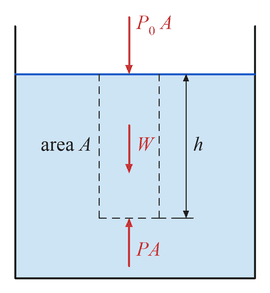
Step 2 — List the vertical forces. Three vertical forces act on the column. At the top, the atmosphere pushes down with a force . The weight of the column, of volume , acts downwards:
At the bottom, the liquid below pushes up with a force . (The sideways forces on the curved surface are horizontal and cancel.)
Step 3 — Apply the condition of equilibrium. The column is at rest, so the upward force equals the total downward force:
The pressure due to the liquid column alone (the gauge pressure) is .
Step 4 — Explain the effect of gravity. The term comes from the weight of the liquid above the point. Because of gravity, the pressure increases with depth, by for every metre in a liquid of density ; points at the same depth in the same liquid at rest have the same pressure, whatever the shape of the vessel. The greater the value of , the faster the pressure increases with depth. In a freely falling vessel (effective ) the liquid has no weight to support, so the pressure is the same at all depths.
Therefore, the pressure at a depth in a liquid of density is , and because of gravity the pressure increases in proportion to the depth (and to ).