
Question 662 marksEasy
“The upper surface of wings of an aeroplane are made convex upwards and lower concave downwards.” Why?
Confirming your payment
Sign up now and get 250 free tokens.
Fluid Pressure and Viscosity · Question 66 of 78
“The upper surface of wings of an aeroplane are made convex upwards and lower concave downwards.” Why?
Solution:
Concept: By Bernoulli's theorem, where air flows faster its pressure is lower.
Step 1 — See what the shape does. With the upper surface curved upwards (convex) and the lower surface hollowed (concave), the air flowing over the top of the wing moves faster than the air flowing below it; the streamlines crowd together above the wing, as in the figure.
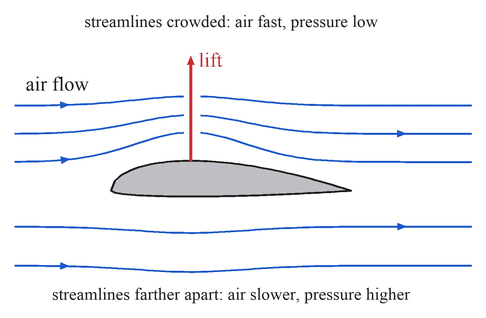
Step 2 — Find the force. The faster air above has a lower pressure, and the slower air below has a higher pressure. The pressure difference over the area of the wing gives an upward force, the dynamic lift.
Note: The pressure difference and the downward turning of the air behind the wing are two descriptions of the same lift force, not two separate sources of it: the wing pushes the air downwards, so by Newton's third law the air pushes the wing upwards. The angle at which the wing meets the air matters as much as its curved shape.
Therefore, the wings are shaped this way so that air flows faster over the upper surface than under the lower one; the resulting difference of pressure gives the upward lift that supports the aeroplane.