
Question 121 markMCQMedium
The given figure shows the flow of liquid through a horizontal pipe. Three tubes , and are connected to the pipe. The radii of the tube, , and at the junction are respectively 2 cm, 1 cm and 2 cm.
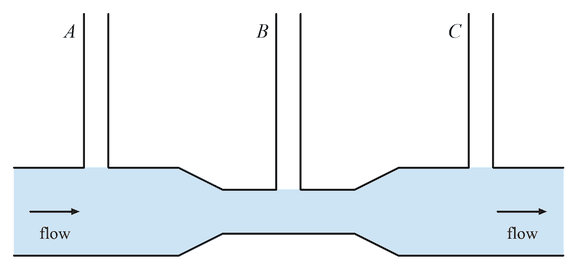
It can be said that the
Confirming your payment
Sign up now and get 250 free tokens.
Fluid Pressure and Viscosity · Question 12 of 78
The given figure shows the flow of liquid through a horizontal pipe. Three tubes , and are connected to the pipe. The radii of the tube, , and at the junction are respectively 2 cm, 1 cm and 2 cm.
It can be said that the
(A) height of the liquid in the tube is maximum
(B) height of the liquid in the tubes and is the same
(C) height of the liquid in all the three tubes is the same
(D) height of the liquid in the tubes and is the same
Answer: (D) Height of the liquid in the tubes A and C is the same
Concept: For steady flow of an ideal liquid in a horizontal pipe, the equation of continuity gives = constant, and Bernoulli's theorem gives = constant. The height of liquid in a vertical tube joined to the pipe measures the pressure there.
Step 1 — Compare the speeds. The pipe is circular, so its cross-section is . The radii at A, B and C are 2 cm, 1 cm and 2 cm, so by continuity
So the liquid moves four times as fast at B as at A. The radii at A and C are equal, so .
Step 2 — Compare the pressures. Since is the same everywhere, equal speeds at A and C mean equal pressures there, and the much larger speed at B means a lower pressure at B.
Step 3 — Compare the heights. The liquid rises highest where the pressure is greatest. So the heights in A and C are equal, and the height in B is less, as the figure shows.
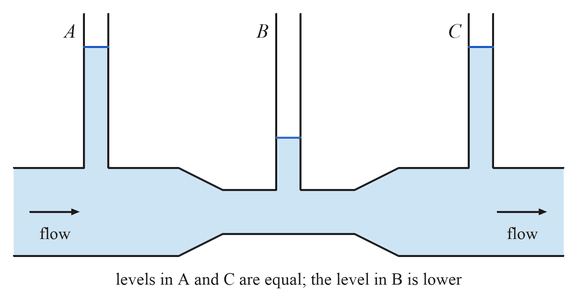
Note: this treats the liquid as non-viscous, as Bernoulli's theorem does; in a real liquid viscosity makes the pressure fall slowly along the pipe, so C would stand a little lower than A.
Therefore, the height of the liquid in the tubes A and C is the same, option (D).