
Question 775 marksHard
State and prove Bernoulli's theorem.
Confirming your payment
Sign up now and get 250 free tokens.
Fluid Pressure and Viscosity · Question 77 of 78
State and prove Bernoulli's theorem.
Solution:
Concept: Bernoulli's theorem applies the work–energy principle to a liquid flowing along a tube of flow: the work done on it by the pressure forces equals its gain in kinetic and potential energy.
Step 1 — State the theorem. For the steady, streamline flow of an ideal (incompressible and non-viscous) liquid, the sum of the pressure energy, kinetic energy and potential energy per unit volume is the same at every point along a streamline:
Step 2 — Set up the proof. Consider an ideal liquid of density flowing steadily through a tube of flow from A to B, as in the figure. At A the cross-section is , the pressure , the speed and the height ; at B they are , , and .
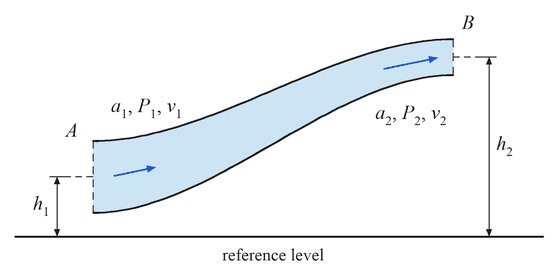
Step 3 — Find the net work done by pressure. In a small time , the liquid at A moves through , so the force does work on it. At B, the liquid moves through against the force , and work is done against it. By continuity, the volume moved is the same at both ends:
So the net work done on the liquid is
Step 4 — Find the gain in energy. The effect of the flow is to move a mass from A to B (the liquid in between is unchanged, since the flow is steady). Its gain in kinetic energy and in potential energy is
Step 5 — Apply the work–energy principle. The liquid is non-viscous, so no energy is lost; the net work equals the gain in energy:
We cancel and collect the terms for A on the left and for B on the right:
Since A and B are any two points on the streamline, has the same value everywhere along it.
Therefore, Bernoulli's theorem, along a streamline, follows from equating the net work done by the pressure forces to the gain in kinetic and potential energy of the flowing ideal liquid.