
Question 785 marksMedium
Explain the working of a venturimeter. Obtain an expression for the volume of liquid flowing per second through pipe.
Confirming your payment
Sign up now and get 250 free tokens.
Fluid Pressure and Viscosity · Question 78 of 78
Explain the working of a venturimeter. Obtain an expression for the volume of liquid flowing per second through pipe.
Solution:
Concept: A venturimeter measures the rate of flow of a liquid in a pipe. It uses the equation of continuity, , and Bernoulli's theorem for a horizontal pipe, .
Step 1 — Describe the instrument. A venturimeter is a horizontal tube with a wide part of cross-section (the same as the pipe) and a narrow throat of cross-section , joined into the pipe. Two vertical tubes (or a manometer) are joined at the wide part and at the throat, as in the figure.
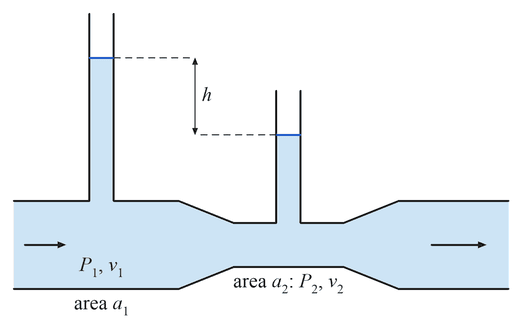
Step 2 — Explain the working. The liquid speeds up as it enters the narrow throat, so by Bernoulli's theorem its pressure there falls. The liquid in the tube at the throat stands lower than in the tube at the wide part, by a height . The pressure difference is
Step 3 — Use the equation of continuity. The same volume passes both sections each second:
Step 4 — Use Bernoulli's theorem. For the horizontal tube, the heights are equal, so
We put in and :
Step 5 — Find the volume per second. The volume of liquid flowing per second is :
So measuring , with and known, gives the rate of flow.
Therefore, a venturimeter works because the pressure falls where the liquid speeds up in the throat, and the volume flowing per second is , where is the difference in levels.