
Question 141 markMCQMedium
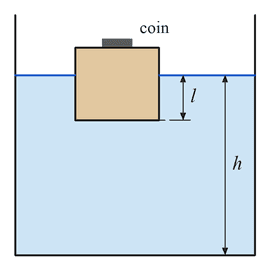
A wooden block, with a coin placed on its top, floats in water as shown in the given figure. The distance and are shown there. After some time, the coin falls into the water. Then
Confirming your payment
Sign up now and get 250 free tokens.
Fluid Pressure and Viscosity · Question 14 of 78
A wooden block, with a coin placed on its top, floats in water as shown in the given figure. The distance and are shown there. After some time, the coin falls into the water. Then
(A) decreases and increases
(B) increases and decreases
(C) both and increase
(D) both and decrease
Answer: (D) Both l and h decrease
Concept: A floating body displaces water whose mass equals its own mass; a body that sinks displaces only its own volume.
Step 1 — Find what happens to l. Here is the depth of the block below the water surface. When the coin falls off, the block is lighter and needs to displace less water, so it rises and decreases.
Step 2 — Find the water displaced because of the coin. Let the coin have mass and density , and let water have density . While it rests on the floating block, the block displaces an extra volume to carry it. After it sinks, the coin displaces only its own volume .
Step 3 — Find what happens to h. A coin is much denser than water, so . The total volume of water displaced decreases, so the water level, and with it the depth , decreases.
Therefore, both and decrease, option (D).