
Question 522 marksMedium
What is Magnus effect?
Confirming your payment
Sign up now and get 250 free tokens.
Fluid Pressure and Viscosity · Question 52 of 78
What is Magnus effect?
Solution:
Concept: By Bernoulli's theorem, the side of a body past which the air moves faster has the lower pressure.
Step 1 — Look at a spinning ball. A ball that moves through the air while spinning drags a thin layer of air round with it. On one side this layer moves in the same direction as the air streaming past the ball, so the air there moves faster; on the other side it moves against the stream, so the air there is slowed down.
Step 2 — Find the sideways force. The pressure is lower on the faster side and higher on the slower side. The pressure difference gives a sideways force on the ball, towards the low-pressure side, so its path curves. In the figure the ball moves to the left with a clockwise spin, the air above it moves faster, and the force acts upwards.
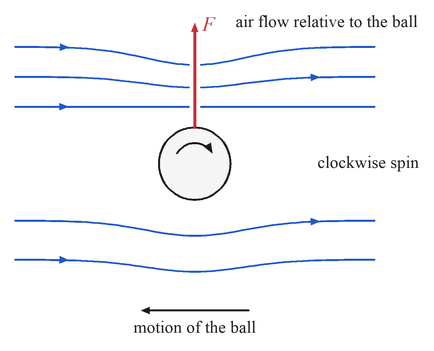
Therefore, the Magnus effect is the curving of the path of a spinning ball moving through a fluid, caused by the difference in pressure on its two sides; for example, a spinning cricket ball swerves in the air.