
Question 703 marksMedium
Explain Newton's formula for viscosity and hence define coefficient of viscosity. Give the S.I. unit and C.G.S unit of coefficient of viscosity.
Confirming your payment
Sign up now and get 250 free tokens.
Fluid Pressure and Viscosity · Question 70 of 78
Explain Newton's formula for viscosity and hence define coefficient of viscosity. Give the S.I. unit and C.G.S unit of coefficient of viscosity.
Solution:
Concept: When a liquid flows over a fixed surface, the layer touching the surface is at rest and the layers above move faster and faster. Each layer is held back by the slower layer below it; this tangential force is the viscous force.
Step 1 — Describe the velocity gradient. In the figure, the speed of the layers increases with distance from the fixed surface. Two layers a small distance apart move with speeds and . The rate of change of speed with distance, , is called the velocity gradient.
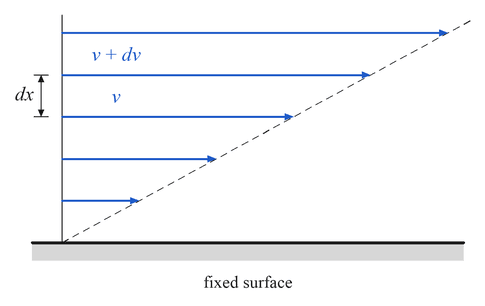
Step 2 — State Newton's formula. Newton found that the viscous force between two layers is proportional to the area of the layers in contact and to the velocity gradient between them:
Here is a constant for the liquid at a given temperature, called its coefficient of viscosity. The minus sign shows that the viscous force opposes the relative motion of the layers.
Step 3 — Define the coefficient of viscosity. Taking the magnitude, . If and , then . So the coefficient of viscosity of a liquid is the tangential force per unit area required to maintain unit velocity gradient between its layers.
Step 4 — Give the units. In S.I. units, is in newtons, in and in , so is in , called the pascal second (Pa s) or decapoise. In C.G.S. units it is , called the poise. They are related by
Its dimensional formula is .
Therefore, Newton's formula is ; the coefficient of viscosity is the tangential force per unit area needed to maintain unit velocity gradient, with S.I. unit (pascal second) and C.G.S. unit the poise.