
Question 693 marksMedium
State Pascal's law. Mention the applications of Pascal's law. Explain the working of (i) hydraulic lift and (ii) hydraulic brake.
Confirming your payment
Sign up now and get 250 free tokens.
Fluid Pressure and Viscosity · Question 69 of 78
State Pascal's law. Mention the applications of Pascal's law. Explain the working of (i) hydraulic lift and (ii) hydraulic brake.
Solution:
Concept: A liquid is (nearly) incompressible, so a push applied at one place in an enclosed liquid is passed on to every part of it.
Step 1 — State Pascal's law. Pressure applied to an enclosed liquid at rest is transmitted equally and undiminished to every part of the liquid and to the walls of the container (when the effect of gravity is neglected).
Step 2 — Mention the applications. Pascal's law is used in the hydraulic lift, the hydraulic press, hydraulic brakes, hydraulic jacks and the hydraulic systems of aircraft and earth-moving machines.
Step 3 — Explain the hydraulic lift (i). Two cylinders, one with a small piston of area and the other with a large piston of area , are joined by a pipe and filled with liquid, as in the figure. A force on the small piston creates a pressure in the liquid:
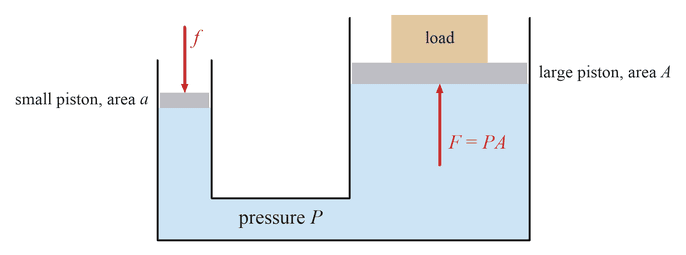
By Pascal's law this same pressure acts on the large piston, which is pushed up with a force
Since is much larger than , a small force on the small piston lifts a heavy load such as a car on the large piston. (The small piston has to move through a much larger distance, so energy is not gained.)
Step 4 — Explain the hydraulic brake (ii). When the driver presses the brake pedal, it pushes the piston of the master cylinder, which is filled with brake fluid. The pressure produced is transmitted by the fluid through the pipes, equally, to the wheel cylinders at all the wheels. There the pressure pushes out pistons of larger area, which press the brake shoes against the brake drums (or, in disc brakes, the pads against the discs) and stop the wheels.
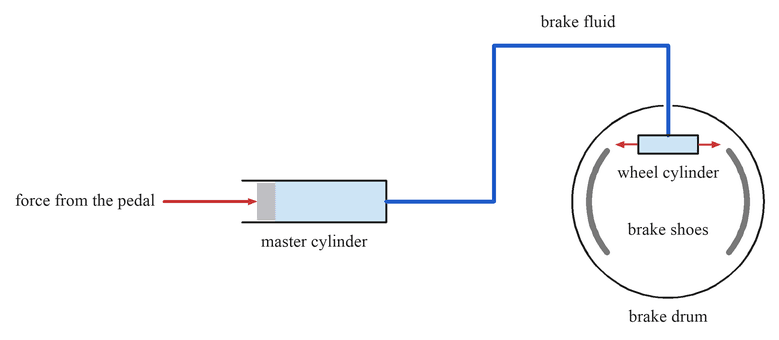
Because the same pressure reaches every wheel cylinder at once, the brakes on all the wheels act together and the two wheels on each axle are braked equally. The wheel pistons are larger than the master piston, so a small force on the pedal gives a large braking force.
Therefore, Pascal's law states that pressure applied to an enclosed liquid is transmitted equally in all directions; in a hydraulic lift and a hydraulic brake, a small force on a small piston produces a pressure that gives a much larger force on a larger piston.