
Question 713 marksMedium
Distinguish between streamline flow and turbulent flow. What is critical velocity and Reynold's number? What is the significance of Reynold's number?
Confirming your payment
Sign up now and get 250 free tokens.
Fluid Pressure and Viscosity · Question 71 of 78
Distinguish between streamline flow and turbulent flow. What is critical velocity and Reynold's number? What is the significance of Reynold's number?
Solution:
Concept: A liquid flows smoothly at low speeds, but above a certain speed its motion becomes irregular. The Reynolds number (named after Osborne Reynolds) tells which kind of flow to expect.
Step 1 — Distinguish the two kinds of flow. In streamline flow, every particle passing a point follows the same path with the same velocity as the particles before it; the streamlines are smooth and never cross, and the velocity at each point stays constant. In turbulent flow, the velocity at a point changes continuously and haphazardly in magnitude and direction, eddies form, and much energy is lost. The figure compares them.
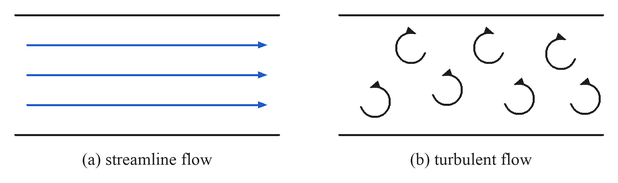
Step 2 — Define the critical velocity. The critical velocity is the speed of a liquid up to which its flow is streamline and above which it becomes turbulent.
Step 3 — Define the Reynolds number. For a liquid of density and coefficient of viscosity flowing with speed through a tube of diameter , the Reynolds number is
It is a pure number, the ratio of the inertial force to the viscous force in the flow. The critical velocity is the speed at which reaches its critical value:
Step 4 — Give its significance. The Reynolds number decides the type of flow: if is less than about 2000 the flow is streamline, if it is more than about 3000 the flow is turbulent, and between these values the flow is unstable. Since it is a pure number, flows of different fluids in tubes of different sizes behave alike when they have the same Reynolds number, which allows models to be tested in place of large systems.
Therefore, streamline flow is steady and orderly while turbulent flow is irregular with eddies; the critical velocity is the speed at which streamline flow turns turbulent; and the Reynolds number tells whether a flow will be streamline (below about 2000) or turbulent (above about 3000).