Solution:
Concept: A body moving through a viscous liquid is acted on by its weight, the upthrust of the liquid and the viscous drag 6πηav, which opposes its motion and grows with its speed. It moves with a constant (terminal) velocity once these forces balance.
Step 1 — List the forces. The sphere has volume 34πa3. Its weight acts downwards:
W=34πa3σg
The upthrust equals the weight of liquid displaced and acts upwards:
U=34πa3ρg
Since ρ>σ, the upthrust is greater than the weight.
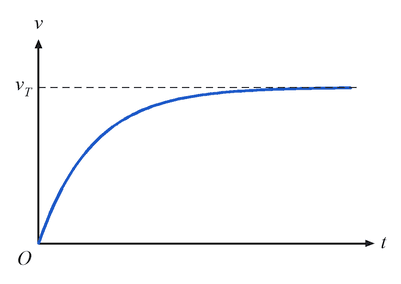
Step 2 — Describe the motion. When released at rest, the sphere has a net upward force U−W, so it starts to rise with an upward acceleration. As it moves up, the viscous drag F=6πηav acts downwards (opposite to its motion) and grows with its speed. So the net upward force, and the acceleration, become smaller and smaller. Soon the drag together with the weight balances the upthrust; after that the sphere rises with a constant velocity, its terminal velocity. The figure shows the forces, and the speed–time graph shows the speed levelling off.

Step 3 — Write the condition at terminal velocity. When the sphere moves up with its terminal velocity v, the forces balance:
U=W+F
34πa3ρg=34πa3σg+6πηav
Step 4 — Solve for v. We take the weight to the left-hand side:
6πηav=34πa3(ρ−σ)g
Dividing both sides by 6πηa:
v=3×6πηa4πa3(ρ−σ)g
v=9η2a2(ρ−σ)g
Therefore, the sphere first rises with decreasing acceleration and then moves upwards with a constant terminal velocity v=9η2a2(ρ−σ)g.
