
Question 745 marksMedium
(a) Explain Stokes' law.
(b) Define terminal velocity.
(c) Describe an experiment to determine the terminal velocity.
(d) How is the viscosity of a highly viscous liquid determined by measuring the terminal velocity?
Confirming your payment
Sign up now and get 250 free tokens.
Fluid Pressure and Viscosity · Question 74 of 78
(a) Explain Stokes' law.
(b) Define terminal velocity.
(c) Describe an experiment to determine the terminal velocity.
(d) How is the viscosity of a highly viscous liquid determined by measuring the terminal velocity?
Solution:
Concept: A small sphere moving slowly through a viscous fluid feels a drag that grows with its speed; when it falls, the drag soon grows enough to balance the other forces, and it moves at a constant speed.
Step 1 — Explain Stokes' law (a). When a small sphere moves through a fluid, the layer of fluid in contact with it moves with it, while the fluid far away stays at rest, so the sphere sets up relative motion between layers, which viscosity opposes. Stokes showed that the viscous drag on a small, smooth, rigid sphere of radius moving slowly with velocity through a fluid of coefficient of viscosity is
The law holds when the sphere moves slowly (streamline flow, no eddies) through a fluid that is uniform and extends far on all sides.
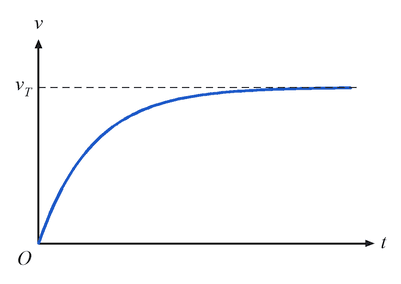
Step 2 — Define terminal velocity (b). As a sphere falls through a viscous fluid, the drag increases with its speed. When the upthrust and the viscous drag together balance its weight, the net force is zero and the sphere moves with a constant velocity. This constant velocity is called the terminal velocity. The speed–time graph shows the speed rising and levelling off at the terminal velocity .
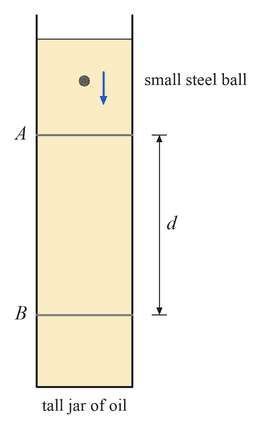
Step 3 — Describe the experiment (c). A tall, wide glass jar is filled with the liquid (for example, glycerine or castor oil). Two marks A and B are made on it, a distance apart, with A well below the surface so that the ball reaches its terminal velocity before passing A, as in the figure. A small steel ball, wetted with the liquid, is dropped gently along the axis of the jar. A stop-watch is started as the ball passes A and stopped as it passes B; let the time be . (Equal times for equal distances below A confirm that the speed is constant.)
The terminal velocity is
Step 4 — Find the viscosity (d). At the terminal velocity, for a ball of density in a liquid of density , the drag plus upthrust equals the weight:
So we measure the radius of the ball (with a screw gauge), the densities and , and the terminal velocity , and put them in this formula. A highly viscous liquid is needed so that the ball falls slowly enough for the flow to stay streamline and for the time to be measured accurately.
Therefore, (a) Stokes' law gives the drag on a small sphere moving slowly through a fluid; (b) terminal velocity is the constant velocity reached when the drag and upthrust balance the weight; (c) it is found by timing the fall of a ball between two marks, ; (d) the viscosity is then .