Solution:
Concept: By Newton's formula, the viscous force between layers is F=ηAdxdv; a sphere falling through a liquid reaches a terminal velocity v=9η2a2(ρ−σ)g, so for the same sphere, a more viscous liquid gives a smaller terminal velocity.
Step 1 — Define the coefficient of viscosity (a). The coefficient of viscosity of a fluid is the tangential force per unit area required to maintain unit velocity gradient between its layers:
η=AdxdvF
Step 2 — Find its dimensions. Force has dimensions [MLT−2], area [L2] and velocity gradient [T−1]:
[η]=[L2][T−1][MLT−2]
[η]=[ML−1T−1]
Step 3 — Define streamline flow. The flow of a liquid is streamline when every particle passing a given point moves along the same path and with the same velocity as the particles that passed that point before it.
Step 4 — State the necessary conditions (b). The spheres must be small, smooth and rigid, and the same sphere (or identical spheres) should be used for both oils. They must fall slowly, so that the flow round them is streamline with no eddies, and centrally in columns that are wide (walls far away) and long, so that the terminal velocity is reached well before the timing starts. Both oils must be at the same, steady temperature, since viscosity changes with temperature, and no air bubbles should cling to the spheres.
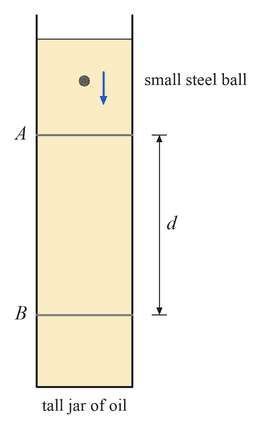
Step 5 — State the measurements. Measure the density ρ of the spheres and the densities σ1 and σ2 of the two oils. In each oil, mark two points a distance d apart well below the surface and measure the times t1 and t2 taken by the sphere to fall between them, so that the terminal velocities are v1=t1d and v2=t2d.
Step 6 — Compare the viscosities. At the terminal velocity, 6πηav=34πa3(ρ−σ)g in each oil. Dividing the result for oil 1 by that for oil 2 (the same a and g):
η2η1=(ρ−σ2)v1(ρ−σ1)v2
η2η1=(ρ−σ2)t2(ρ−σ1)t1
Therefore, (a) η is the tangential force per unit area for unit velocity gradient, with dimensions [ML−1T−1], and streamline flow is flow in which the velocity at each point stays the same; (b) using the same small smooth sphere falling slowly through long, wide columns at the same temperature, and measuring the densities and the fall times t1, t2 over equal distances, η2η1=(ρ−σ2)t2(ρ−σ1)t1.
