
Opening your dashboard
Class 11 Physics Chapter 14 Fluid Pressure and Viscosity: Practice Questions
133 questions on Chapter 14, each worked through on its own page with the AI tutor. Class 11 Physics, ICSE 2026-27.
133 questions
1–4 marks · Mixed difficulty
- 11 mark
Question 1
A tank of water stands on the floor of a goods lift, and the water in it is m deep. The lift starts to move upwards with an acceleration of . (Hypothetical data.) Take and the density of water as . While the lift is accelerating, the gauge pressure at the bottom of the tank is
- 23 marks
Question 2
A measuring cylinder with a flat base of internal area holds cm of water, with cm of oil floating on top of it, as shown in the figure. (Hypothetical data.) The density of the oil is , that of water is , and .
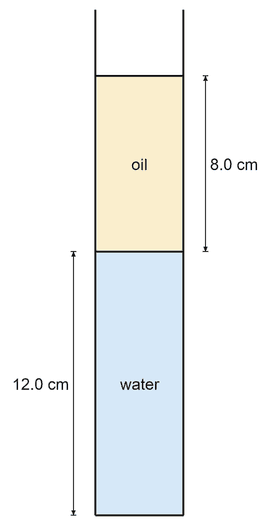
(a) Find the gauge pressure at the boundary between the oil and the water.
(b) Find the gauge pressure at the base of the cylinder.
(c) Find the force that the liquids exert on the base, and show that it equals the total weight of the two liquids.
- 33 marks
Question 3
In a standing adult, the mean blood pressure in the large arteries at the level of the heart is mmHg above atmospheric pressure. The feet are m below the heart and the top of the head is m above it. (Hypothetical data.) Treat the blood in the large arteries as a column of liquid at rest, of density ; take and Pa.
(a) Estimate the mean arterial blood pressure in the feet, in mmHg.
(b) Estimate the mean arterial blood pressure at the top of the head, in mmHg.
(c) Explain why a doctor measures blood pressure on the upper arm, held at the level of the heart.
- 41 mark
Question 4
The graph shows how the absolute pressure changes with the depth below the open surface in two liquids, P and Q, kept in tall tanks side by side. (Hypothetical data.) Take .
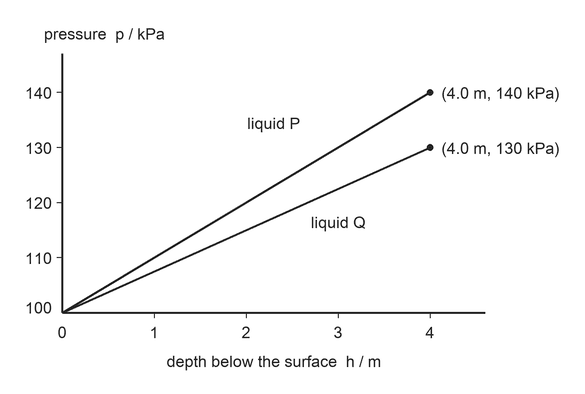
The density of liquid Q is about
- 53 marks
Question 5
A glass vessel is shaped like a frustum of a cone. Its flat base has a diameter of cm, its open top has a diameter of cm, and its height is cm, as shown in the figure. It is filled with water to the brim. (Hypothetical data.) Take and the density of water as . The volume of a frustum of height with end radii and is .
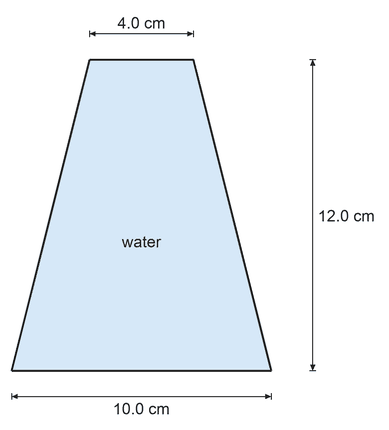
(a) Find the force (thrust) that the water exerts on the base of the vessel.
(b) Find the weight of the water in the vessel.
(c) The answers to (a) and (b) are not equal. Explain where the difference comes from.
- 61 mark
Question 6
An open-tube mercury manometer is joined to a bulb of gas. The mercury in the limb joined to the bulb stands cm higher than the mercury in the open limb, as shown in the figure.

The atmospheric pressure is cm of mercury, which is Pa. (Hypothetical data.) The absolute pressure of the gas is about
- 72 marks
Question 7
A student blows as hard as they can into one limb of a U-tube that contains water; the other limb is open to the air. The water levels end up cm apart, as shown in the figure. (Hypothetical data.) Take , the density of water as , the density of mercury as , and Pa.
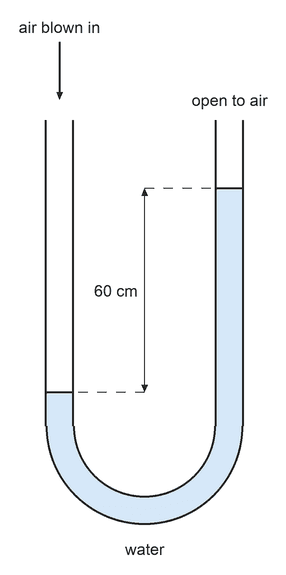
(a) Find the gauge pressure of the air in the student's mouth, in pascals and in mmHg.
(b) What difference in levels would a mercury U-tube show for the same pressure? Why is water the better choice for this measurement?
- 81 mark
Question 8
A mercury barometer reads cm at the foot of a tall tower and cm at its top. (Hypothetical data.) Treat the density of the air as constant at over this height, and take the density of mercury as . The height of the tower is about
- 93 marks
Question 9
The figure shows an inclined-tube manometer used to measure small gas pressures. A wide well of oil (density ) is joined near its base to a narrow glass tube that slopes upwards at to the horizontal. The top of the well is connected to the gas, and the far end of the tube is open to the air. When the gas is connected, the oil in the tube moves cm along the tube from the zero mark. (Hypothetical data.) The well is so wide that its oil level hardly changes. Take and .

(a) Find the gauge pressure of the gas.
(b) What reading would an ordinary vertical U-tube manometer with the same oil show for this pressure?
(c) By what factor does sloping the tube magnify the reading, and why is this useful?
- 102 marks
Question 10
When you drink through a straw, you lower the air pressure in your mouth and the atmosphere pushes the drink up the straw. A certain person can lower the pressure in the mouth to at most kPa below atmospheric pressure. (Hypothetical data.) Take .
(a) What is the greatest height to which this person can draw water (density ) up a vertical straw?
(b) Can the same person drink orange juice (density ) from a glass through a vertical straw m long whose lower end is just below the surface of the juice? Explain.
- 111 mark
Question 11
In an ideal hydraulic lift (no friction and no leaks), the large piston has times the area of the small piston, and both pistons are at the same level. Which statement is correct?
- 124 marks
Question 12
In a car's hydraulic brake, the brake pedal and its lever push the piston of the master cylinder with a force of kN. The master-cylinder piston has a diameter of cm. The brake fluid carries the pressure along a pipe to a wheel cylinder whose piston has a diameter of cm, as shown in the figure. (Hypothetical data.) Treat the master cylinder as feeding this one wheel cylinder, take both pistons to be at the same level, and ignore friction.

(a) Find the pressure in the brake fluid.
(b) Find the force with which the wheel-cylinder piston pushes on the brake pad.
(c) The wheel-cylinder piston must move mm to press the pad against the brake disc. How far must the master-cylinder piston move?
(d) Why must the brake fluid contain no air bubbles?
- 133 marks
Question 13
A hand-operated bottle jack (a small hydraulic lift) has a ram of diameter cm that carries the load. The operator's lever pushes a narrow plunger down with a force of N, as shown in the figure. The jack is designed so that this force supports a load of N on the ram. (Hypothetical data.) Ignore friction and the weights of the pistons, and take the plunger and the ram to be at the same level.
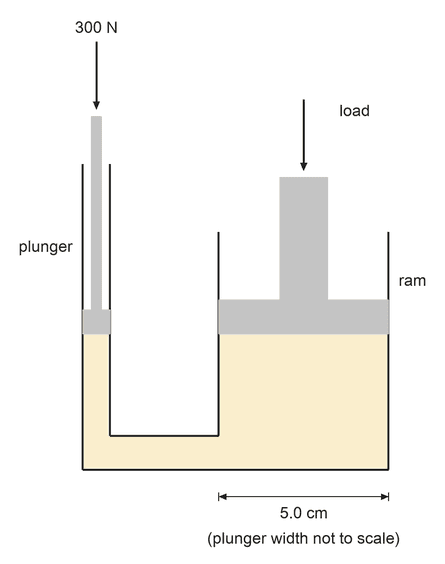
(a) Find the diameter of the plunger.
(b) Each stroke pushes the plunger down by cm. How far does the ram rise in one stroke?
(c) How many strokes are needed to raise the load by cm? Check your answer by comparing the work done on the plunger with the work done on the load.
- 143 marks
Question 14
A glass bottle is filled to the brim with water and closed with a cork of cross-sectional area . The flat base of the bottle has an area of , and the water is cm deep. (Hypothetical data.) Take and the density of water as , and ignore friction between the cork and the neck.
(a) The cork is pushed in with an extra force of N. By how much does the force of the water on the base increase?
(b) The base cracks if the gauge pressure on it goes above Pa. What is the largest extra force that can be put on the cork?
- 151 mark
Question 15
Two vertical cylinders, A and B, stand on a common base and are joined at the bottom. They contain water, and each is closed by a piston that rests on the water and slides without friction; the air above both pistons is at atmospheric pressure. Piston A has an area of and a mass of kg, and piston B has an area of . In equilibrium the underside of piston A is m above the underside of piston B, as shown in the figure. (Hypothetical data.) Take and the density of water as .

The mass of piston B is
- 163 marks
Question 16
A hydrometer of mass g has a uniform stem of cross-sectional area . In pure water (density ) it floats with a mark W on its stem exactly at the surface. In a sugar solution it floats higher, with W cm above the surface, as shown in the figure. (Hypothetical data.)
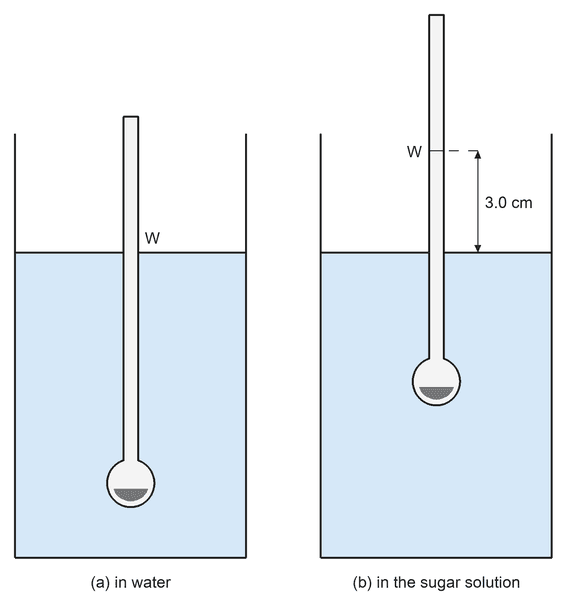
(a) Find the volume of the hydrometer below the mark W.
(b) Find the density of the sugar solution.
(c) Explain why the density marks on a hydrometer stem increase downwards.
- 173 marks
Question 17
A weather balloon is filled with of helium at ground level, where the density of the air is and that of the helium in the balloon is . The rubber envelope and the instrument package together have a mass of kg. (Hypothetical data.) Take , and ignore the volume of the envelope material and of the package.
(a) Find the upthrust of the air on the balloon.
(b) Find the net upward force on the balloon at the moment it is released.
(c) What is the largest extra mass the balloon could carry and still just rise?
- 181 mark
Question 18
A spring balance marked in grams reads g when a hollow brass ornament hangs from it in air, and g when the ornament hangs fully under water. (Hypothetical data.) The density of brass is and that of water is . The volume of the hollow space inside the ornament is
- 193 marks
Question 19
A diver uses an air-filled lift bag to raise an iron anchor of mass kg from the sea bed. The density of iron is and that of sea water is . (Hypothetical data.) Take , and ignore the mass of the bag, the mass of the air in it and the volume of the bag's fabric. The volume of a fixed amount of air increases when the pressure on it falls.
(a) Find the least volume of air the bag must hold to just lift the anchor off the sea bed.
(b) Once the anchor starts to rise, the bag and anchor rise faster and faster unless the diver lets some air out of the bag. Explain why.
- 201 mark
Question 20
A cargo ship of total mass kg sails from a river (fresh water, density ) into the sea (density ). The area of the ship's horizontal cross-section at the waterline is , and its sides are vertical near the waterline. (Hypothetical data.) What happens to the ship's level in the water as it passes into the sea?
- 211 mark
Question 21
A thin layer of a liquid fills the gap between a fixed horizontal plate and a parallel plate that is pulled along at a steady speed . The flow is steady and in layers (laminar), and the liquid obeys Newton's formula for viscosity. How does the speed of the liquid depend on the height above the fixed plate?
- 223 marks
Question 22
A machine shaft of radius cm turns at revolutions per minute inside a bearing cm long. A film of oil mm thick, with a coefficient of viscosity of Pa s, separates the shaft from the bearing, as shown in the figure. (Hypothetical data.) The film is so thin compared with the radius that it may be treated as a flat layer between a fixed surface and a surface moving at the shaft's surface speed, with the speed changing linearly across the film.
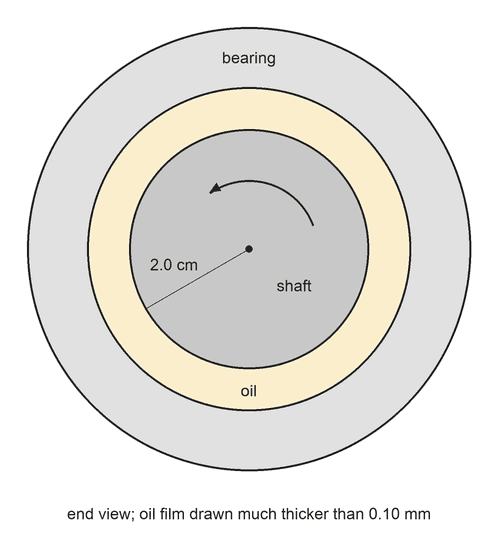
(a) Find the speed of the shaft's surface.
(b) Find the viscous force on the shaft.
(c) Find the power wasted in the oil film, and say what happens to this energy.
- 231 mark
Question 23
Two liquids, P and Q, are tested in a viscometer that shears a thin layer of each at different velocity gradients and measures the tangential force per unit area (the shear stress) needed. The results are given below. (Hypothetical data.)
Velocity gradient (s⁻¹) 50 100 200 400 Shear stress for P (Pa) 0.050 0.100 0.200 0.400 Shear stress for Q (Pa) 1.2 1.6 2.2 3.0 Which liquid obeys Newton's formula for viscosity, and what is its coefficient of viscosity?
- 243 marks
Question 24
A flat-bottomed metal block of mass kg and base area slides down a plane inclined at to the horizontal, on a film of oil mm thick with a coefficient of viscosity of Pa s, as shown in the figure. (Hypothetical data.) Assume that the film keeps its thickness and that the speed changes linearly across it. Take and .
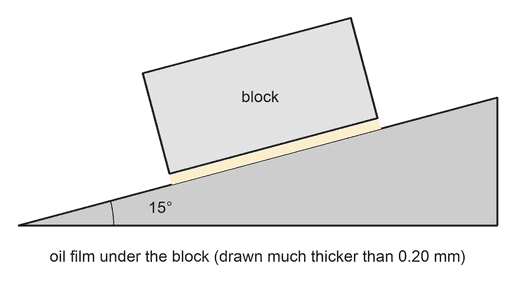
(a) Explain why the block soon slides at a steady speed.
(b) Find this steady speed.
(c) How would the steady speed change if the oil were warmed? Give a reason.
- 251 mark
Question 25
A small steel ball is released from rest in a tall, wide jar of glycerine. Its weight is and the upthrust on it is . After a while it falls at its terminal speed . Assuming that Stokes' law holds throughout the fall, the viscous force on the ball at the instant its speed is is
- 263 marks
Question 26
In a school laboratory, a small metal ball of radius is dropped into a tall, wide jar of glycerine at (density , coefficient of viscosity ). Once it has reached its terminal speed, it takes to fall between two marks apart. (Hypothetical data.) Take and assume that Stokes' law holds.
(a) Find the terminal speed of the ball.
(b) Find the density of the metal.
(c) The ball is made of aluminium (), steel (), brass () or lead (). Which metal is it most likely to be?
- 273 marks
Question 27
A sealed hollow plastic ball of radius and mass is held at the bottom of a tall, wide tank of thick sugar syrup (density , coefficient of viscosity ) and then released. (Hypothetical data.) Take and assume that Stokes' law holds.
(a) Find the mean density of the ball and say whether it rises or sinks.
(b) Find its terminal speed.
(c) How long does it take to move at this speed?
- 281 mark
Question 28
A steel ball falls through a lubricating oil at a terminal speed of when the oil's coefficient of viscosity is . The oil is then warmed until its coefficient of viscosity falls to . (Hypothetical data.) Ignoring the small change in the oil's density, the new terminal speed of the same ball is about
- 293 marks
Question 29
A small steel ball is fired vertically downwards into a tall jar of glycerine. It enters the glycerine at a speed three times its terminal speed in glycerine. Assume that Stokes' law holds throughout.
(a) Explain, in terms of the forces on the ball, how its speed changes after it enters the glycerine.
(b) Sketch the graph of its speed against time from the moment it enters the glycerine.
- 301 mark
Question 30
A fatty deposit narrows a short length of an artery so that its internal radius there becomes 10% smaller than before. (Hypothetical data.) Treat the blood as a liquid obeying Poiseuille's formula and ignore all other changes. To keep the same volume of blood flowing each second through that length, the pressure difference across it must increase by about
- 313 marks
Question 31
Water (coefficient of viscosity , density ) flows from a large tank, kept at a constant level, through a horizontal capillary tube of length . The axis of the tube is below the water surface, and the water leaves the far end of the tube into the air. In minutes, of water is collected. (Hypothetical data.) Take . The arrangement is shown in the figure.
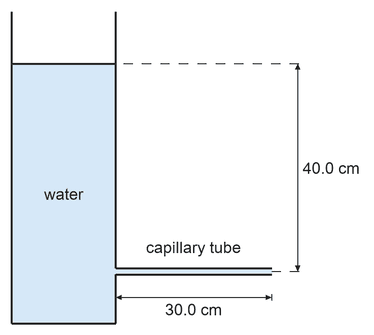
(a) Find the internal radius of the tube.
(b) Find the average speed of the water in the tube. Then use the Reynolds number , where is the internal diameter, to check that the flow is streamline, so that Poiseuille's formula applies.
- 321 mark
Question 32
Water is driven through a single horizontal tube of internal radius by a fixed pressure difference, and the flow obeys Poiseuille's formula. The tube is then replaced by four tubes of the same length, each of internal radius , placed side by side between the same two ends, so that their total cross-sectional area equals that of the old tube. The total volume of water flowing per second becomes
- 333 marks
Question 33
In a machine, oil of coefficient of viscosity and density is fed to a bearing through a thin tube of length and internal diameter . The bearing needs of oil every second. (Hypothetical data.)
(a) Find the pressure difference that must be kept between the ends of the tube.
(b) Find the rate at which work is done in pushing the oil through the tube. (Viscosity turns this work into heat.)
(c) On a cold morning the oil's coefficient of viscosity is twice as large. What pressure difference is then needed for the same supply of oil?
- 343 marks
Question 34
To measure the viscosity of a liquid of density , a student lets it flow through a horizontal capillary tube of internal radius and length under several constant pressure heads , each measured in metres of the same liquid. The graph shows the volume flowing per second against . (Hypothetical data.) Take .
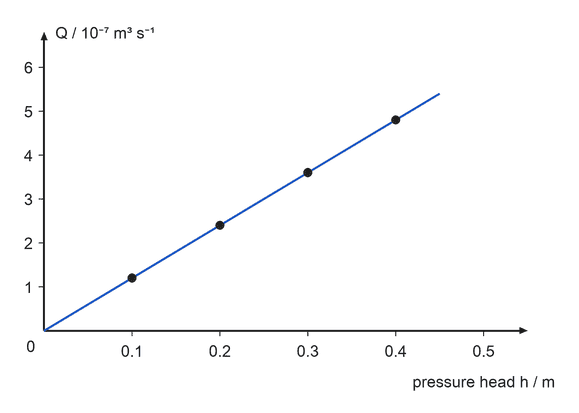
(a) Explain why the graph is a straight line through the origin.
(b) Find the slope of the graph.
(c) Use the slope to find the coefficient of viscosity of the liquid.
- 353 marks
Question 35
Water (density , coefficient of viscosity ) is to be carried through a pipe at a steady rate of litres per minute. Take the Reynolds number for flow in a pipe of internal diameter as , where is the average speed, and take the flow to be streamline when is below 2000 and turbulent when it is above about 3000. (Hypothetical data.)
(a) If is the volume flowing per second, show that .
(b) Find in a pipe of internal diameter , and state the type of flow.
(c) Find the smallest internal diameter for which this flow would be streamline.
- 361 mark
Question 36
Four steady flows are listed below. Take the Reynolds number as , where is the diameter of the pipe or duct, and take a flow to be turbulent when is above about 3000. (Hypothetical data.)
Flow Fluid Density (kg m⁻³) Coefficient of viscosity (Pa s) Speed (m s⁻¹) Diameter (cm) P honey Q water R air S blood Which flow is turbulent?
- 372 marks
Question 37
When a kitchen tap is opened only slightly, the falling stream of water is smooth and glass-clear. When the tap is opened wide, the stream becomes rough, wobbly and white. Explain this change using the ideas of critical velocity and Reynolds number.
- 381 mark
Question 38
Water flows through a pipe of fixed diameter. When the water is warmed from to , its coefficient of viscosity falls from to , and its density falls from to . The critical velocity of the water in this pipe
- 393 marks
Question 39
Engineers want to study the flow of air around a car that is long and moves at through air (density , coefficient of viscosity ). They test a one-fifth scale model in a water tunnel (water: density , coefficient of viscosity ). By the law of similarity, the patterns of flow are alike when the Reynolds numbers are equal; for a body, take , where is its length. (Hypothetical data.)
(a) Find the Reynolds number for the real car.
(b) At what speed must the water flow past the model?
(c) At what speed would air have to flow past the same model to give the same Reynolds number? Use your answer to suggest why water is used.
- 403 marks
Question 40
Blood leaves the heart through the aorta, of internal radius , at an average speed of . All of it later passes through the body's capillaries, where it moves at only about . (Hypothetical data.) Treat the blood as an incompressible liquid in steady flow.
(a) Find the total cross-sectional area of all the capillaries carrying the blood.
(b) If each capillary has an internal radius of , about how many capillaries carry blood at any instant?
(c) Why is the slow speed in the capillaries useful to the body?
- 411 mark
Question 41
A river wide and deep flows at . Further on it passes through a rocky gorge wide, where it is deep. (Hypothetical data.) Treating each cross-section as a rectangle in which the water moves at one average speed, the speed of the water in the gorge is about
- 423 marks
Question 42
A water main of internal diameter , in which water flows at , divides into two branch pipes, as shown in the figure. In branch 1, of internal diameter , the water moves at . Branch 2 has an internal diameter of . (Hypothetical data.) The water is incompressible and the flow is steady.
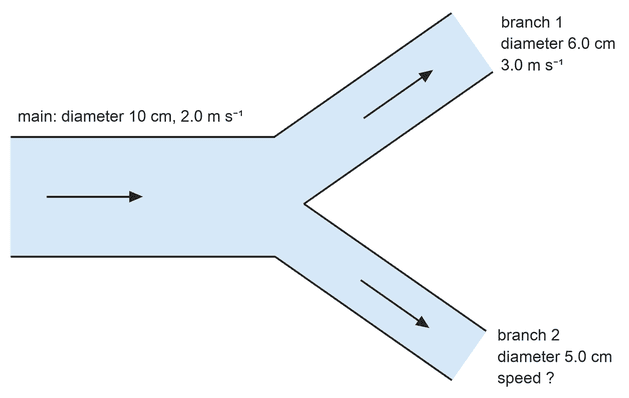
(a) Find the volume of water flowing per second in the main and in branch 1.
(b) Find the speed of the water in branch 2.
(c) Find the mass of water passing through branch 2 each second (density of water ).
- 431 mark
Question 43
A cylindrical water tank of internal diameter is filled through a pipe of internal diameter , in which the water moves at . No water leaves the tank. (Hypothetical data.) The water level in the tank rises at
- 442 marks
Question 44
Air enters a long, straight duct of uniform cross-section at , with a density of . A heater inside the duct warms the air, so that at the outlet its density is only . (Hypothetical data.) The flow is steady.
(a) Find the speed of the air at the outlet.
(b) Explain why the volume of air passing per second is not the same at the inlet and the outlet, although the mass passing per second is.
- 453 marks
Question 45
A siphon tube of uniform bore takes water from a large open tank, as shown in the figure. The highest point C of the tube is above the water surface in the tank, and the open outlet end of the tube is below that surface. (Hypothetical data.) Treat water as an ideal liquid of density , and take and atmospheric pressure as .

(a) Find the speed at which the water leaves the outlet.
(b) Find the pressure of the water at C.
(c) In this ideal case, what is the greatest height of C above the water surface in the tank for which the siphon could still work?
- 461 mark
Question 46
In a perfume sprayer, air from a squeezed bulb rushes across the top of a thin vertical tube whose lower end dips into the perfume. The top of the tube is above the surface of the perfume, and the air above the perfume in the bottle stays at atmospheric pressure. The perfume has a density of and air a density of . (Hypothetical data.) The arrangement is shown in the figure.
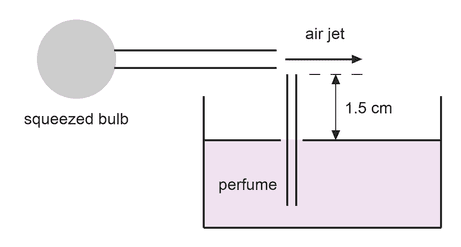
Take . Applying Bernoulli's theorem to the air, which starts from rest at atmospheric pressure, the least speed of the air across the top of the tube that will just draw perfume up to it is about
- 473 marks
Question 47
Water flows steadily through a horizontal tube that narrows from an internal diameter of to a throat of internal diameter and then widens again to , from where it pours into the open air. In the wide parts the water moves at . A thin side tube joins the throat and dips into an open beaker of water below, as shown in the figure. (Hypothetical data.) Treat water as an ideal liquid of density , and take and atmospheric pressure as .
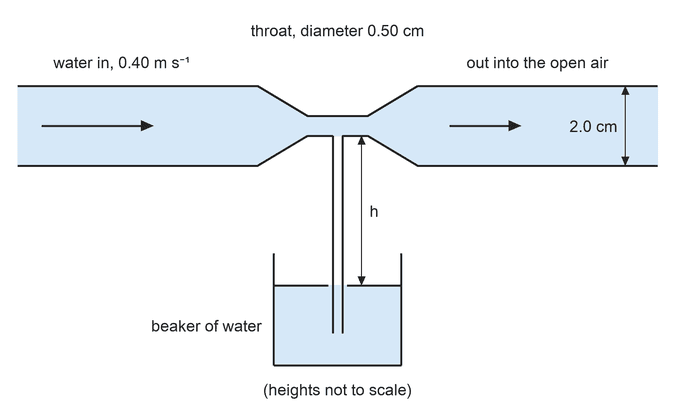
(a) Find the speed of the water at the throat.
(b) Find the pressure at the throat, given that the water in the wide part leading to the outlet is at atmospheric pressure.
(c) Find the greatest height of the throat above the water surface in the beaker for which water from the beaker could be drawn up to the throat.
- 481 mark
Question 48
An ideal liquid of density flows steadily upwards at through a vertical pipe of uniform cross-section. Point X in the pipe is below point Y, as shown in the figure. (Hypothetical data.)
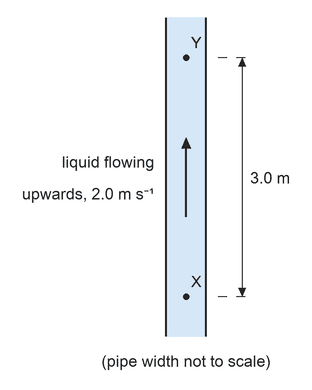
Take . The pressure at X is greater than the pressure at Y by
- 493 marks
Question 49
Water enters a house through a horizontal pipe of internal diameter at ground level, where its speed is and its gauge pressure is . A pipe of internal diameter carries the water to a bathroom tap higher, as shown in the figure. (Hypothetical data.) Treat water as an ideal liquid of density , and take .
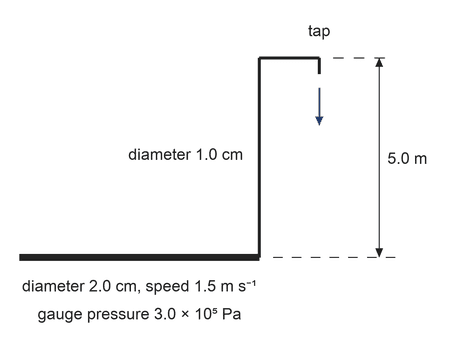
(a) Find the speed of the water in the narrow pipe.
(b) Find the gauge pressure in the narrow pipe at the height of the tap.
(c) Find the volume of water delivered per minute, in litres.
- 501 mark
Question 50
Hydrostatic pressure is a scalar quantity, even though pressure is force divided by area and force is a vector. Why?
- 512 marks
Question 51
(a) Ice floats in water with about nine-tenths of its volume submerged. What is the fraction submerged for an iceberg floating on freshwater lake of a (hypothetical) planet whose gravity is ten times that of the Earth?
(b) What is the fractional volume submerged of an ice cube in a pail of water placed in an enclosure which is freely falling under gravity?
- 522 marks
Question 52
The force required by a man to move his limbs immersed in water is smaller than the force for the same movement in air. Why?
- 532 marks
Question 53
A piece of iron sinks in water, but a ship made of iron floats in water. Why?
- 542 marks
Question 54
A man is sitting in a boat, which is floating in a pond. If the man drinks some water from the pond, will the level of water in the pond decrease?
- 552 marks
Question 55
A boat floating in a water tank is carrying a number of large stones. If the stones were unloaded into water, what will happen to water level?
- 562 marks
Question 56
An ice block with a cork piece embedded inside floats in water. What will happen to the level of water when ice melts?
- 571 mark
Question 57
What is the effect of temperature on coefficient of viscosity of a liquid?
- 582 marks
Question 58
What is the reason for floating of clouds in the sky?
- 592 marks
Question 59
“Bubbles of air can rise up through a liquid.” Why?
- 601 mark
Question 60
When we try to close a water tap with our fingers, fast jets of water gush through the opening between our fingers. Why?
- 612 marks
Question 61
Explain why a fluid flowing out of a small hole in a vessel results in a backward thrust on the vessel.
- 622 marks
Question 62
Roofs of the huts are blown up during stormy days. Why?
- 632 marks
Question 63
To keep a piece of paper horizontal, you should blow over, not under it. Why?
- 642 marks
Question 64
Why does flag flutter, when strong winds are blowing on a certain day?
- 652 marks
Question 65
When air is blown in between two balls suspended close to each other, they are attracted towards each other. Why?
- 663 marks
Question 66
What height of water column will produce the same pressure as a 760 mm high column of Hg?
- 673 marks
Question 67
Calculate the specific gravity of an iron piece having a mass of 200 g and volume 25 cm³.
- 683 marks
Question 68
A square plate of 0.1 m side moves parallel to another plate with a velocity of , both plates immersed in water. If the viscous force is 0.02 N and the coefficient of viscosity 0.01 poise, what is the distance apart?
- 693 marks
Question 69
A flat plate is separated from a large plate by a layer of glycerine of thickness m. If the coefficient of viscosity of glycerine is 2 N s/m², what is the force required to keep the plate moving with a velocity of m/s? Area of the plate is m².
- 703 marks
Question 70
Two metal plates of area each, are kept in water and one plate is moved over the other with a certain velocity. The distance between the plates is m. If the horizontal force applied to move the plate is N, calculate the velocity of the plate. Given of water is decapoise.
- 713 marks
Question 71
A flat plate of area 0.05 m² is separated from another large plate at rest by a liquid layer of uniform thickness 1 μm. The tangential force needed to move the smaller plate with a constant velocity of is 20 N. Calculate the coefficient of viscosity of the liquid.
- 723 marks
Question 72
A small glass sphere of radius m is moving through a liquid of viscosity 0.11 decapoise. Calculate the viscous force acting on it if the speed of the ball is .
- 733 marks
Question 73
A gas bubble of diameter 0.02 m rises steadily at the rate of through a solution of density . Calculate the coefficient of viscosity of the solution. Neglect the density of the gas.
- 743 marks
Question 74
A drop of water of radius m is falling through a medium whose density is and coefficient of viscosity poise. Find the terminal velocity of the drop.
- 753 marks
Question 75
The rate of flow of a liquid through a capillary tube of radius is under a pressure difference of . Calculate the rate of flow when the diameter is reduced to half and the pressure difference is made .
- 763 marks
Question 76
Calculate the mass of alcohol flowing in two minutes through a tube of radius m and length 0.5 m, if there is a constant pressure head of 0.6 m of alcohol. Density of alcohol is 800 kg/m³. Coefficient of viscosity of alcohol N s/m²?
- 773 marks
Question 77
A liquid flows through two capillary tube under the same pressure head. The lengths of the tube are in the ratio 2:1 and the ratio of their diameters is 2:3. Compare the rates of flow of liquid through the tubes.
- 783 marks
Question 78
An orifice of diameter 8 mm is made on one side of a tank in which water level is 10 mm above the orifice. What is the rate of discharge of water through the orifice?
- 793 marks
Question 79
Calculate the speed of efflux of kerosene oil from an orifice of a tank in which pressure is 4 atmosphere. Density of kerosene oil = 0.72 kg/litre.
- 803 marks
Question 80
Calculate the speed at which the velocity head of stream of water is equal to 40 cm of water.
- 811 mark
Question 81
The heart of man pumps 5 litres of blood through the arteries per minute at a pressure of 150 mm of mercury. If the density of mercury be and , the power of heart in watt is
- 821 mark
Question 82
The pressure at the bottom of a tank containing a liquid does not depend on
- 831 mark
Question 83
If the atmospheric pressure is , then the pressure at depth below the surface of a liquid of density open to the atmosphere is
- 841 mark
Question 84
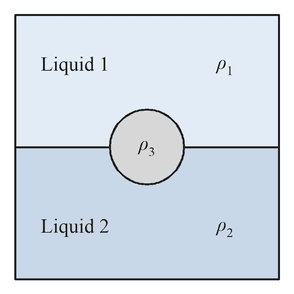
A jar is filled with two non-mixing liquids 1 and 2 having densities and , respectively. A solid ball, made of a material of density , is dropped in the jar. It comes to equilibrium in the position shown in the given figure. Which of the following is true for , and ?
- 851 mark
Question 85
Two non-mixing liquids of densities and are put in a container. The height of each liquid is . A solid cylinder of length and density is put in this container. The cylinder floats with its axis vertical and length in the denser liquid. The density is equal to
- 861 mark
Question 86
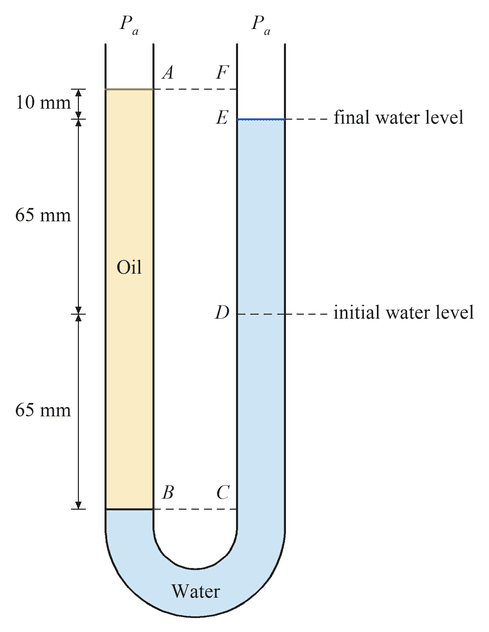
A tube with both ends open to the atmosphere, is partially filled with water. Oil, which is immiscible with water, is poured into one side until it stands at a distance of 10 mm above the water level on the other side. Meanwhile the water rises by 65 mm from its original level, as shown in the given figure. The density of the oil is
- 871 mark
Question 87
A spherical solid ball of volume is made of a material of density . It is falling through a liquid of density . Assume that the liquid applies a viscous force on the ball that is proportional to the square of its speed , i.e., . The terminal speed of the ball is
- 881 mark
Question 88
Two spheres of the same material but of radii and are allowed to fall vertically downwards through a liquid of density . The ratio of their terminal velocities is
- 891 mark
Question 89
An ice block contains a glass ball when the ice melts within the water containing vessel, the level of water
- 901 mark
Question 90
The working of an atomiser depends upon
- 911 mark
Question 91
If the terminal speed of a sphere of gold (density ) is 0.2 m/s in a viscous liquid (density ), find the terminal speed of a sphere of silver (density ) of the same size in the same liquid.
- 921 mark
Question 92
According to Bernoulli's equation,
The terms A, B and C are generally called respectively
- 931 mark
Question 93
Consider the following equation of Bernoulli's theorem.
The dimensions of are same as that of which of the following
- 941 mark
Question 94
Aerofoils are so designed that the speed of air
- 951 mark
Question 95
Water falls from a tap, down the streamline
- 961 mark
Question 96
A fluid is in streamline flow across of a horizontal pipe of variable area of cross section. For this which of the following statements is correct?
- 971 mark
Question 97
A large open tank has two holes in the wall. One is a square hole of side at a depth from the top and the other is a circular hole of radius at a depth from the top. When the tank is completely filled with water, the quantities of water flowing out per second from both the holes are the same. Then is equal to
- 981 mark
Question 98
The cylindrical tube of a spray pump has radius, , one end of which has fine holes, each of radius . If the speed of the liquid in the tube is , the speed of the ejection of the liquid through the holes is
- 991 mark
Question 99
Water is filled in a cylindrical container to a height of 3 m as shown in the given figure. The ratio of the cross-sectional area of the orifice and the beaker is 0.1. The square of the speed of the liquid coming out from the orifice is

- 1001 mark
Question 100
A small sphere of radius '' falls from rest in a viscous liquid. As a result, heat is produced due to viscous force. The rate of production of heat when the sphere attains its terminal velocity, is proportional to
- 1011 mark
Question 101
The top of a water tank is open to air and its water level is maintained. It is giving out water per minute through a circular opening of 2 cm radius in its wall. The depth of the centre of the opening from the level of water in the tank is close to
- 1021 mark
Question 102
Water flows into a large tank with flat bottom at the rate of . Water is also leaking out of a hole of area at its bottom. If the height of the water in the tank remains steady, then this height is
- 1031 mark
Question 103
A liquid of density is coming out of a hose pipe of radius with horizontal speed and hits a mesh. 50% of the liquid passes through the mesh unaffected. 25% loses all of its momentum and 25% comes back with the same speed. The resultant pressure the mesh will be
- 1041 mark
Question 104
Water from a pipe is coming at a rate of 100 litres per minute. If the radius of the pipe is 5 cm, the Reynolds number for the flow is of the order of (density of water , coefficient of viscosity of water )
- 1051 mark
Question 105
A wooden block floating in a bucket of water has of its volume submerged. Where certain amount of an oil is poured into the bucket, it is found that the block is just under the oil surface with half of its volume under water and half in oil. The density of oil relative to that of water is
- 1061 mark
Question 106
A submarine experiences a pressure of at a depth of in a sea. When it goes further to a depth of , it experiences a pressure of . Then is approximately (density of water and acceleration due to gravity )
- 1071 mark
Question 107
A cubical block of side 0.5 m floats on water with 30% of its volume under water. What is the maximum weight that can be put on the block without fully submerging it under water (take density of water )?
- 1081 mark
Question 108
A solid sphere of radius acquires a terminal velocity when falling (due to gravity) through a viscous fluid having a coefficient of viscosity . The sphere is broken into 27 identical solid spheres. If each of these spheres acquires a terminal velocity when falling through the same fluid, the ratio equals
- 1091 mark
Question 109
A small hole of area of cross section is present near the bottom of a fully filled open tank of height 2 m. Taking . The rate of flow of water through the open hole would be nearly
- 1101 mark
Question 110
A leak proof cylinder of length 1 m, made of a metal which has very low coefficient of expansion is floating vertically in water at 0°C such that its height above the water surface is 20 cm. When the temperature of water is increased to 4°C, the height of the cylinder above the water surface becomes 21 cm. The density of water at relative to the density at is close to
- 1111 mark
Question 111
An ideal fluid flows (laminar flow) through a pipe of non-uniform diameter. The maximum and minimum diameters of pipes are 6.4 cm and 4.8 cm, respectively. The ratio of the minimum and the maximum velocities of fluid in this pipe is
- 1121 mark
Question 112
In an experiment to verify Stokes' law, a small spherical ball of radius and density falls under gravity through a distance in air before entering a tank of water. If the terminal velocity of the ball inside water is same as its velocity just before entering the water surface, then the value of is proportional to (ignore viscosity of air)
- 1131 mark
Question 113
Consider a solid sphere of radius and mass density
The minimum density of a liquid in which it will float is
- 1141 mark
Question 114
A cube of metal is subjected to a hydrostatic pressure 4 GPa. The percentage change in the length of the side of the cube is close to (Given bulk modulus of metal )
- 1151 mark
Question 115
An air bubble of radius 1 cm in water has an upward acceleration . The density of water is and water offers negligible drag force on the bubble. The mass of the bubble is
- 1161 mark
Question 116
A hollow spherical shell at outer radius floats just submerged under the water surface. The inner radius of the shell is . If the specific gravity of the shell material is w.r.t. water, the value of is
- 1171 mark
Question 117
The normal density of a material is and its bulk modulus of elasticity is . The magnitude of increase in density of material, when a pressure is applied uniformly on all sides, will be
- 1181 mark
Question 118
A fluid is flowing through a horizontal pipe of varying cross-section, with speed at a point where the pressure is Pascal. At another point where pressure is Pascal, its speed is . If the density of the fluid is and the flow is streamline, then is equal to
- 1191 mark
Question 119
The pressure acting on a submarine is at a certain depth. If the depth is doubled, the percentage increase in the pressure acting on the submarine would be (Assume that atmospheric pressure is , density of water is , )
- 1201 mark
Question 120
The velocity of a small ball of mass and density , when dropped in a container filled with glycerine, become constant after some time. If the density of glycerine is , then the viscous force acting on the ball will be
- 1211 mark
Question 121
A raindrop with radius falls from a cloud at a height above the ground. Assume that the drop is spherical throughout its fall and the force of buoyance may be neglected, then the terminal speed attained by the raindrop is
[Density of water , density of air , and coefficient of viscosity of air ]
- 1221 mark
Question 122
An object is located at 2 km beneath the surface of the water. If the fractional compression is 1.36%, the ratio of hydraulic stress to the corresponding hydraulic strain will be ______ [Given, density of water is and ]
- 1231 mark
Question 123
Which of the following equations is dimensionally incorrect?
Where = time, = height, = surface tension, = angle, = density, , = radius, = acceleration due to gravity, = volume, = pressure, = work done, = torque, = permittivity, = electric field, = current density, = length
(A)
(B)
(C)
(D)
- 1241 mark
Question 124
If is the density and is the coefficient of viscosity of fluid which flows with a speed in a pipe of diameter , the correct formula for Reynold's number is
- 1251 mark
Question 125
A hydraulic automobile lift is designed to lift vehicle of mass 5000 kg. The area of cross-section of the cylinder carrying the load is . The maximum pressure the smaller piston would have to bear is
- 1261 mark
Question 126
Given below are two statements:
Statement I: Pressure in a reservoir of water is same at all points at the same level of water.
Statement II: The pressure applied to enclosed water is transmitted in all directions equally. In the light of above statements, choose the correct answer from the options given below.
- 1271 mark
Question 127
Assertion: A thin stainless steel needle can lay floating on a still water surface.
Reason: Any object floats when the buoyancy force balances the weight of the object.
- 1281 mark
Question 128
Assertion: In taking into account the fact that any object which floats must have an average density less than that of water, during world war I, a number of cargo vessels are made of concrete.
Reason: Concrete cargo vessels were filled with air.
- 1291 mark
Question 129
Assertion: A bubble comes from the bottom of a lake to the top.
Reason: Its radius increases.
- 1301 mark
Question 130
Assertion: The buoyant force on a submerged rigid object can be considered to be acting at the centre of mass of the object.
Reason: For a rigid body, a force field distributed uniformly through its volume can be considered to be acting at the centre of mass of the body.
- 1311 mark
Question 131
Assertion: The pressure of water reduces when it flows from a narrow pipe to a wider pipe.
Reason: Since for a wider pipe area is large, so flow of speed is small and pressure also reduces proportionately.
- 1321 mark
Question 132
A spherical ball of radius 1 mm and density 10.5 g/cc is dropped in glycerine of coefficient of viscosity 9.8 poise and density 1.5 g/cc. Viscous force on the ball when it attains constant velocity is N. The value of is ______.
[Given , .]
- 1331 mark
Question 133
The surface of water in a water tank of cross-section area on the top of a house is m above the tap level. The speed of water coming out through the tap of cross-section area is 30 cm/s. At that instant, is m/s. The value of will be ______.