
Opening your dashboard
Class 11 Physics Chapter 14 Fluid Pressure and Viscosity: Competency-Based Questions (CBQ)
45 questions on Chapter 14, each worked through on its own page with the AI tutor. Class 11 Physics, ICSE 2026-27.
45 questions
1–4 marks · Mixed difficulty
- 13 marks
Question 1
Competency: Application
A housing society stores its water in a tank on the roof of a tall block of flats. The water surface in the tank is above the ground. The floors are apart, and on every floor the taps are above that floor, so the ground-floor taps are above the ground. When all the taps are closed, the water in the pipes is at rest. (Hypothetical data.) Take and the density of water as .
(a) Find the gauge pressure of the water at a closed ground-floor tap.
(b) A washing machine works properly only if the gauge pressure at its tap is at least . Counting the ground floor as floor 0, find the highest floor on which a washing machine fed from this tank works properly.
(c) The society plans to replace the tank with one twice as wide, holding twice as much water, with its water surface at the same height. A member says that the pressure at the ground-floor taps will then double. Is the member right? Explain.
- 21 mark
Question 2
Competency: Analysis & Evaluation
Engineers designing a concrete dam across a river valley make its wall much thicker at the bottom than at the top.
Assertion (A): The wall of a dam is made much thicker at its base than at its top.
Reason (R): The pressure that the water exerts on the dam increases with depth below the water surface.
- 31 mark
Question 3
Competency: Application
A diver's electronic depth gauge measures the gauge pressure of the water around it and turns it into a depth by assuming that the water is sea water of density . The diver uses the gauge in a freshwater lake (density ) and stops at a true depth of . (Hypothetical data.) Take . The depth shown by the gauge is
- 43 marks
Question 4
Competency: Application
A suction-cup hook is pressed onto the underside of a smooth horizontal glass shelf, and a load is hung from its hook, as shown in the figure. The rim of the cup seals a circle of diameter against the glass. After pressing, the air trapped under the cup is at an absolute pressure of of mercury, while the atmospheric pressure in the room is of mercury. (Hypothetical data.) Take the density of mercury as and , and ignore the mass of the cup and any leaks.
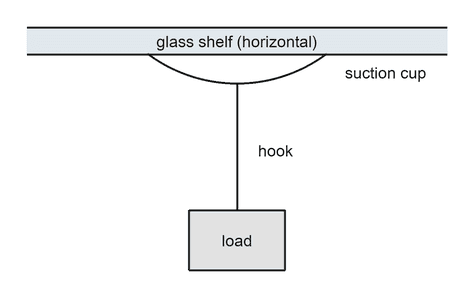
(a) Find, in pascals, the difference between the atmospheric pressure and the pressure of the trapped air.
(b) Find the largest load (as a force and as a mass) that the hook can hold before the cup is pulled off.
(c) The same cup, again with its trapped air at of mercury, is used at a hill station where the atmospheric pressure is of mercury. By what fraction does the largest load change?
- 51 mark
Question 5
Competency: Analysis & Evaluation
A tourist buys a sealed packet of potato chips at the foot of a mountain and carries it up to a high pass, where it is noticeably colder. On the way up, the packet swells like a pillow.
Assertion (A): A sealed packet of chips carried up a mountain swells up.
Reason (R): The air sealed in the packet expands because the air temperature is lower at high altitude.
- 63 marks
Question 6
Competency: Application
A cotton mill uses a hydraulic press to squeeze cotton into bales, as shown in the figure. The operator works a lever that pushes a small pump piston of diameter into the oil; the oil drives up a ram of diameter , which presses the cotton against a fixed plate. A relief valve lets oil escape if its pressure goes above , so this is the largest pressure the press can use. The lever multiplies the operator's push times. (Hypothetical data.) Ignore friction and the weights of the pistons.

(a) Find the largest force that the ram can exert on the cotton.
(b) Find the force on the pump piston, and the push the operator must apply to the lever, when the oil is at this largest pressure.
(c) The underside of the ram is higher than the underside of the pump piston, and the oil has a density of . Take . By how much is the pressure under the ram less than the pressure under the pump piston, and is it reasonable to treat the pressure as the same everywhere in the oil?
- 71 mark
Question 7
Competency: Analysis & Evaluation
A mechanic finds that a car's brake pedal feels “spongy”: it goes down much farther than usual before the brakes grip. The mechanic traces the fault to a bubble of air trapped in the brake fluid. The best explanation of the spongy pedal is that
- 83 marks
Question 8
Competency: Application
In a sports-science laboratory, the body density of an athlete is found by weighing the athlete under water. The athlete's mass in air is . Seated on a chair that hangs from a scale in a tank, the athlete breathes out fully and goes completely under water; the scale then shows an apparent mass of . This reading has already been corrected for the chair and for the small amount of air that always stays in the lungs. A simple model treats the body as fat of density and lean tissue of density . (Hypothetical data.) Take the density of water as .
(a) Use Archimedes' principle to find the volume of the athlete's body and its average density.
(b) Find the fraction of the athlete's mass that is fat, according to the model.
(c) Suppose the athlete had kept an extra litres of air in the lungs instead of breathing out fully. Find the apparent mass and the fat fraction the method would then give, and explain why the athlete must breathe out fully.
- 91 mark
Question 9
Competency: Analysis & Evaluation
A child holds a helium balloon on a short string inside a car with all its windows closed. When the car pulls away quickly from a traffic light, a key hanging from the mirror swings backwards, but the balloon leans forwards.
Assertion (A): When a closed car accelerates forwards, a helium balloon held on a string inside it leans forwards.
Reason (R): When the car accelerates forwards, the air in the car crowds towards the back, so the air pressure at the back of the car becomes greater than at the front.
- 101 mark
Question 10
Competency: Analysis & Evaluation
At a science fair, a “Cartesian diver” is made from a small glass dropper that is partly filled with water and has a bubble of air trapped at its closed upper end. It floats just at the top of a plastic bottle that is filled to the brim with water and tightly capped. When the bottle is squeezed, the diver sinks; when the squeeze is released, the diver rises again. The diver sinks because
- 111 mark
Question 11
Competency: Analysis & Evaluation
Engineers designing a jet engine note that the hot gases inside it are more viscous than the same gases at room temperature, whereas the engine's lubricating oil becomes less viscous as it warms up.
Assertion (A): The coefficient of viscosity of a gas increases when the gas is heated.
Reason (R): The molecules of a gas are much farther apart than the molecules of a liquid.
- 121 mark
Question 12
Competency: Analysis & Evaluation
During steady rain, water runs down a smooth sloping roof as a thin sheet of uniform thickness. The flow is steady and streamline, the air above exerts almost no drag on the water, and the water obeys Newton's formula for viscosity. Within the sheet, the viscous force per unit area between neighbouring layers is greatest
- 133 marks
Question 13
Competency: Application
A water-treatment plant lets river water stand in a settling tank deep so that particles in it sink to the bottom. Treat the particles as small spheres that fall at their terminal speeds through still water (density , coefficient of viscosity ), and assume that Stokes' law holds. The mineral grains have a density of . (Hypothetical data.) Take .
(a) Find the terminal speed of a silt grain of radius , and the time it takes to settle through the full depth of the tank.
(b) Clay grains of the same mineral have a radius of only . Using a ratio, find how long they take to settle through the tank.
(c) The plant adds alum, which makes the clay grains stick together into loose clumps (flocs) of radius and average density . Find how long the flocs take to settle through the tank, and explain why adding alum helps.
- 141 mark
Question 14
Competency: Analysis & Evaluation
In a laboratory, a steel ball is dropped into a tall jar of oil. After a short distance it falls at a steady speed all the way to the bottom.
Assertion (A): While the ball falls at its terminal speed, it loses no mechanical energy, because no net force acts on it.
Reason (R): At terminal speed, the viscous force on the ball balances its weight minus the upthrust on it.
- 151 mark
Question 15
Competency: Application
A recycling laboratory separates a mixture of tiny glass beads (density ) and plastic beads (density ), all of radius , by letting them settle through a tall column of still water (density ). Both kinds of bead fall at their terminal speeds and obey Stokes' law. (Hypothetical data.) Compared with a plastic bead, a glass bead falls
- 163 marks
Question 16
Competency: Analysis & Evaluation
An Ostwald viscometer, shown in the figure, compares the viscosity of a liquid with that of water. The same volume of each liquid is put into it in turn and sucked up the narrow limb above mark A; then the time taken for the level to fall from A to B, as the liquid drains through the capillary, is measured. The viscometer stands vertically in a water bath at . With water (density , coefficient of viscosity ) the time is ; with ethanol (density ) it is . (Hypothetical data.)

(a) Using Poiseuille's formula, show that for liquids 1 and 2 timed in this way, .
(b) Find the coefficient of viscosity of ethanol.
(c) The radius of the capillary is hard to measure precisely. Explain why this method does not need it, and find the error in that a error in the radius would cause if were found directly from Poiseuille's formula instead.
- 171 mark
Question 17
Competency: Analysis & Evaluation
A town engineer wants to estimate the pressure needed to drive water through a wide water main in which the flow is turbulent. A trainee suggests using Poiseuille's formula.
Assertion (A): Poiseuille's formula cannot be used to find the rate of flow of water in a wide water main where the flow is turbulent.
Reason (R): Poiseuille's formula holds only for an ideal liquid, whose coefficient of viscosity is zero.
- 183 marks
Question 18
Competency: Analysis & Evaluation
A pipeline of internal diameter carries crude oil (density ) at an average speed of . In summer the coefficient of viscosity of the oil is ; on cold winter nights it rises to . Take the Reynolds number as , where is the internal diameter of the pipe, and take the flow to be streamline when is below about 2000 and turbulent when it is above about 3000. (Hypothetical data.)
(a) Find the Reynolds number of the flow in summer, and say whether the flow is streamline or turbulent.
(b) Find the Reynolds number on a winter night, at the same speed, and state the type of flow.
(c) Find the volume of oil delivered per hour, and state in which season Poiseuille's formula could be used to estimate the pressure needed to drive the oil, giving a reason.
- 191 mark
Question 19
Competency: Analysis & Evaluation
A student watching water flow through a glass tube says: “If I open the tap to make the water go twice as fast, the flow will surely become turbulent.”
Assertion (A): If the speed of the water in a pipe is doubled, a flow that was streamline will always become turbulent.
Reason (R): For a given pipe and liquid, the Reynolds number is directly proportional to the speed of flow.
- 203 marks
Question 20
Competency: Application
A Doppler ultrasound scan of an artery in a patient's neck measures the average speed of the blood as at point P, where the internal diameter of the artery is , and as at point Q, in a part narrowed by a fatty deposit, as shown in the figure. (Hypothetical data.) Treat the blood as an incompressible liquid of density in steady flow, and the artery as horizontal.
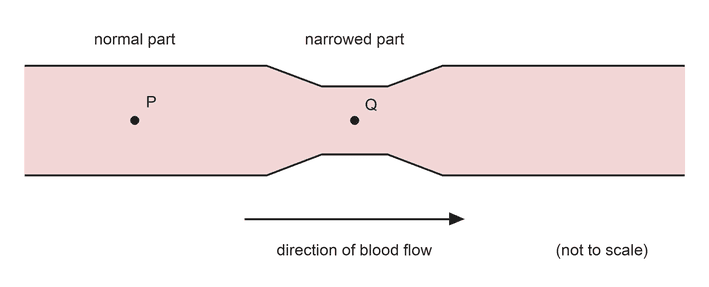
(a) Find the volume of blood passing P each second, in .
(b) Use the equation of continuity to find the internal diameter of the artery at Q, and the fraction by which the diameter is reduced there.
(c) Treating the blood as an ideal liquid, use Bernoulli's theorem to find how much lower the pressure is at Q than at P, in pascals and in mmHg ().
- 211 mark
Question 21
Competency: Application
Toothpaste is squeezed steadily out of a tube. Near the nozzle, the body of the tube is still round, with an internal diameter of ; the nozzle has an internal diameter of . The ribbon of paste leaves the nozzle at . (Hypothetical data.) Treating the paste as incompressible and moving at one speed across each cross-section, the speed of the paste in the round part of the tube is about
- 223 marks
Question 22
Competency: Application
Firefighters must send a jet of water straight up to a fire above the nozzle. The hose has an internal diameter of and the nozzle an internal diameter of . (Hypothetical data.) Treat the water as an ideal liquid of density , take , ignore air resistance, and take the nozzle and the hose just behind it to be at the same level.
(a) Find the least speed with which the water must leave the nozzle.
(b) Find the speed of the water in the hose, and the least gauge pressure needed in the hose just behind the nozzle.
(c) Find the volume of water used each minute.
- 231 mark
Question 23
Competency: Analysis & Evaluation
A family notices that the smoke from their kitchen chimney goes up more readily on windy days than on calm days.
Assertion (A): Smoke goes up a chimney more readily when a wind blows across the top of the chimney.
Reason (R): The hot gases in a chimney are less dense than the cold air outside.
- 241 mark
Question 24
Competency: Application
During a cyclone, wind blows at across the flat roof of a house, while the air inside the house is still and at atmospheric pressure. The roof has an area of , and the density of air is . (Hypothetical data.) Assume that the moving air started from still air at atmospheric pressure, and apply Bernoulli's theorem, ignoring differences in height. The upward force on the roof due to the pressure difference is about
- 253 marks
Question 25
Competency: Analysis & Evaluation
A small wind tunnel draws air through a settling chamber of square cross-section, by , into a test section of square cross-section, by , as shown in the figure. The air moves at in the settling chamber. Pressure tappings in the walls of the chamber and of the test section are joined to the two limbs of a water U-tube manometer. (Hypothetical data.) Take the density of air as , that of water as and , and ignore differences in height. Air may be treated as incompressible when its speed is well below the speed of sound in air, ; its density then changes by only about of its value.
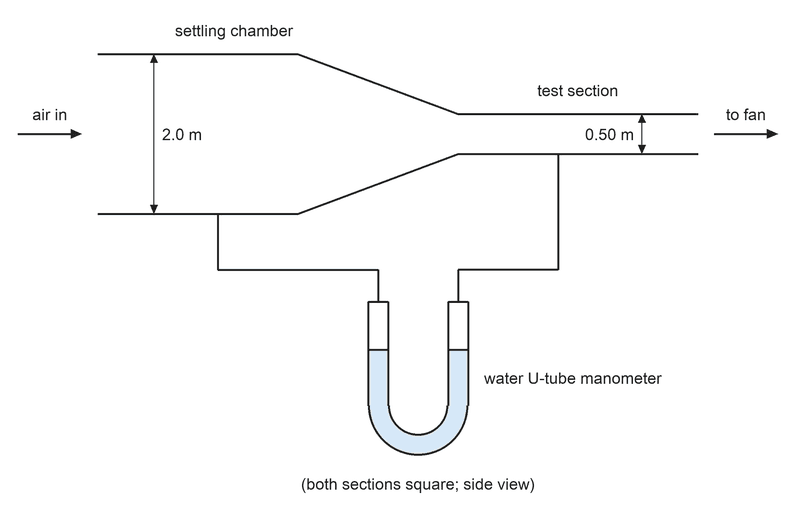
(a) Find the speed of the air in the test section.
(b) Find the pressure difference between the settling chamber and the test section, and the difference in the water levels of the manometer.
(c) Check whether treating the air as incompressible is reasonable in this tunnel.
- 264 marks
Question 26
A large flat plate of area is pulled at a steady over a fixed parallel plate. The gap holds two liquids that do not mix: a layer of glycerine mm thick (coefficient of viscosity Pa s) next to the fixed plate, and a layer of oil mm thick (coefficient of viscosity Pa s) next to the moving plate, as shown in the figure. (Hypothetical data.) The flow is steady and laminar, and the speed changes linearly across each layer.

(a) Explain why the viscous force per unit area is the same in both layers.
(b) Find the speed of the boundary between the two liquids.
(c) Find the force needed to keep the plate moving.
- 273 marks
Question 27
A piece of wood of volume 0.6 m³ floats in water. Find the volume exposed. What force is required to immerse it completely under water? Density of wood = 800 kg/m³.
- 283 marks
Question 28
A cube of side 4 cm is just completely immersed in a liquid A. When it is put in a liquid B, it floats with 2 cm outside the liquid. Calculate the ratio of densities of the two liquids.
- 293 marks
Question 29
An iron block is suspended from a string and is then completely immersed in a container of water. The mass of iron is 1 kg and its density is 7200 kg/m³. What is the tension in the string before and after the iron block is immersed?
- 303 marks
Question 30
An iron ball of radius 0.3 cm falls through a column of oil of density . It is found to attain a terminal velocity of . Determine the viscosity of the oil. Given that the density of iron is .
- 313 marks
Question 31
An air bubble of diameter 2 cm is allowed to rise through a long cylindrical column of viscous liquid and travels at the rate of . If the density of the liquid is , find the coefficient of viscosity. Density of air is neglected.
- 323 marks
Question 32
Compute the terminal velocity of a rain drop of radius 0.3 mm. Take coefficient of viscosity of air poise and density of air . Density of water , .
- 333 marks
Question 33
A glass ball of radius m and density fall in a jar filled with oil of density . The terminal velocity is found to be . Calculate the coefficient of viscosity of oil.
- 343 marks
Question 34
A steel ball of radius m is released in an oil of viscosity and density . Calculate the terminal velocity of ball. Take density of steel as .
- 353 marks
Question 35
Determine the radius of a drop of water falling through air, if it covers 0.048 m in 4 s with a uniform velocity. Assume the density of air as 0.00121 g/cc and .
- 363 marks
Question 36
Two equal drops of water are falling through air with a steady velocity of 10 cm/s. If the drops recombine to form a single drop, what would be their terminal velocity?
- 373 marks
Question 37
In giving a patient blood transfusion, the bottle is set up so that the level of blood is 1.3 m above the needle, which has an internal diameter of 0.36 mm and is 0.03 m in length. If 4.5 cc of blood passes through the needle in one minute, calculate the viscosity of blood if density is .
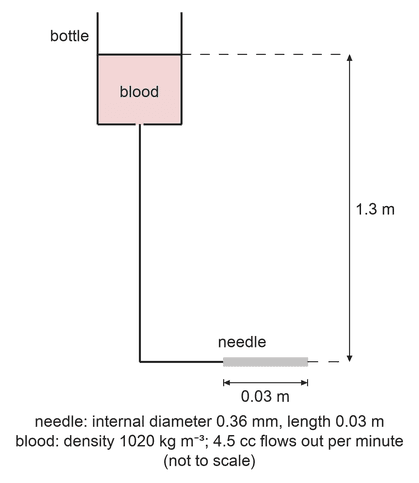
- 383 marks
Question 38
A capillary tube of length 0.6 m and radius m is connected in series with another capillary tube of length 0.45 m and radius m. The tubes are arranged horizontally. End is connected to a vessel of water having constant pressure head of 0.8 m. The end is open to the atmosphere. Find the pressure at the junction .

- 393 marks
Question 39
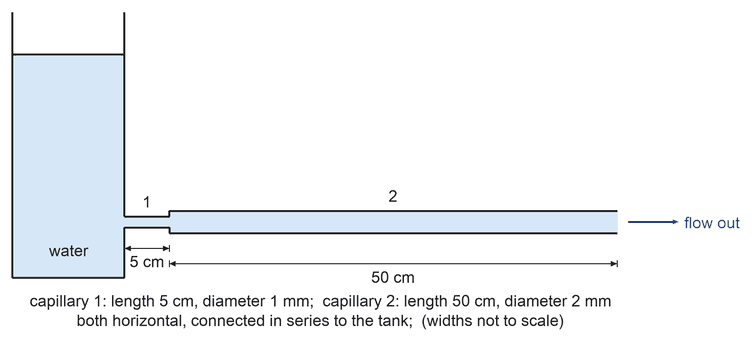
A capillary tube of length 5 cm and diameter 1 mm is connected to a tank horizontally. The rate of flow of water is 10 cc per minute. Calculate the rate of flow of water through another capillary tube of diameter 2 mm and length 50 cm is connected in series with the first capillary.
- 403 marks
Question 40
Water flows through a hose (pipe) whose internal diameter is 2 cm at a speed of 1 m/s. What should be the diameter of the nozzle if the water is to emerge at a speed of 4 m/s?
- 413 marks
Question 41
The reading of pressure meter attached with a closed water pipe is . On opening the valve of the pipe, the reading of pressure meter is reduced to . Calculate the speed of water flowing out of the pipe.
- 423 marks
Question 42
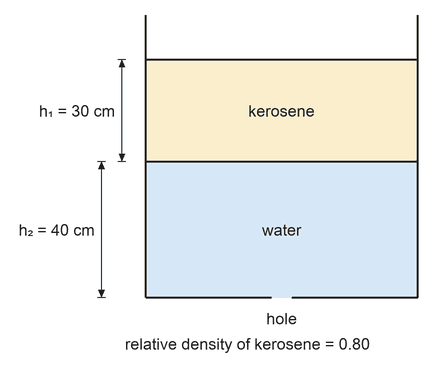
A wide tank is filled with water and kerosene. The tank has a small hole at the bottom. The height of water layer is 40 cm and that of the kerosene layer is 30 cm. Find the velocity of the water flow, neglecting the viscosity. Given relative density of kerosene is 0.80.
- 433 marks
Question 43
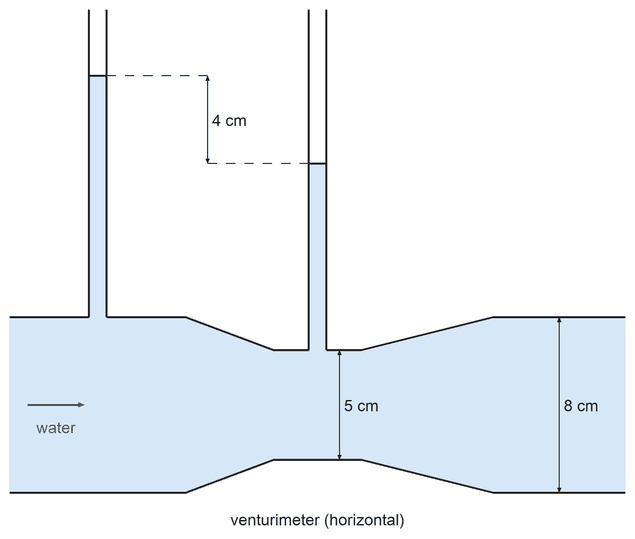
The diameter of a pipe at two points where a venturimeter is connected is 5 cm and 8 cm and the difference of level in it is 4 cm. Calculate the mass of water flowing through the pipe per second.
- 443 marks
Question 44
A large storage tank is filled to a height . There is a hole at the height from the bottom of the tank as shown in the given figure. How far from the tank will the stream land?

- 454 marks
Question 45
The cross-section area of the pipe shown in the given figure is 50 cm² at the wider portions and 20 cm² at the constriction.

The rate of flow of water through the pipe is 4000 cm³/s. Find
(i) the velocities at the wide and the narrow portions,
(ii) the pressure difference between these portions and
(iii) the difference in height between the mercury columns in the U-tube.