
Competency: Application
A suction-cup hook is pressed onto the underside of a smooth horizontal glass shelf, and a load is hung from its hook, as shown in the figure. The rim of the cup seals a circle of diameter against the glass. After pressing, the air trapped under the cup is at an absolute pressure of of mercury, while the atmospheric pressure in the room is of mercury. (Hypothetical data.) Take the density of mercury as and , and ignore the mass of the cup and any leaks.
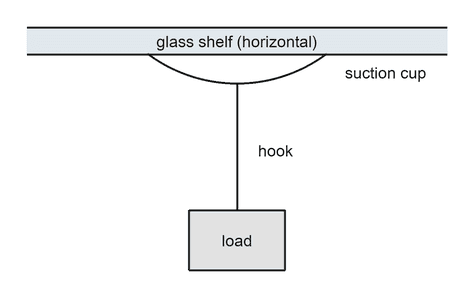
(a) Find, in pascals, the difference between the atmospheric pressure and the pressure of the trapped air.
(b) Find the largest load (as a force and as a mass) that the hook can hold before the cup is pulled off.
(c) The same cup, again with its trapped air at of mercury, is used at a hill station where the atmospheric pressure is of mercury. By what fraction does the largest load change?