
Opening your dashboard
Class 10 Chemistry Chapter 10: Study of Compounds – Nitric Acid Solutions
49 textbook questions with step-by-step answers, free to read, for ICSE 2026-27.
Get talked through Ch 10, not just shown the answer
Reading a finished solution is not the same as being able to do it. The AI tutor takes one question at a time and works it with you, in your own words, until you can.
- Ask it out loud, in your own words
- It gives you the next step, not the answer
- Stuck on part (ii)? Start there
49 questions with solutions
1–5 marks · Mixed difficulty
- 11 mark
Question 1
Fill in the blank :
Cold dil. nitric acid reacts with copper to form ............. (hydrogen, nitrogen dioxide, nitric oxide).
Solve with AIWritten solution
Solution:
Concept: Nitric acid is an oxidising acid, so it does not give hydrogen with copper. Cold, dilute nitric acid is reduced to nitric oxide (NO); concentrated acid gives nitrogen dioxide instead.
Step 1 — See what the blank asks.
We need the gas formed when copper reacts with cold, dilute nitric acid, chosen from hydrogen, nitrogen dioxide and nitric oxide.
Step 2 — Write the reaction.
Copper is oxidised to copper nitrate, and the dilute acid is reduced to nitric oxide:
Step 3 — Check with the observation.
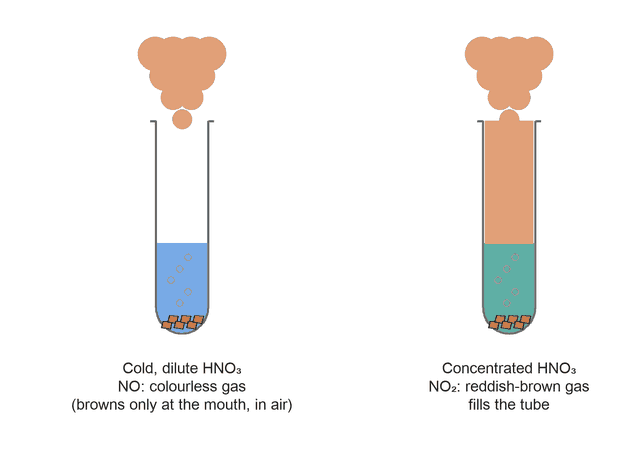
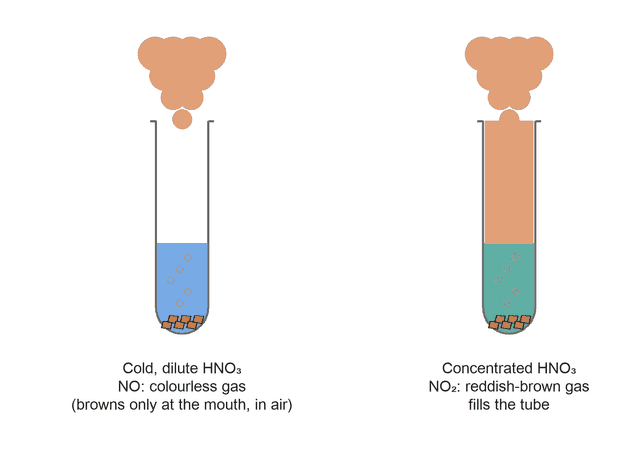
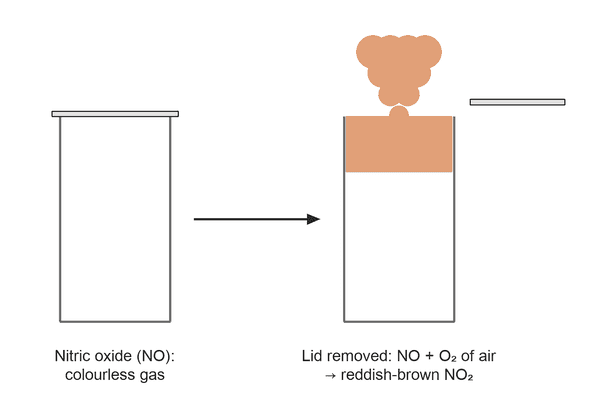
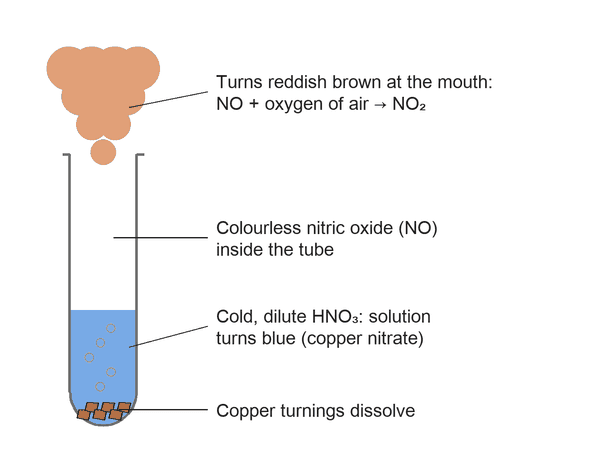
The gas in the tube is colourless, so it is not nitrogen dioxide. At the mouth of the tube it meets the oxygen of the air and turns reddish brown, which is what nitric oxide does.

Watch out: Hydrogen is never the answer for copper: copper is below hydrogen in the activity series, and nitric acid oxidises any hydrogen to water.
Therefore, cold dil. nitric acid reacts with copper to form nitric oxide.
- 25 marks
Question 2
What is : (a) aqua fortis, (b) aqua regia (c) Fixation of Nitrogen ?
Solve with AIWritten solution
Solution:
Concept: These are three standard terms from the chemistry of nitric acid and nitrogen. Each needs a definition and one supporting fact.
Step 1 — (a) Aqua fortis.
Aqua fortis (Latin for 'strong water') is the old name for nitric acid, . It got this name because it attacks nearly all metals and turns them into soluble nitrates; it even dissolves silver and copper, which hydrochloric acid and dilute sulphuric acid do not attack.
Step 2 — (b) Aqua regia.
Aqua regia ('royal water') is a mixture of 1 part concentrated nitric acid and 3 parts concentrated hydrochloric acid by volume. The nitric acid oxidises the hydrochloric acid, giving nitrosyl chloride and nascent chlorine, [Cl]:
The nascent chlorine attacks even the noble metals gold and platinum, which no single acid dissolves, and turns them into soluble chlorides:
Step 3 — (c) Fixation of atmospheric nitrogen.
Fixation of nitrogen is the conversion of free atmospheric nitrogen into useful nitrogenous compounds (such as nitrates and ammonia) that plants can use. For example, during lightning the nitrogen and oxygen of the air combine:
The nitric oxide is finally washed into the soil as nitrates. Nitrogen-fixing bacteria in the root nodules of leguminous plants also fix nitrogen.
Watch out: Aqua regia is 3 parts HCl to 1 part HNO₃, not the other way round.
Therefore, (a) aqua fortis is nitric acid; (b) aqua regia is 1 part conc. HNO₃ + 3 parts conc. HCl, which dissolves gold and platinum; (c) fixation of nitrogen is the conversion of free atmospheric nitrogen into useful nitrogen compounds.
- 32 marks
Question 3
During thunderstorm, rain water contains nitric acid. Explain with reactions.
Solve with AIWritten solution
Solution:
Concept: The very high temperature of a lightning discharge (about 3000 °C) makes the nitrogen and oxygen of the air combine. The product is changed step by step into nitric acid, which comes down with the rain.
Step 1 — Lightning makes nitric oxide.
At the temperature of the lightning flash, nitrogen combines with oxygen to form colourless nitric oxide:
Step 2 — Nitric oxide is oxidised in air.
The nitric oxide combines with more oxygen of the air to give reddish-brown nitrogen dioxide:
Step 3 — Nitrogen dioxide dissolves in rain.
Nitrogen dioxide dissolves in the rain water, in the presence of oxygen, forming nitric acid:

Step 4 — The acid reaches the soil.
The nitric acid is washed down by the rain and reacts with salts in the soil to form nitrates. This is a natural fixation of nitrogen.
Watch out: Nitrogen and oxygen do not combine at ordinary temperatures; the very high temperature of lightning is needed.
Therefore, thunderstorm rain contains nitric acid because lightning makes N₂ and O₂ form NO, which is oxidised to NO₂, and NO₂ dissolves in rain water with oxygen to give HNO₃.
- 45 marks
Question 4
Ammonia is used in the Ostwald process,
(a) Give the source of reactants used in this process.
(b) Name the catalyst used in the process.
(c) Name the oxidising agent used in this process.
(d) What is the ratio of ammonia and air taken in this process?
(e) Why is quartz used in this process ?
Solve with AIWritten solution
Solution:
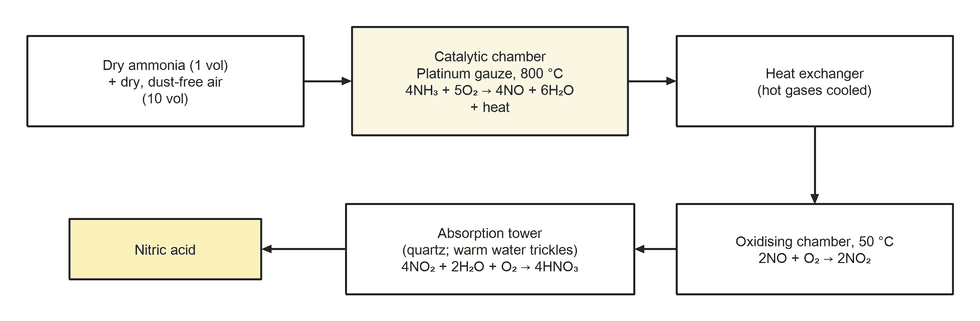
Concept: In the Ostwald process, ammonia is oxidised by the oxygen of the air over a platinum gauze catalyst at about 800 °C to nitric oxide. Nitric oxide is then oxidised by more air to nitrogen dioxide, which is absorbed in water, with air, to give nitric acid. The figure shows the stages.

Step 1 — (a) Sources of the reactants.
Each reactant comes from a cheap, plentiful source:
- Ammonia is made by the Haber process.
- Oxygen comes from air, which is first made dry and free of dust.
- Water is the warm water that trickles down the absorption tower.
Step 2 — (b) Catalyst.
The catalyst is platinum gauze, kept at about 800 °C. The reaction gives out heat, so once started it keeps the gauze hot:
Step 3 — (c) Oxidising agent.
The oxygen of the air is the oxidising agent. It oxidises ammonia to nitric oxide in the catalytic chamber, and nitric oxide to nitrogen dioxide in the oxidising chamber (about 50 °C):
Step 4 — (d) Ratio of ammonia and air.
Ammonia and air are taken in the ratio 1 : 10 by volume. A large excess of air is used because only about one-fifth of air is oxygen, and oxygen is needed in all three stages.
Step 5 — (e) Use of quartz.
The absorption tower is packed with quartz pieces because quartz is acid resistant: nitric acid does not attack it. The packing also gives a large surface, so the nitrogen dioxide dissolves uniformly in the trickling water:
Watch out: The catalyst is platinum, not iron (iron is the Haber-process catalyst).
Therefore, (a) ammonia from the Haber process, oxygen from dry dust-free air, and water; (b) platinum gauze; (c) oxygen of the air; (d) ammonia : air = 1 : 10 by volume; (e) quartz is acid resistant and helps NO₂ dissolve uniformly.
- 55 marks
Question 5
(a) Write a balanced chemical equation for the laboratory preparation of nitric acid.
(b) In the preparation of nitric acid from KNO, concentrated hydrochloric acid is not used in place of concentrated sulphuric acid. Explain why ?
(c) Conc. nitric acid prepared in laboratory is yellow in colour. Why ? How is this colour removed ?
(d) Give reasons for the following :
In the laboratory preparation of nitric acid, the mixture of concentrated sulphuric acid and sodium nitrate should not be heated very strongly above 200°C.
Solve with AIWritten solution
Solution:
Concept: In the laboratory, nitric acid is made by heating potassium nitrate (nitre) with concentrated sulphuric acid in an all-glass retort, below 200 °C. Concentrated sulphuric acid is non-volatile, so it displaces the volatile nitric acid, which distils over and is condensed in a cooled receiver.
Step 1 — (a) Equation for the laboratory preparation.
Equal weights of potassium nitrate and conc. sulphuric acid are heated gently (180–200 °C) in an all-glass retort. Potassium hydrogen sulphate and nitric acid form:

Step 2 — (b) Why not conc. hydrochloric acid.
Hydrochloric acid is itself volatile. On heating, its vapours would distil over together with the nitric acid vapours, so the nitric acid collected would be impure. Conc. sulphuric acid is non-volatile, so only nitric acid distils over.
Step 3 — (c) Why the acid is yellow.
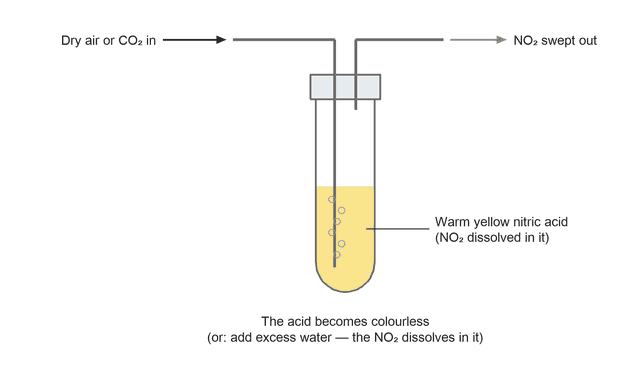
During the distillation, a portion of the nitric acid decomposes on heating. The reddish-brown nitrogen dioxide formed dissolves in the acid and makes it yellow:
Step 4 — (c) How the colour is removed.
The dissolved NO₂ is removed in either of two ways:
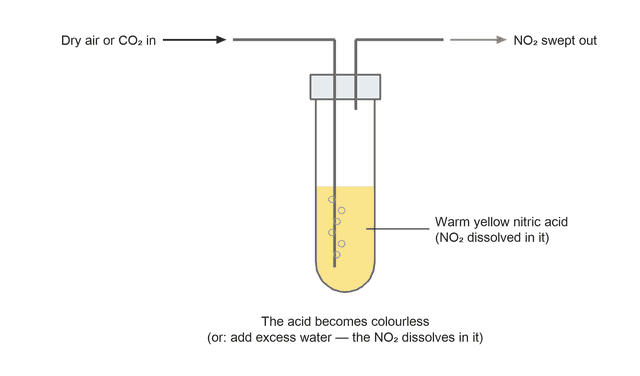
- Bubble dry air or carbon dioxide through the warm yellow acid. The gas sweeps out the NO₂, and the acid becomes colourless.
- Add excess water. The nitrogen dioxide dissolves in the water and turns back into nitric acid.
Step 5 — (d) Why not above 200 °C.
At a higher temperature the acid salt reacts further and the normal salt, sodium sulphate, forms:
- The sodium sulphate forms a hard crust that sticks to the walls of the retort and is difficult to remove.
- The high temperature may damage the glass retort.
- More of the nitric acid decomposes, and fuel is wasted.
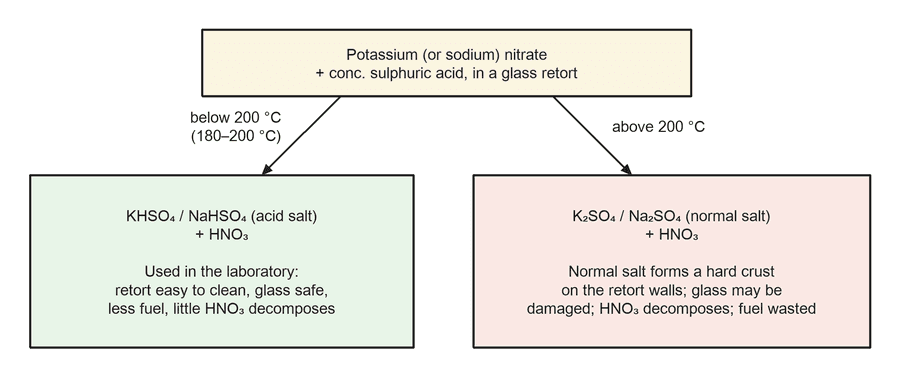
Watch out: The reaction below 200 °C gives the acid salt (KHSO₄ or NaHSO₄), not the normal salt.
Therefore, (a) KNO₃ + H₂SO₄ → KHSO₄ + HNO₃ (below 200 °C); (b) HCl is volatile and would make the nitric acid impure; (c) dissolved NO₂ from decomposition makes it yellow, removed by bubbling dry air or CO₂ through the warm acid (or adding water); (d) above 200 °C a hard crust of Na₂SO₄ forms, the glass may crack, the acid decomposes and fuel is wasted.
- 64 marks
Question 6
(a) Nitric acid cannot be concentrated beyond 68% by the distillation of a dilute solution of HNO. State the reason.
(b) What is passive iron ? How is passivity removed?
Solve with AIWritten solution
Solution:
Concept: 68% nitric acid is a constant boiling mixture, and passivity is caused by a very thin oxide layer on the metal surface.
Step 1 — (a) Why distillation stops at 68%.
An aqueous solution containing 68% nitric acid forms a constant boiling mixture, which boils at about 121 °C. At this composition the vapour has the same composition as the liquid, so distilling it only gives back 68% acid. Distillation therefore cannot concentrate it further.
Step 2 — (a) How a stronger acid is made.
To get a stronger acid (up to about 98%, fuming nitric acid), the 68% acid is distilled with conc. sulphuric acid, which holds back the water.
Step 3 — (b) What passive iron is.
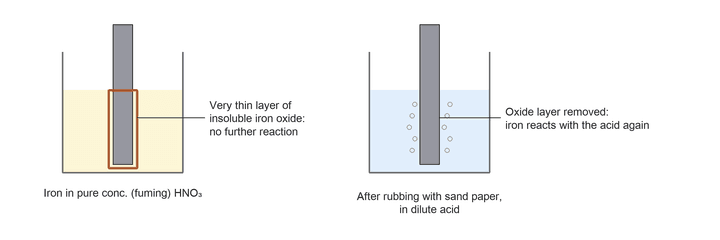
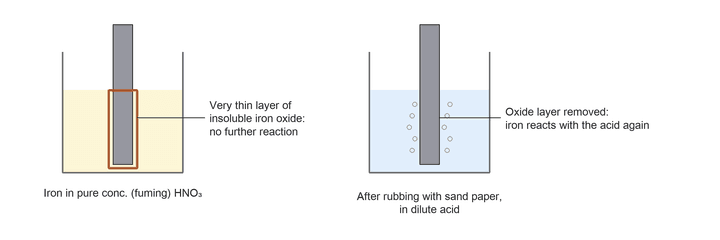
When iron is dipped in pure concentrated (fuming) nitric acid, it becomes passive (inert): afterwards it no longer reacts, even with dilute acids. The acid forms an extremely thin layer of insoluble iron oxide on the surface, and this layer stops any further reaction. Aluminium, cobalt and nickel are also made passive in this way.
Step 4 — (b) How passivity is removed.
The oxide layer is removed by rubbing the surface with sand paper, or by treating the metal with strong reducing agents. The iron then becomes active again.
Watch out: Passivity is a surface effect: the iron itself is unchanged under the thin oxide layer.
Therefore, (a) 68% nitric acid is a constant boiling mixture, so its vapour has the same composition as the liquid; (b) passive iron is iron made inert by a thin insoluble oxide layer formed by fuming nitric acid, removed by rubbing with sand paper or treating with strong reducing agents.
- 74 marks
Question 7
Name the products formed when :
(a) carbon and conc. nitric acid is heated,
(b) dilute HNO is added to copper.
Solve with AIWritten solution
Solution:
Concept: Nitric acid is a strong oxidising agent: it readily gives nascent oxygen, [O], which oxidises metals and non-metals. The acid itself is reduced to an oxide of nitrogen: nitrogen dioxide, NO₂ (reddish brown) from the concentrated acid, and nitric oxide, NO (colourless) from the dilute acid.
Step 1 — (a) Carbon heated with conc. nitric acid.
The nascent oxygen of the hot concentrated acid oxidises carbon to carbon dioxide, and the acid is reduced to reddish-brown nitrogen dioxide:

Step 2 — (b) Dilute nitric acid and copper.
The dilute acid oxidises copper to copper (II) nitrate (a blue solution) and is itself reduced to colourless nitric oxide, which turns brown at the mouth of the tube in air:
Watch out: Copper and dilute nitric acid give nitric oxide (NO), not hydrogen and not nitrogen dioxide.
Therefore, (a) carbon dioxide, nitrogen dioxide and water; (b) copper (II) nitrate, nitric oxide and water.
- 85 marks
Question 8
Give two chemical equations for each of the following :
(a) Reactions of nitric acid with non-metals.
(b) Nitric acid showing as acidic character.
(c) Nitric acid acting as oxidising agent.
Solve with AIWritten solution
Solution:
Concept: As an acid, nitric acid neutralises bases and decomposes carbonates. As an oxidising agent, its nascent oxygen oxidises non-metals and metals, and the acid is reduced to NO₂ (concentrated acid) or NO (dilute acid).
Step 1 — (a) Reactions with non-metals.
Hot concentrated nitric acid oxidises carbon to carbon dioxide and sulphur to sulphuric acid, giving off reddish-brown NO₂:
Step 2 — (b) Acidic character.
Like any acid, nitric acid gives a salt and water with an alkali, and a salt, water and carbon dioxide with a carbonate:
Step 3 — (c) Oxidising agent.
Nitric acid oxidises copper, which dilute hydrochloric and dilute sulphuric acids do not attack. The concentrated acid gives NO₂ and the dilute acid gives NO:
Watch out: In (b) choose reactions that only show acid behaviour (salt + water); the reaction with copper shows oxidising behaviour, not acidic behaviour.
Therefore, (a) C and S with hot conc. HNO₃; (b) HNO₃ with NaOH and with CaCO₃; (c) HNO₃ (conc. and dilute) with copper, as written above.
- 95 marks
Question 9
Write balanced equations and name the products formed when :
(a) sodium hydrogen carbonate is added to nitric acid,
(b) cupric oxide reacts with nitric acid,
(c) zinc reacts with dilute nitric acid,
(d) concentrated nitric acid is heated.
Solve with AIWritten solution
Solution:
Concept: Parts (a) and (b) show the acidic character of nitric acid; part (c) shows its oxidising character; part (d) shows that it is unstable to heat.
Step 1 — (a) Sodium hydrogen carbonate and nitric acid.
The acid decomposes the hydrogen carbonate with brisk effervescence of carbon dioxide:
The products are sodium nitrate, water and carbon dioxide.
Step 2 — (b) Cupric oxide and nitric acid.
The black basic oxide dissolves in the acid to give a blue solution of the salt:
The products are copper (II) nitrate and water.
Step 3 — (c) Zinc and dilute nitric acid.
No hydrogen is given off, because the acid's nascent oxygen oxidises it to water; the acid is reduced to nitric oxide:
The products are zinc nitrate, water and nitric oxide.
Step 4 — (d) Concentrated nitric acid heated.
The acid decomposes and reddish-brown fumes appear:
The products are nitrogen dioxide, water and oxygen.
Watch out: Zinc with dilute nitric acid does not give hydrogen (only very dilute, about 1%, acid gives hydrogen, and then only with magnesium and manganese).
Therefore, (a) NaNO₃, H₂O and CO₂; (b) Cu(NO₃)₂ and H₂O; (c) Zn(NO₃)₂, H₂O and NO; (d) NO₂, H₂O and O₂.
- 105 marks
Question 10
How will you prepare the following from nitric acid ?
(a) Sodium nitrate (b) Copper nitrate
(c) Lead nitrate (d) Magnesium nitrate
(e) Ferric nitrate (f) Aqua regia
Solve with AIWritten solution
Solution:
Concept: A metal oxide or hydroxide (a base) reacts with dilute nitric acid to give only the soluble metal nitrate and water. Add the base to the acid until no more dissolves, filter off the excess, and evaporate the filtrate to get crystals of the nitrate.
Step 1 — (a) Sodium nitrate.
Neutralise the acid with sodium hydroxide solution:
Step 2 — (b) Copper nitrate.
Dissolve copper (II) oxide in the acid:
Step 3 — (c) Lead nitrate.
Dissolve lead (II) oxide in the acid:
Step 4 — (d) Magnesium nitrate.
Dissolve magnesium oxide in the acid:
Step 5 — (e) Ferric nitrate.
Dissolve ferric hydroxide in the acid:
Step 6 — (f) Aqua regia.
Mix 1 volume of conc. nitric acid with 3 volumes of conc. hydrochloric acid. The nitric acid oxidises the hydrochloric acid to nascent chlorine:
Watch out: For sodium nitrate use titration with an indicator, since sodium hydroxide is soluble and its excess cannot be filtered off.
Therefore, each nitrate is made by reacting nitric acid with the metal's oxide or hydroxide (NaOH, CuO, PbO, MgO, Fe(OH)₃), and aqua regia by mixing 1 volume of conc. HNO₃ with 3 volumes of conc. HCl.
- 115 marks
Question 11
Write equation for the following conversions A, B, C and D.
 Solve with AI
Written solution
Solution:
Concept: Follow the copper round the cycle. In A copper is oxidised by nitric acid; in B copper nitrate is decomposed by heat; in C copper is oxidised by air; in D copper oxide is reduced back to copper.
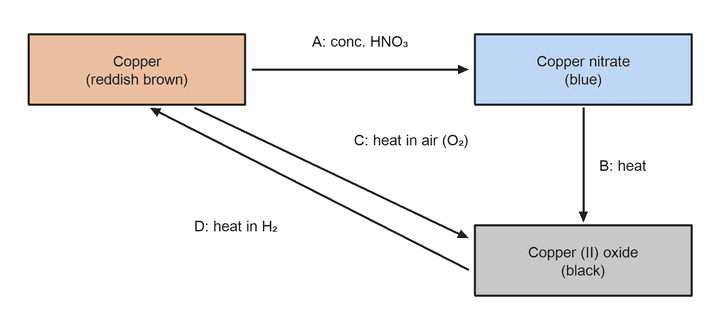
Step 1 — A: copper to copper nitrate.
Concentrated nitric acid oxidises copper; reddish-brown NO₂ is given off and the solution turns blue:
Step 2 — B: copper nitrate to copper oxide.
On heating, copper nitrate gives reddish-brown NO₂ and oxygen and leaves a black residue of copper (II) oxide:
Step 3 — C: copper to copper oxide.
Copper heated in air is oxidised to black copper (II) oxide:
Step 4 — D: copper oxide to copper.
Heated copper (II) oxide is reduced by hydrogen; the black solid turns reddish brown:
Watch out: Copper does not give hydrogen with nitric acid, so A is an oxidation, not a displacement.
Therefore, A: Cu + 4HNO₃ → Cu(NO₃)₂ + 2H₂O + 2NO₂; B: 2Cu(NO₃)₂ → 2CuO + 4NO₂ + O₂; C: 2Cu + O₂ → 2CuO; D: CuO + H₂ → Cu + H₂O.
- 125 marks
Question 12
Correct the following, if required :
(a) HNO is a strong reducing agent.
(b) NaNO gives NO and O on heating.
(c) Constant boiling nitric acid contains 80% nitric acid by weight.
(d) Nitric acid remains colourless even when exposed to light.
(e) Magnesium reacts with nitric acid to liberate hydrogen gas.
Solve with AIWritten solution
Solution:
Concept: Each statement is wrong as printed. For each, write the corrected statement and give the reason.
Step 1 — (a) Oxidising, not reducing.
is a strong oxidising agent. It readily gives nascent oxygen, which oxidises metals and non-metals:
Step 2 — (b) Sodium nitrate gives no NO₂.
gives sodium nitrite and oxygen on heating. Sodium and potassium nitrates give only oxygen:
Step 3 — (c) The constant boiling mixture is 68%.
Constant boiling nitric acid contains 68% nitric acid by weight, and it boils at about 121 °C.
Step 4 — (d) The acid turns yellow in light.
Nitric acid turns yellow when exposed to light. It decomposes, and the nitrogen dioxide formed dissolves in it:
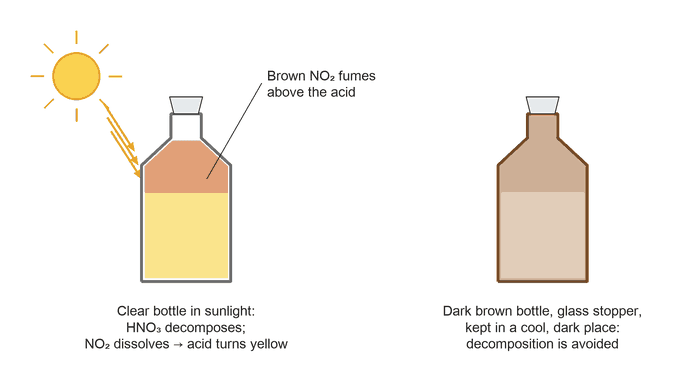
Step 5 — (e) Hydrogen only with very dilute acid.
Magnesium liberates hydrogen only with very dilute (about 1%) nitric acid. At this dilution the oxidising action of the acid is so weak that the hydrogen is not oxidised to water:
Watch out: In (e), ordinary dilute nitric acid does not give hydrogen even with magnesium.
Therefore, (a) HNO₃ is a strong oxidising agent; (b) NaNO₃ gives NaNO₂ and O₂ on heating; (c) constant boiling nitric acid contains 68% HNO₃; (d) nitric acid turns yellow in light; (e) magnesium liberates hydrogen only with very dilute (1%) nitric acid.
- 131 mark
Question 13
The nitrate salt which does not give a mixture of NO and O on heating is :
Solve with AIAnswer
(A)
- Correct
(B)
(C)
(D)
Answer: (B)
Concept: Nitrates behave in four ways on heating. Sodium and potassium nitrates melt and give only oxygen, leaving the nitrite. Ammonium nitrate changes completely into dinitrogen oxide (N₂O) and steam, leaving nothing. Silver (and mercury) nitrates leave the metal, with NO₂ and O₂. Most other metal nitrates (lead, zinc, copper, calcium …) leave the metal oxide, with reddish-brown NO₂ and O₂.
Step 1 — Sort the four nitrates.
Potassium is an alkali metal, so potassium nitrate is in the group that gives only oxygen. Silver nitrate leaves silver; copper and zinc nitrates leave their oxides.
Step 2 — Write the reaction of the odd one.
Potassium nitrate melts and gives only oxygen, leaving potassium nitrite. No nitrogen dioxide is formed:

Watch out: Silver nitrate leaves the metal, not the oxide, but it still gives a mixture of NO₂ and O₂.
Why the other options are wrong:
- (A) : Silver nitrate leaves silver and gives a mixture of NO₂ and O₂.
- (C) : Copper nitrate leaves black CuO and gives a mixture of NO₂ and O₂.
- (D) : Zinc nitrate leaves ZnO and gives a mixture of NO₂ and O₂.
Therefore, the nitrate that does not give NO₂ and O₂ is KNO₃, option (B).
- 141 mark
Question 14
The chemical used in the brown ring test is :
Solve with AIAnswer
(A)
- Correct
(B)
(C)
(D)
Answer: (B)
Concept: The brown ring test detects the nitrate ion. Freshly prepared iron (II) sulphate reduces the nitrate (as nitric acid) to nitric oxide, and then joins with the nitric oxide to form the brown compound nitroso ferrous sulphate, FeSO₄·NO, at the junction with the conc. sulphuric acid layer.
Step 1 — Reduce the nitrate.
Iron (II) sulphate, in the presence of conc. sulphuric acid, reduces the nitric acid to nitric oxide and is itself oxidised to iron (III) sulphate:
Step 2 — Form the brown ring.
More iron (II) sulphate joins with the nitric oxide to give the brown compound:
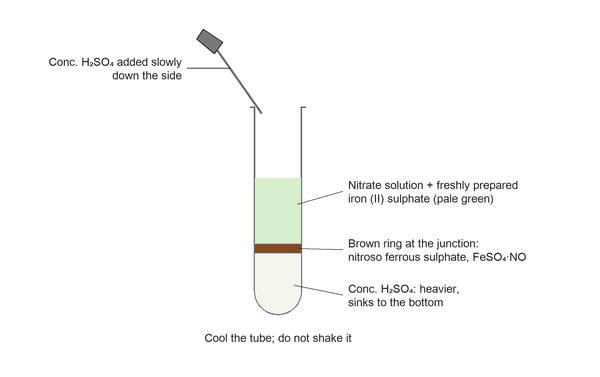
Watch out: The solution must be freshly prepared; old FeSO₄ solution is oxidised by air to Fe₂(SO₄)₃ and fails.
Why the other options are wrong:
- (A) : Copper sulphate cannot reduce the nitrate to NO and cannot form the brown compound.
- (C) : Iron (III) sulphate is already oxidised, so it cannot reduce the nitrate; it is what FeSO₄ turns into.
- (D) : Zinc sulphate takes no part in the test.
Therefore, the chemical used in the brown ring test is FeSO₄, option (B).
- 151 mark
Question 15
Lead nitrate decomposes on heating to give :
Solve with AIAnswer
(A) NO
(B)
- Correct
(C)
(D)
Answer: (C)
Concept: Nitrates behave in four ways on heating. Sodium and potassium nitrates melt and give only oxygen, leaving the nitrite. Ammonium nitrate changes completely into dinitrogen oxide (N₂O) and steam, leaving nothing. Silver (and mercury) nitrates leave the metal, with NO₂ and O₂. Most other metal nitrates (lead, zinc, copper, calcium …) leave the metal oxide, with reddish-brown NO₂ and O₂.
Step 1 — Place lead nitrate in its group.
Lead is a heavy metal, so its nitrate leaves the metal oxide and gives nitrogen dioxide and oxygen.
Step 2 — Write the reaction.
Lead nitrate crackles (decrepitates), gives reddish-brown NO₂ and leaves yellow lead (II) oxide:
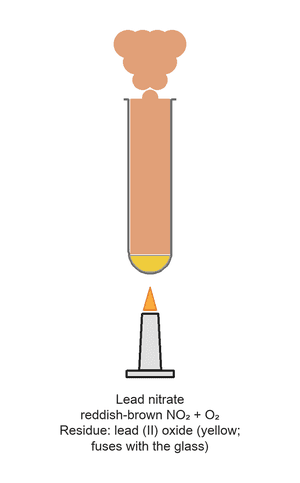
Why the other options are wrong:
- (A) NO: NO is formed when metals react with dilute nitric acid, not when nitrates are heated.
- (B) : N₂O is formed by heating ammonium nitrate.
- (D) : N₂O₅ is not a product of heating lead nitrate.
Therefore, lead nitrate decomposes on heating to give NO₂, option (C).
- 161 mark
Question 16
In the laboratory preparation of nitric acid, nitre is heated with :
Solve with AIAnswer
(A) conc. HCl
- Correct
(B) conc.
(C) dil.
(D) conc.
Answer: (B) conc.
Concept: In the laboratory, nitric acid is made by heating potassium nitrate (nitre) with concentrated sulphuric acid in an all-glass retort, below 200 °C. Concentrated sulphuric acid is non-volatile, so it displaces the volatile nitric acid, which distils over and is condensed in a cooled receiver.
Step 1 — Use a non-volatile acid.
A volatile acid is made from its salt with a non-volatile acid, so that only the volatile acid distils over. Conc. sulphuric acid is non-volatile.
Step 2 — Write the reaction.
Nitre (potassium nitrate) is heated gently with conc. sulphuric acid:
Why the other options are wrong:
- (A) conc. HCl: Conc. HCl is volatile; its vapours would distil over with the nitric acid and make it impure.
- (C) dil. : Dilute sulphuric acid contains much water, which would distil over and give only a dilute acid.
- (D) conc. : Conc. H₃PO₄ is not the reagent of the laboratory method; conc. H₂SO₄ is used.
Therefore, nitre is heated with conc. H₂SO₄, option (B).
- 171 mark
Question 17
Nitric acid is manufactured by :
Solve with AIAnswer
(A) Bayer's process
(B) Haber's process
- Correct
(C) Ostwald process
(D) Contact process
Answer: (C) Ostwald process
Concept: In the Ostwald process, ammonia is oxidised by the oxygen of the air over a platinum gauze catalyst at about 800 °C to nitric oxide. Nitric oxide is then oxidised by more air to nitrogen dioxide, which is absorbed in water, with air, to give nitric acid.
Step 1 — Recall the industrial method.
Nitric acid is manufactured from ammonia by the Ostwald process. Its first stage is the catalytic oxidation of ammonia:

Watch out: The Haber process makes ammonia, the raw material, not nitric acid itself.
Why the other options are wrong:
- (A) Bayer's process: Bayer's process purifies bauxite, the ore of aluminium.
- (B) Haber's process: Haber's process makes ammonia, the raw material of the Ostwald process.
- (D) Contact process: The Contact process makes sulphuric acid.
Therefore, nitric acid is manufactured by the Ostwald process, option (C).
- 181 mark
Question 18
The catalyst used in the manufacture of HNO is :
Solve with AIAnswer
- Correct
(A) Pt
(B)
(C) Fe
(D) Pd
Answer: (A) Pt
Concept: In the Ostwald process, ammonia is oxidised by the oxygen of the air over a platinum gauze catalyst at about 800 °C to nitric oxide. Nitric oxide is then oxidised by more air to nitrogen dioxide, which is absorbed in water, with air, to give nitric acid.
Step 1 — Name the catalyst.
In the Ostwald process, ammonia and air are passed over platinum gauze at about 800 °C. The reaction gives out heat, which keeps the catalyst hot:
Why the other options are wrong:
- (B) : V₂O₅ is the catalyst of the Contact process (sulphuric acid).
- (C) Fe: Iron is the catalyst of the Haber process (ammonia).
- (D) Pd: Palladium is not the catalyst used in the Ostwald process.
Therefore, the catalyst used in the manufacture of HNO₃ is platinum, option (A).
- 191 mark
Question 19
Cold and dilute HNO reacts with Cu to give :
Solve with AIAnswer
(A)
- Correct
(B) NO
(C)
(D)
Answer: (B) NO
Concept: Nitric acid is a strong oxidising agent: it readily gives nascent oxygen, [O], which oxidises metals and non-metals. The acid itself is reduced to an oxide of nitrogen: nitrogen dioxide, NO₂ (reddish brown) from the concentrated acid, and nitric oxide, NO (colourless) from the dilute acid.
Step 1 — Use the concentration.
The acid here is cold and dilute, so it is reduced only as far as nitric oxide.
Step 2 — Write the reaction.
Copper is oxidised to copper nitrate and colourless NO is given off:
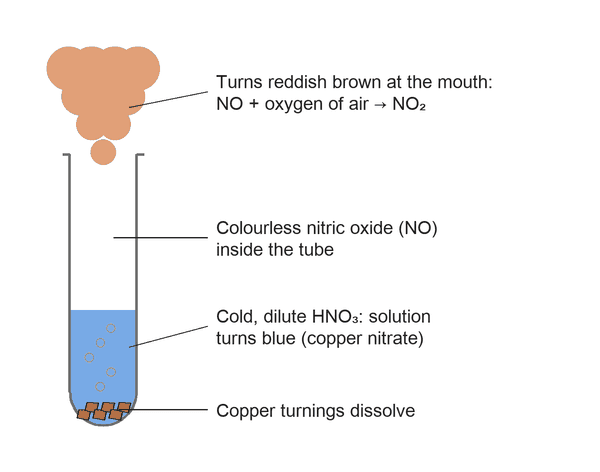
Watch out: NO is colourless; the brown colour seen at the mouth of the tube is NO₂ formed in air.
Why the other options are wrong:
- (A) : NO₂ is given by concentrated (or hot) nitric acid.
- (C) : Nitrogen gas is not formed in this reaction.
- (D) : Oxygen is not a product of copper with nitric acid.
Therefore, cold, dilute HNO₃ reacts with Cu to give NO, option (B).
- 201 mark
Question 20
The brown ring test is used for the detection of :
Solve with AIAnswer
(A)
(B)
- Correct
(C)
(D)
Answer: (C)
Concept: The brown ring test detects the nitrate ion. Freshly prepared iron (II) sulphate reduces the nitrate (as nitric acid) to nitric oxide, and then joins with the nitric oxide to form the brown compound nitroso ferrous sulphate, FeSO₄·NO, at the junction with the conc. sulphuric acid layer.
Step 1 — Link the test to its ion.
The brown compound needs nitric oxide, and nitric oxide comes only from the reduction of a nitrate (nitric acid) by iron (II) sulphate:
Why the other options are wrong:
- (A) : Carbonate is detected by effervescence of CO₂ with a dilute acid.
- (B) : Chloride is detected with silver nitrate solution (white precipitate).
- (D) : Sulphite is detected by the SO₂ it gives with a dilute acid.
Therefore, the brown ring test is used to detect NO₃⁻, option (C).
- 211 mark
Question 21
Sulphur reacts with conc. HNO to give :
Solve with AIAnswer
(A)
(B)
- Correct
(C)
(D)
Answer: (C)
Concept: Nitric acid is a strong oxidising agent: it readily gives nascent oxygen, [O], which oxidises metals and non-metals. The acid itself is reduced to an oxide of nitrogen: nitrogen dioxide, NO₂ (reddish brown) from the concentrated acid, and nitric oxide, NO (colourless) from the dilute acid.
Step 1 — Apply the oxidising action.
Hot conc. nitric acid oxidises sulphur all the way to sulphuric acid, and reddish-brown NO₂ is given off:
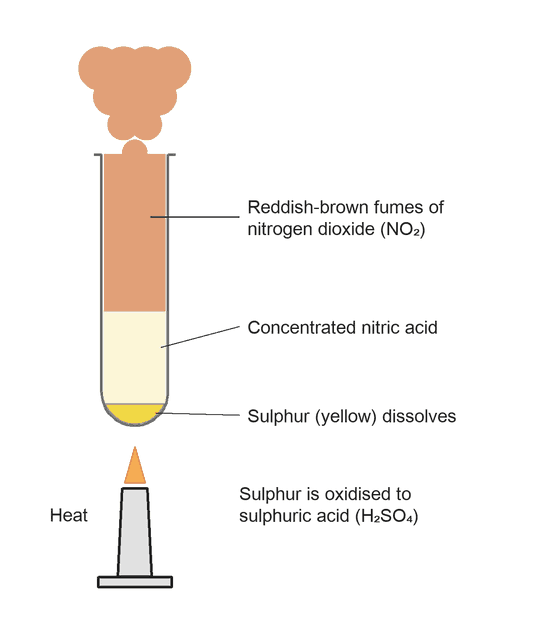
Why the other options are wrong:
- (A) : SO₂ is not the final product; the sulphur is oxidised fully to sulphuric acid.
- (B) : Hydrogen is not given off by conc. nitric acid.
- (D) : H₂S would need sulphur to be reduced, but nitric acid is an oxidising agent.
Therefore, sulphur reacts with conc. HNO₃ to give H₂SO₄, option (C).
- 221 mark
Question 22
The solvent for NO is :
Solve with AIAnswer
- Correct
(A) Freshly prepared
(B)
(C)
(D)
Answer: (A) Freshly prepared
Concept: Freshly prepared iron (II) sulphate solution absorbs nitric oxide, forming brown nitroso ferrous sulphate. This is the reaction behind the brown ring test.
Step 1 — Write the absorption.
Nitric oxide dissolves in fresh ferrous sulphate solution by forming a compound with it:
Step 2 — See why it must be fresh.
On standing, iron (II) sulphate is oxidised by air to iron (III) sulphate, which does not absorb NO.
Why the other options are wrong:
- (B) : Fe₂(SO₄)₃ is an iron (III) salt; it does not absorb NO.
- (C) : FeCl₃ is also an iron (III) salt; it does not absorb NO.
- (D) : FeCl₂ also contains iron (II), but a stored solution is oxidised by air, and the reagent named for absorbing NO is freshly prepared FeSO₄, so (A) is the intended answer.
Therefore, the solvent for NO is freshly prepared FeSO₄, option (A).
- 231 mark
Question 23
The acid which can be used to etch designs on brassware is :
Solve with AIAnswer
(A) HCl
- Correct
(B)
(C)
(D)
Answer: (B)
Concept: Nitric acid is a solvent for most metals (all except noble metals such as gold and platinum). It dissolves copper and zinc, the metals of brass, so it is used to etch designs on copper and brassware.
Step 1 — See how etching works.
The brass is coated with wax and the design is scratched through the wax. The acid dissolves only the exposed metal, for example the copper:
Why the other options are wrong:
- (A) HCl: Hydrochloric acid does not attack copper, so it cannot etch brass.
- (C) : Sulphuric acid attacks copper only when hot and concentrated; it is not used for etching brass.
- (D) : Carbonic acid is a very weak acid and does not attack copper.
Therefore, the acid used to etch designs on brassware is HNO₃, option (B).
- 241 mark
Question 24
HNO is kept in reagent bottles because it is :
Solve with AIAnswer
(A) an oxidising agent
(B) a reducing agent
(C) hygroscopic in nature
- Correct
(D) decomposed in the presence of light
Answer: (D) decomposed in the presence of light
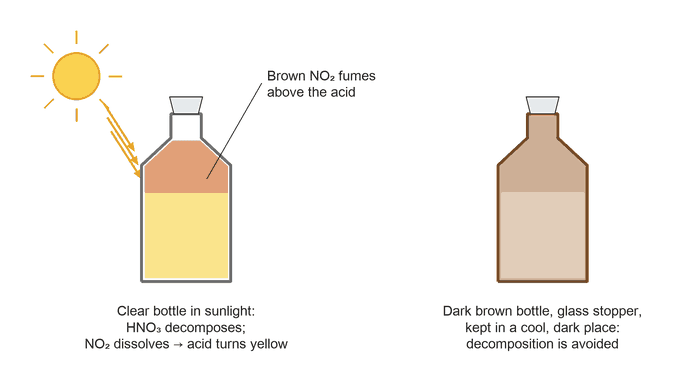
Concept: Nitric acid is unstable: in light, or on heating, part of it decomposes into nitrogen dioxide, water and oxygen. The reddish-brown NO₂ dissolves in the remaining acid and makes it yellow. So it is kept in coloured (brown) reagent bottles, away from light.
Step 1 — Write the decomposition.
Light decomposes nitric acid even at room temperature:
Step 2 — See how the bottle helps.
A coloured bottle cuts out the light, so the acid does not decompose.
Why the other options are wrong:
- (A) an oxidising agent: Nitric acid is an oxidising agent, but that is not why it is kept in coloured bottles.
- (B) a reducing agent: Nitric acid is not a reducing agent.
- (C) hygroscopic in nature: Being hygroscopic is not the reason for coloured bottles; they are used to keep out light.
Therefore, HNO₃ is kept in coloured reagent bottles because it decomposes in light, option (D).
- 251 mark
Question 25
The nitrate which does not leave any residue behind on heating is :
Solve with AIAnswer
(A)
- Correct
(B)
(C)
(D)
Answer: (B)
Concept: Nitrates behave in four ways on heating. Sodium and potassium nitrates melt and give only oxygen, leaving the nitrite. Ammonium nitrate changes completely into dinitrogen oxide (N₂O) and steam, leaving nothing. Silver (and mercury) nitrates leave the metal, with NO₂ and O₂. Most other metal nitrates (lead, zinc, copper, calcium …) leave the metal oxide, with reddish-brown NO₂ and O₂.
Step 1 — Find the nitrate with no metal.
Ammonium nitrate contains no metal, so all its products are gases (dinitrogen oxide and steam) and nothing is left:
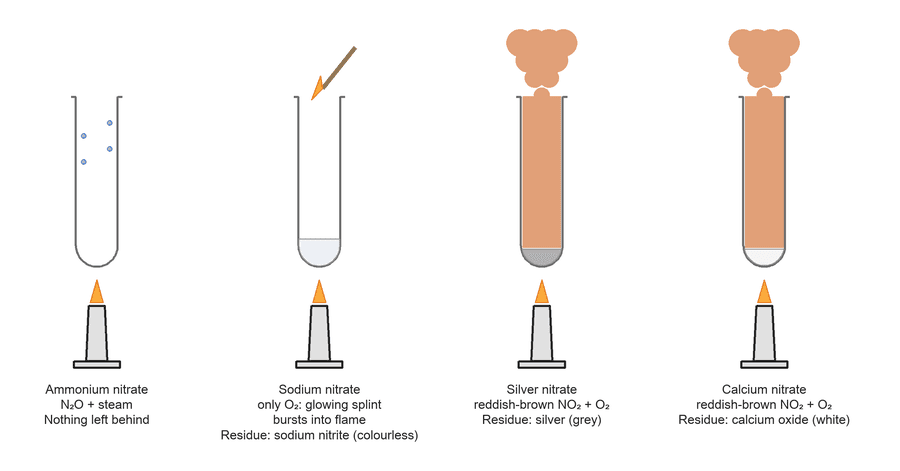
Why the other options are wrong:
- (A) : Sodium nitrate leaves sodium nitrite.
- (C) : Silver nitrate leaves silver.
- (D) : Calcium nitrate leaves calcium oxide.
Therefore, the nitrate that leaves no residue is NH₄NO₃, option (B).
- 261 mark
Question 26
On heating zinc nitrate, the products formed are zinc oxide, nitrogen dioxide and oxygen. Zinc oxide is :
P a black solid
Q brown when hot, yellow when cold
R yellow when hot, white when cold
Which of the following is true ?
Solve with AIAnswer
(A) Only P
(B) Only Q
- Correct
(C) Only R
(D) Both Q and R
Answer: (C) Only R
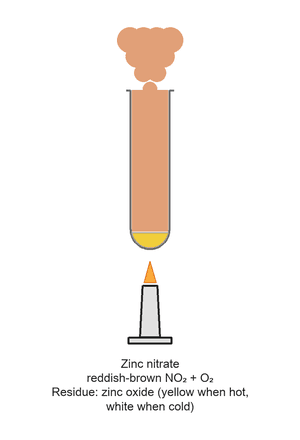
Concept: Zinc oxide is yellow when hot and white when cold, and this colour change identifies it.
Step 1 — Write the reaction.
Zinc nitrate decomposes on heating into zinc oxide, nitrogen dioxide and oxygen:
Step 2 — Judge each statement.
Compare each statement with the real colours:
- P is false: zinc oxide is not black (black is copper (II) oxide).
- Q is false: brown when hot and yellow when cold describes lead (II) oxide.
- R is true: zinc oxide is yellow when hot and white when cold.
Why the other options are wrong:
- (A) Only P: P is false.
- (B) Only Q: Q is false; it describes lead (II) oxide.
- (D) Both Q and R: Q is false, so 'both Q and R' cannot be true.
Therefore, only statement R is true, option (C).
- 271 mark
Question 27
The following questions are Assertion-Reason based questions. Choose the answer based on the codes given below.
(1) Both A and R are true and R is the correct explanation of A.
(2) Both A and R are true but R is not the correct explanation of A.
(3) A is true but R is false.
(4) A is false but R is true.
Assertion (A) : KNO and conc. HSO are the reactants for the preparation of nitric acid.
Reason (R) : Conc. HSO being a non volatile acid is required to prepare volatile acids.
Solve with AIAnswer
- Correct
(A) (1)
(B) (2)
(C) (3)
(D) (4)
Answer: (A) (1)
Concept: In an assertion–reason item, judge the assertion (A) and the reason (R) separately as true or false, and then decide whether R correctly explains A. A non-volatile acid is used to prepare a volatile acid from its salt.
Step 1 — Judge the assertion.
Potassium nitrate and conc. sulphuric acid are the reactants for the laboratory preparation of nitric acid, so A is true:
Step 2 — Judge the reason.
Conc. sulphuric acid is non-volatile, so it stays behind while the volatile acid distils over. R is true.
Step 3 — Link them.
This is exactly why conc. sulphuric acid is chosen, so R explains A.
Why the other options are wrong:
- (B) (2): Code (2) would mean R does not explain A, but it does.
- (C) (3): Code (3) says R is false, but R is true.
- (D) (4): Code (4) says A is false, but A is true.
Therefore, both A and R are true and R explains A, option (A).
- 281 mark
Question 28
The following questions are Assertion-Reason based questions. Choose the answer based on the codes given below.
(1) Both A and R are true and R is the correct explanation of A.
(2) Both A and R are true but R is not the correct explanation of A.
(3) A is true but R is false.
(4) A is false but R is true.
Assertion (A) : Nitric acid prepared in the laboratory is yellow in colour.
Reason (R) : Brown gas is used in its preparation.
Solve with AIAnswer
(A) (1)
(B) (2)
- Correct
(C) (3)
(D) (4)
Answer: (C) (3)
Concept: In an assertion–reason item, judge the assertion (A) and the reason (R) separately as true or false, and then decide whether R correctly explains A. Nitric acid is unstable: in light, or on heating, part of it decomposes into nitrogen dioxide, water and oxygen. The reddish-brown NO₂ dissolves in the remaining acid and makes it yellow.
Step 1 — Judge the assertion.
Nitric acid collected in the laboratory is slightly yellow, so A is true:
Step 2 — Judge the reason.
No brown gas is used: the reactants are potassium nitrate and conc. sulphuric acid. The brown gas is a decomposition product that dissolves in the acid. R is false.
Why the other options are wrong:
- (A) (1): Code (1) needs R to be true, but R is false.
- (B) (2): Code (2) needs R to be true, but R is false.
- (D) (4): Code (4) says A is false, but A is true.
Therefore, A is true but R is false, option (C).
- 291 mark
Question 29
The following questions are Assertion-Reason based questions. Choose the answer based on the codes given below.
(1) Both A and R are true and R is the correct explanation of A.
(2) Both A and R are true but R is not the correct explanation of A.
(3) A is true but R is false.
(4) A is false but R is true.
Assertion (A) : Catalytic oxidation of Ammonia does not require any external heat in Oswald process.
Reason (R) : Catalytic oxidation of ammonia is an endothermic process.
Solve with AIAnswer
(A) (1)
(B) (2)
- Correct
(C) (3)
(D) (4)
Answer: (C) (3)
Concept: In an assertion–reason item, judge the assertion (A) and the reason (R) separately as true or false, and then decide whether R correctly explains A. The catalytic oxidation of ammonia is exothermic.
Step 1 — Judge the assertion.
Once the reaction has started, the heat it gives out keeps the platinum gauze at about 800 °C, so no external heat is needed. A is true:
Step 2 — Judge the reason.
The reaction gives out heat, so it is exothermic, not endothermic. R is false.
Watch out: An endothermic reaction would need a continuous supply of heat, the opposite of what A says.
Why the other options are wrong:
- (A) (1): Code (1) needs R to be true, but R is false.
- (B) (2): Code (2) needs R to be true, but R is false.
- (D) (4): Code (4) says A is false, but A is true.
Therefore, A is true but R is false, option (C).
- 301 mark
Question 30
The following questions are Assertion-Reason based questions. Choose the answer based on the codes given below.
(1) Both A and R are true and R is the correct explanation of A.
(2) Both A and R are true but R is not the correct explanation of A.
(3) A is true but R is false.
(4) A is false but R is true.
Assertion (A) : The yellow colour of nitric acid is removed by using carbon dioxide gas or dry air.
Reason (R) : Carbon dioxide gas or dry air drives away NO gas from the warm nitric acid.
Solve with AIAnswer
- Correct
(A) (1)
(B) (2)
(C) (3)
(D) (4)
Answer: (A) (1)
Concept: In an assertion–reason item, judge the assertion (A) and the reason (R) separately as true or false, and then decide whether R correctly explains A. The yellow colour of nitric acid is due to dissolved NO₂.
Step 1 — Judge the assertion.
Bubbling carbon dioxide or dry air through the acid removes its yellow colour, so A is true.
Step 2 — Judge the reason.
These gases sweep the NO₂ out of the warm acid. R is true.
Step 3 — Link them.
Removing the NO₂ is exactly how the colour goes, so R explains A.
Why the other options are wrong:
- (B) (2): Code (2) would mean R does not explain A, but it does.
- (C) (3): Code (3) says R is false, but R is true.
- (D) (4): Code (4) says A is false, but A is true.
Therefore, both A and R are true and R explains A, option (A).
- 311 mark
Question 31
The following questions are Assertion-Reason based questions. Choose the answer based on the codes given below.
(1) Both A and R are true and R is the correct explanation of A.
(2) Both A and R are true but R is not the correct explanation of A.
(3) A is true but R is false.
(4) A is false but R is true.
Assertion (A) : Nitric acid reacts with NaOH/KOH to form salt and water.
Reason (R) : Alkalies react with acids to form salt and water.
Solve with AIAnswer
- Correct
(A) (1)
(B) (2)
(C) (3)
(D) (4)
Answer: (A) (1)
Concept: In an assertion–reason item, judge the assertion (A) and the reason (R) separately as true or false, and then decide whether R correctly explains A. Nitric acid is a strong monobasic acid, so it shows the general reaction acid + alkali → salt + water (neutralisation).
Step 1 — Judge the assertion.
Nitric acid reacts with sodium hydroxide (or potassium hydroxide) to form a salt and water, so A is true:
Step 2 — Judge the reason.
All alkalis react with acids to form a salt and water. R is true.
Step 3 — Link them.
A is one case of this general rule, so R explains A.
Why the other options are wrong:
- (B) (2): Code (2) would mean R does not explain A, but it does.
- (C) (3): Code (3) says R is false, but R is true.
- (D) (4): Code (4) says A is false, but A is true.
Therefore, both A and R are true and R explains A, option (A).
- 321 mark
Question 32
The following questions are Assertion-Reason based questions. Choose the answer based on the codes given below.
(1) Both A and R are true and R is the correct explanation of A.
(2) Both A and R are true but R is not the correct explanation of A.
(3) A is true but R is false.
(4) A is false but R is true.
Assertion (A) : Cold and dilute nitric acid oxidise metals to their nitrates and nitric oxide.
Reason (R) : Hot and concentrated nitric acid liberates nitrogen dioxide.
Solve with AIAnswer
(A) (1)
- Correct
(B) (2)
(C) (3)
(D) (4)
Answer: (B) (2)
Concept: In an assertion–reason item, judge the assertion (A) and the reason (R) separately as true or false, and then decide whether R correctly explains A. The product of nitric acid with a metal depends on the concentration and temperature of the acid: cold, dilute acid gives NO; hot, concentrated acid gives NO₂.
Step 1 — Judge the assertion.
Cold, dilute nitric acid oxidises metals such as copper to nitrates and gives nitric oxide, so A is true:
Step 2 — Judge the reason.
Hot, concentrated nitric acid gives nitrogen dioxide, so R is true:
Step 3 — Link them.
R is about the concentrated acid, so it does not explain why the dilute acid gives nitric oxide.
Watch out: Two true statements about the same acid need not explain each other; check that R gives the reason for A.
Why the other options are wrong:
- (A) (1): Code (1) would need R to explain A, but R is about a different acid strength.
- (C) (3): Code (3) says R is false, but R is true.
- (D) (4): Code (4) says A is false, but A is true.
Therefore, both A and R are true but R does not explain A, option (B).
- 335 marks
Question 33
Name :
(a) a nitrate of metal which on heating does not give nitrogen dioxide.
(b) a nitrate which on heating leaves no residue behind.
(c) a metal nitrate which on heating is changed into metal oxide.
(d) a metal nitrate which on heating is changed into metal.
(e) a solution which absorbs nitric oxide.
(f) the oxide of nitrogen which turns brown on exposure to air.
(g) the gas produced when copper reacts with conc. HNO.
Solve with AIWritten solution
Solution:
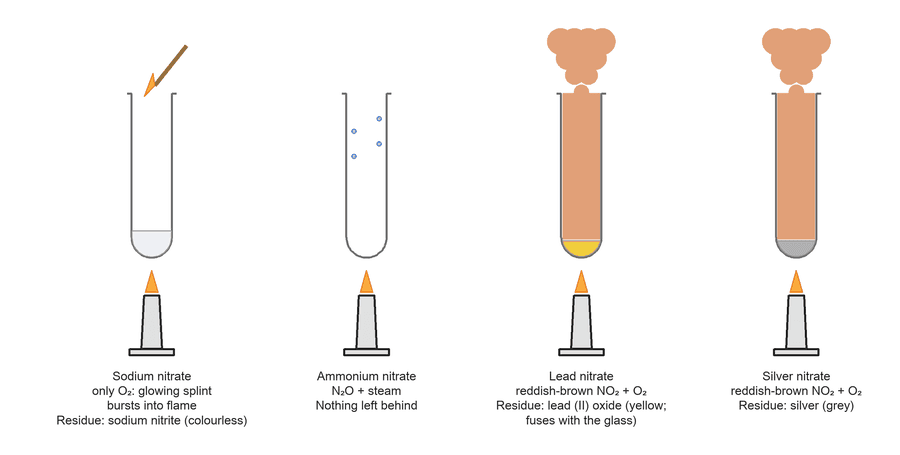
Concept: Nitrates behave in four ways on heating. Sodium and potassium nitrates melt and give only oxygen, leaving the nitrite. Ammonium nitrate changes completely into dinitrogen oxide (N₂O) and steam, leaving nothing. Silver (and mercury) nitrates leave the metal, with NO₂ and O₂. Most other metal nitrates (lead, zinc, copper, calcium …) leave the metal oxide, with reddish-brown NO₂ and O₂.
Step 1 — (a) A metal nitrate that gives no nitrogen dioxide.
Sodium nitrate (or potassium nitrate) melts and gives only oxygen, leaving the nitrite:
Step 2 — (b) A nitrate that leaves no residue.
Ammonium nitrate contains no metal, so it changes completely into gases:
Step 3 — (c) A metal nitrate that changes into the metal oxide.
Lead nitrate (also copper, zinc or calcium nitrate) leaves the metal oxide:
Step 4 — (d) A metal nitrate that changes into the metal.
Silver nitrate (or mercury nitrate) leaves the metal, because the oxide of silver is itself broken down by heat:
Step 5 — (e) A solution that absorbs nitric oxide.
Freshly prepared ferrous sulphate solution absorbs nitric oxide, forming nitroso ferrous sulphate:
Step 6 — (f) The oxide of nitrogen that turns brown in air.
Nitric oxide (NO) is colourless, but it combines with the oxygen of the air to give brown nitrogen dioxide:
Step 7 — (g) The gas from copper and conc. nitric acid.
Concentrated nitric acid oxidises copper and is reduced to reddish-brown nitrogen dioxide:
Watch out: In (f) the gas that turns brown is NO; NO₂ is already brown.
Therefore, (a) sodium (or potassium) nitrate; (b) ammonium nitrate; (c) lead nitrate; (d) silver nitrate; (e) freshly prepared ferrous sulphate solution; (f) nitric oxide, NO; (g) nitrogen dioxide, NO₂.
- 342 marks
Question 34
Identify the gas evolved when :
(a) Sulphur is treated with conc. nitric acid.
(b) A few crystals of KNO are heated in a hard glass test tube.
Solve with AIWritten solution
Solution:
Concept: Concentrated nitric acid is an oxidising agent and is itself reduced to nitrogen dioxide. Potassium nitrate, the nitrate of an alkali metal, gives only oxygen on heating.
Step 1 — (a) Sulphur and conc. nitric acid.
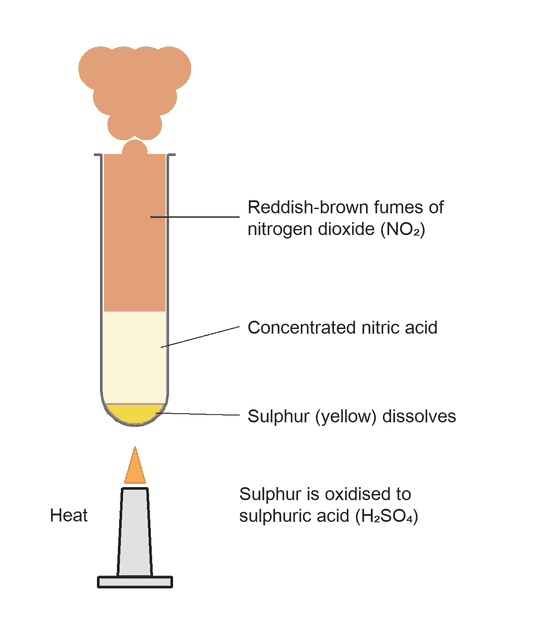
The acid oxidises sulphur to sulphuric acid and gives off reddish-brown fumes of nitrogen dioxide:
Step 2 — (b) Potassium nitrate heated.
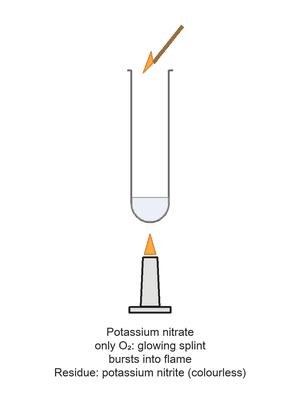
The crystals melt and give oxygen, which makes a glowing splint burst into flame; potassium nitrite is left:
Watch out: Potassium nitrate gives no brown gas on heating, unlike lead or copper nitrate.
Therefore, (a) nitrogen dioxide, NO₂; (b) oxygen, O₂.
- 352 marks
Question 35
Identify the acid :
(a) Which is used for the preparation of non-volatile acid.
(b) The acid which is prepared by catalytic oxidation of ammonia.
Solve with AIWritten solution
Solution:
Concept: A non-volatile acid is used to prepare volatile acids from their salts. Nitric acid is made in industry by the catalytic oxidation of ammonia (Ostwald process).
Step 1 — (a) The acid used to prepare a volatile acid.
Concentrated sulphuric acid is non-volatile. It displaces the volatile nitric acid from potassium nitrate, and only the nitric acid distils over:
Step 2 — (b) The acid made by catalytic oxidation of ammonia.
Nitric acid is made by oxidising ammonia over a platinum catalyst in the Ostwald process:
Note: Part (a) is printed as 'used for the preparation of non-volatile acid'. It is read here as 'the non-volatile acid used for the preparation of volatile acids', which is what the chapter teaches.
Therefore, (a) concentrated sulphuric acid; (b) nitric acid.
- 364 marks
Question 36
From the following list of substances, choose one substance in each case which matches the description given below :
Ammonium nitrate, calcium hydrogen carbonate, copper carbonate, lead nitrate, potassium nitrate, sodium carbonate, sodium hydrogen carbonate, zinc carbonate.
(a) A substance which gives off only oxygen when heated.
(b) A substance which on heating decomposes into dinitrogen oxide [nitrous oxide] and steam.
(c) A substance which gives off oxygen and nitrogen dioxide when heated.
(d) A substance which on heating leaves yellow residue.
Solve with AIWritten solution
Solution:
Concept: Nitrates behave in four ways on heating. Sodium and potassium nitrates melt and give only oxygen, leaving the nitrite. Ammonium nitrate changes completely into dinitrogen oxide (N₂O) and steam, leaving nothing. Silver (and mercury) nitrates leave the metal, with NO₂ and O₂. Most other metal nitrates (lead, zinc, copper, calcium …) leave the metal oxide, with reddish-brown NO₂ and O₂. The carbonates in the list give carbon dioxide on heating, so they cannot match (a)–(c).
Step 1 — (a) Gives off only oxygen.
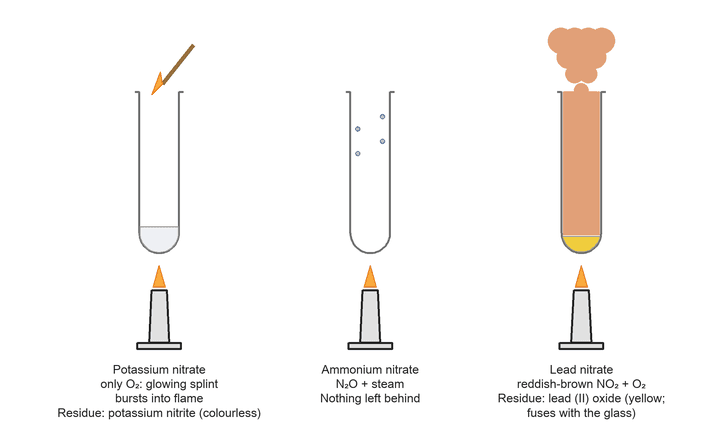
Potassium nitrate gives only oxygen:
Step 2 — (b) Gives dinitrogen oxide and steam.
Ammonium nitrate gives dinitrogen oxide and steam:
Step 3 — (c) Gives oxygen and nitrogen dioxide.
Lead nitrate is the only other nitrate in the list, and it gives nitrogen dioxide and oxygen:
Step 4 — (d) Leaves a yellow residue.
Lead nitrate leaves yellow lead (II) oxide, which stays yellow and fuses with the glass (equation as in (c)). If a different substance is wanted for each part, zinc carbonate also fits: it leaves zinc oxide, which is yellow while hot (and white when cold):
Watch out: The residue of zinc carbonate is yellow only while hot; lead (II) oxide is yellow hot and cold.
Therefore, (a) potassium nitrate; (b) ammonium nitrate; (c) lead nitrate; (d) lead nitrate (or zinc carbonate, whose residue is yellow while hot).
- 371 mark
Question 37
Complete the table :
Name of Process Inputs Equation Output Ammonia + Air Nitric acid Solve with AIWritten solution
Solution:
Concept: In the Ostwald process, ammonia is oxidised by the oxygen of the air over a platinum gauze catalyst at about 800 °C to nitric oxide. Nitric oxide is then oxidised by more air to nitrogen dioxide, which is absorbed in water, with air, to give nitric acid.
Step 1 — Name the process.
Ammonia and air are the inputs and nitric acid is the output, so the process is the Ostwald process.
Step 2 — Write the equations.
The conversion takes three stages. First, ammonia is oxidised over platinum:
Next, nitric oxide is oxidised by more air:
Last, nitrogen dioxide is absorbed in water, with air:
Step 3 — Complete the table.
The key equation (the catalytic oxidation of ammonia) goes in the table:
Name of Process Inputs Equation Output Ostwald process Ammonia + Air (then the two steps of Step 2) Nitric acid Watch out: The Haber process makes ammonia; the Ostwald process turns ammonia into nitric acid.
Therefore, the process is the Ostwald process: 4NH₃ + 5O₂ → 4NO + 6H₂O (Pt, 800 °C), then 2NO + O₂ → 2NO₂ and 4NO₂ + 2H₂O + O₂ → 4HNO₃.
- 385 marks
Question 38
Explain why
(a) Only all-glass apparatus should be used for the preparation of nitric acid by heating concentrated sulphuric acid and potassium nitrate.
(b) Nitric acid is kept in a reagent bottle for a long time.
(c) Iron is rendered passive with fuming HNO. Give reason.
(d) Dil. HNO is generally considered a typical acid but not so in the reaction with metals.
(e) When it is left standing in a glass bottle concentrated nitric acid appears yellow.
Solve with AIWritten solution
Solution:
Concept: Nitric acid is corrosive, unstable to light and heat, and a strong oxidising agent. Each part follows from one of these properties.
Step 1 — (a) Only all-glass apparatus.
Nitric acid vapours are highly corrosive and attack rubber and cork. Stoppers or tubing made of them would be destroyed and would make the acid impure, so the retort has a glass stopper and only glass is used.
Step 2 — (b) Kept in a coloured reagent bottle.
Nitric acid decomposes in light, even at room temperature. For long storage it is kept in a coloured (dark brown) glass-stoppered reagent bottle in a cool, dark place, so that it does not decompose.
Step 3 — (c) Iron made passive.
Fuming nitric acid forms an extremely thin layer of insoluble iron oxide on the surface. This layer stops any further reaction, so the iron becomes passive (inert).
Step 4 — (d) Not a typical acid with metals.
Dilute nitric acid shows the usual acid properties: it turns blue litmus red, neutralises alkalis and decomposes carbonates. But with metals it does not liberate hydrogen. It is a powerful oxidising agent, and the nascent oxygen it forms oxidises the hydrogen to water:
Step 5 — (e) Turns yellow on standing.
Concentrated nitric acid slowly decomposes (faster in light), and the reddish-brown nitrogen dioxide formed dissolves in the acid and makes it yellow:

Therefore, (a) its vapours attack cork and rubber; (b) it decomposes in light, so a coloured bottle is used; (c) a thin insoluble oxide layer forms on the iron; (d) its nascent oxygen oxidises hydrogen to water, so no hydrogen is given off; (e) dissolved NO₂ from its decomposition makes it yellow.
- 392 marks
Question 39
A dilute acid B does not normally give hydrogen when reacted with metals but does give a gas when reacts with copper. Identify B. Write equation with copper.
Solve with AIWritten solution
Solution:
Concept: Ordinary dilute acids give hydrogen with active metals but do not attack copper. An acid that does the opposite must be an oxidising acid: it oxidises the hydrogen to water and can oxidise copper.
Step 1 — Identify B.
Dilute nitric acid does not give hydrogen with metals (its nascent oxygen oxidises the hydrogen to water), yet it reacts with copper. So B is dilute nitric acid.
Step 2 — Write the equation with copper.
Copper is oxidised to copper nitrate (blue solution), and the acid is reduced to nitric oxide:
Step 3 — Name the gas.
The gas is nitric oxide (NO). It is colourless, but turns reddish brown at the mouth of the tube, in air.
Watch out: The gas is NO, not hydrogen; it is the brown colour in air that shows it is NO.
Therefore, B is dilute nitric acid, and 3Cu + 8HNO₃ → 3Cu(NO₃)₂ + 4H₂O + 2NO.
- 405 marks
Question 40
State one observation :
(a) Concentrated nitric acid is reacted with sulphur.
(b) Lead nitrate is heated strongly in a test tube.
(c) Zinc nitrate crystals are strongly heated.
(d) Copper nitrate crystals are heated in a test tube.
Solve with AIWritten solution
Solution:
Concept: An observation is what is seen: the colour of the gas, the change in the solid and the colour of the residue.
Step 1 — (a) Conc. nitric acid and sulphur.
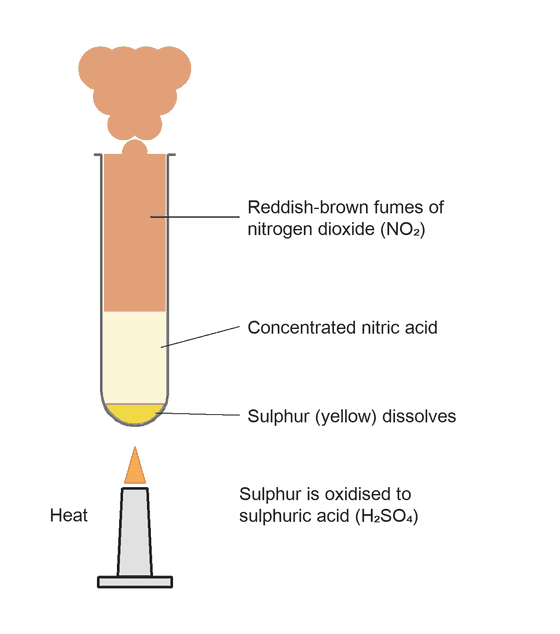
Reddish-brown fumes of nitrogen dioxide are given off and the yellow sulphur dissolves, because it is oxidised to sulphuric acid:
Step 2 — (b) Lead nitrate heated strongly.
The crystals crackle (decrepitate), reddish-brown NO₂ is given off, and a yellow residue of lead (II) oxide is left, which fuses with the glass:
Step 3 — (c) Zinc nitrate heated strongly.
A reddish-brown gas is given off, and the residue (zinc oxide) is yellow when hot and white when cold:
Step 4 — (d) Copper nitrate heated.
The blue crystals give off reddish-brown gas and leave a black residue of copper (II) oxide:

Watch out: An observation is not the name of a product: say 'reddish-brown gas', not just 'NO₂ is formed'.
Therefore, (a) reddish-brown fumes, sulphur dissolves; (b) crackling, reddish-brown gas and a yellow residue fused to the glass; (c) reddish-brown gas and a residue yellow when hot, white when cold; (d) reddish-brown gas and a black residue.
- 412 marks
Question 41
What is the property of nitric acid which allows it to react with copper ?
Solve with AIWritten solution
Solution:
Concept: Copper is below hydrogen in the activity series, so it cannot displace hydrogen from an acid. Nitric acid reacts with it for a different reason.
Step 1 — Name the property.
Nitric acid is a strong oxidising agent. It gives nascent oxygen easily.
Step 2 — See how it acts on copper.
The nascent oxygen oxidises copper (first to copper oxide), and the acid then dissolves the oxide to give copper nitrate. The acid itself is reduced to NO₂ (concentrated) or NO (dilute):
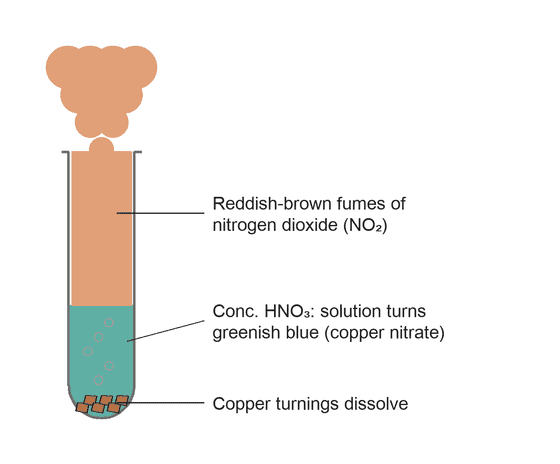
Watch out: The reaction is not a displacement of hydrogen; no hydrogen is given off.
Therefore, nitric acid reacts with copper because it is a strong oxidising agent.
- 425 marks
Question 42
Give balanced equations for the following :
(a) dilute nitric acid and copper carbonate.
(b) oxidation of carbon with conc. HNO.
(c) Laboratory preparation of nitric acid.
(d) Action of heat on a mixture of copper and nitric acid.
Solve with AIWritten solution
Solution:
Concept: Part (a) shows the acidic nature of nitric acid; parts (b) and (d) show its oxidising nature; part (c) is the laboratory method.
Step 1 — (a) Dilute nitric acid and copper carbonate.
The acid decomposes the carbonate with effervescence of carbon dioxide, and a blue solution forms:
Step 2 — (b) Oxidation of carbon.
Hot conc. nitric acid oxidises carbon to carbon dioxide:

Step 3 — (c) Laboratory preparation.
Nitre is heated gently with conc. sulphuric acid:
Step 4 — (d) Heating copper with nitric acid.
The hot (concentrated) acid oxidises copper and gives reddish-brown NO₂:
Therefore, the four balanced equations are as written in Steps 1–4.
- 435 marks
Question 43
X, Y and Z are three crystalline solids which are soluble in water and have a common anion.
To help you to identify X, Y and Z, you are provided with the following experimental observations. Copy and complete the corresponding inferences in (a) to (e).
(a) A reddish-brown gas is obtained when X, Y and Z are separately warmed with concentrated sulphuric acid and copper turning added to the mixture.
INFERENCE 1 : The common anion is the .................... ion.
(b) When X is heated, it melts and gives off only one gas which re-lights a glowing splint.
INFERENCE 2 : The cation in X is either .............. or ................
(c) The action of heat on Y produces a reddish-brown gas and a yellow residue which fuses with the glass of the test tube.
INFERENCE 3 : The metal ion present in Y is the .................. ion.
(d) When Z is heated, it leaves no residue. Warming Z with sodium hydroxide solution liberates a gas which turns moist red litmus paper blue.
INFERENCE 4 : Z contains the ........... cation.
(e) Write the equations for the following reactions:
(1) X and concentrated sulphuric acid (below 200° C). (One equation only for either of the cations given in INFERENCE 2).
(2) Action of heat on Y.
(3) Concentrated nitric acid is added to copper turnings kept in a beaker.
Solve with AIWritten solution
Solution:
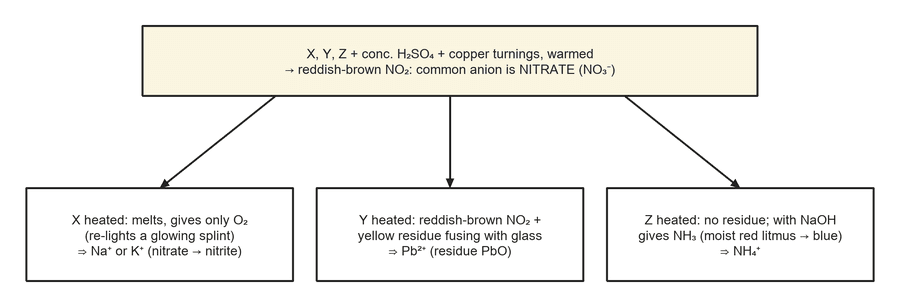
Concept: Reddish-brown NO₂ with conc. sulphuric acid and copper is the test for a nitrate. The action of heat on each nitrate then tells the cation: only oxygen → sodium or potassium; NO₂ and a yellow residue that fuses with glass → lead; no residue → ammonium.
Step 1 — (a) INFERENCE 1: the common anion.
Conc. sulphuric acid makes nitric acid from a nitrate, and the copper reduces it to reddish-brown nitrogen dioxide. So the common anion is the nitrate ion. For example:
Step 2 — (b) INFERENCE 2: the cation in X.
X melts and gives only one gas, oxygen, which re-lights a glowing splint. Only sodium and potassium nitrates do this, so the cation is sodium or potassium.
Step 3 — (c) INFERENCE 3: the metal ion in Y.
Y gives reddish-brown NO₂ and a yellow residue that fuses with the glass, which is lead (II) oxide. So the metal ion is the lead (II) ion.
Step 4 — (d) INFERENCE 4: the cation in Z.
Z leaves no residue, and with sodium hydroxide it gives ammonia, which turns moist red litmus blue. So Z contains the ammonium cation:
Step 5 — (e) The equations.
(1) X (taken as potassium nitrate) with conc. sulphuric acid below 200 °C:
(2) Action of heat on Y (lead nitrate):
(3) Conc. nitric acid added to copper turnings:
Watch out: In (b) only one gas is given off, so X cannot be lead or copper nitrate (they give NO₂ as well as O₂).
Therefore, the common anion is nitrate (NO₃⁻); X contains Na⁺ or K⁺; Y contains Pb²⁺; Z contains NH₄⁺; the equations are as in Step 5.
- 445 marks
Question 44
The diagram given below is a representation of the Industrial preparation of Nitric acid by Ostwald's process. With respect to the process, answer the following questions :
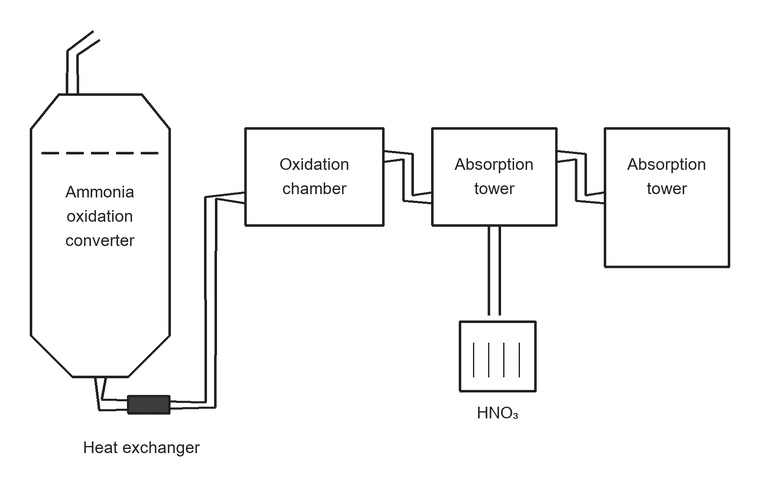
(a) Write the temperature and the catalyst required during the catalytic oxidation of ammonia.
(b) Give balanced chemical equation for the reaction occurring during the conversion of nitrogen dioxide to nitric acid.
Solve with AIWritten solution
Solution:
Concept: In the Ostwald process, ammonia is oxidised by the oxygen of the air over a platinum gauze catalyst at about 800 °C to nitric oxide. Nitric oxide is then oxidised by more air to nitrogen dioxide, which is absorbed in water, with air, to give nitric acid.

Step 1 — (a) Temperature and catalyst.
Ammonia (1 vol) and dry, dust-free air (10 vol) are passed over platinum gauze at about 800 °C:
The reaction is exothermic, so once started it keeps the catalyst at this temperature.
Step 2 — (b) Nitrogen dioxide to nitric acid.
In the oxidising chamber nitric oxide first becomes nitrogen dioxide:
In the absorption tower (packed with quartz, with warm water trickling down) nitrogen dioxide reacts with water and oxygen to form nitric acid:
Watch out: The absorption step needs oxygen as well as water; without it the equation does not balance to nitric acid alone.
Therefore, (a) about 800 °C with a platinum catalyst; (b) 4NO₂ + 2H₂O + O₂ → 4HNO₃.
- 455 marks
Question 45
(a) Mention three important uses of nitric acid. Give the property of nitric acid involved in the use.
(b) Explain with the help of a balanced equation, the brown ring test for nitric acid.
(c) Why is freshly prepared ferrous sulphate solution used for testing the nitrate radical in the brown ring test ?
Solve with AIWritten solution
Solution:
Concept: Each use of nitric acid depends on one of its properties. The brown ring test detects the nitrate ion. Freshly prepared iron (II) sulphate reduces the nitrate (as nitric acid) to nitric oxide, and then joins with the nitric oxide to form the brown compound nitroso ferrous sulphate, FeSO₄·NO, at the junction with the conc. sulphuric acid layer.
Step 1 — (a) Three uses and the property involved.
The table matches each use with the property it relies on:
Use Property involved Etching designs on copper and brassware It is a solvent for most metals Purification of gold (removing Cu, Ag, Zn, Pb impurities) It dissolves the impurity metals but not gold Manufacture of fertilisers such as ammonium nitrate Its acidic nature (it neutralises ammonia) Step 2 — (b) Set up the brown ring test.
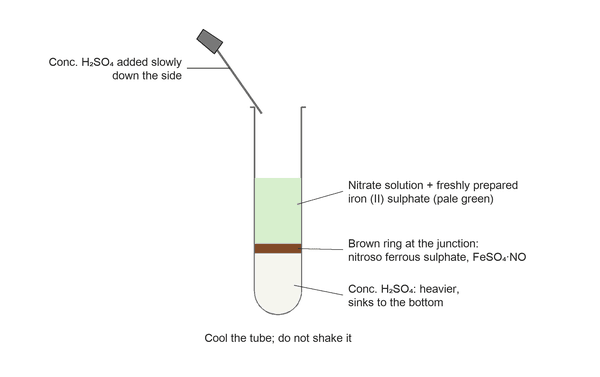
Add freshly prepared saturated iron (II) sulphate solution to the nitrate solution (or dilute nitric acid). Then pour conc. sulphuric acid slowly down the side of the tube. Being heavier, it forms a separate layer at the bottom. Keep the tube cool.
Step 3 — (b) The reactions.
Iron (II) sulphate reduces the nitric acid to nitric oxide:
The nitric oxide joins with more iron (II) sulphate to give the brown compound, which appears as a brown ring at the junction of the two layers:
Step 4 — (c) Why fresh ferrous sulphate.
On exposure to air, ferrous sulphate solution is oxidised to ferric sulphate. Ferric sulphate cannot reduce the nitrate to NO and does not form the brown ring, so the test would fail.
Watch out: Do not shake the tube: the brown compound forms only at the junction of the layers.
Therefore, (a) etching (solvent action), purifying gold (dissolves other metals) and making fertilisers (acidic nature); (b) a brown ring of FeSO₄·NO forms at the junction; (c) old FeSO₄ is oxidised to Fe₂(SO₄)₃, which does not give the test.
- 465 marks
Question 46
The action of heat on the blue crystalline solid X, gives a reddish brown gas Y, a gas which re-lights a glowing splint and leaves a black residue. When gas Z, which has a rotten egg smell, is passed through a solution of X, a black ppt. is formed.
(a) Identify X, Y and Z.
(b) Write equation for action of heat on X.
(c) Write equation between solution of X and gas Z.
Solve with AIWritten solution
Solution:
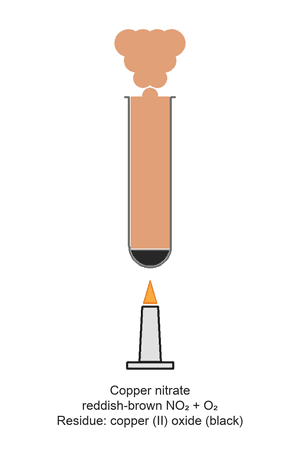
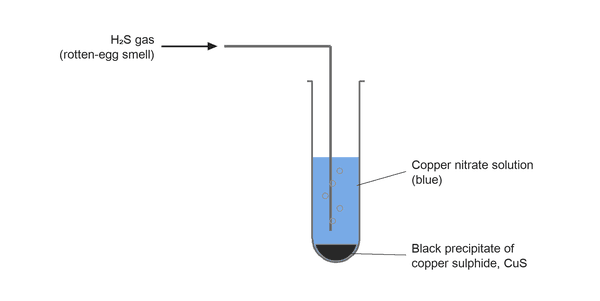
Concept: A blue crystalline solid that gives a reddish-brown gas and oxygen on heating and leaves a black residue (CuO) is copper nitrate. A gas with a rotten-egg smell is hydrogen sulphide, which gives a black precipitate of copper sulphide.
Step 1 — (a) Identify X, Y and Z.
Use each clue in turn:
- X = copper (II) nitrate, Cu(NO₃)₂: blue crystals that leave black copper (II) oxide.
- Y = nitrogen dioxide, NO₂: the reddish-brown gas (the gas that re-lights a glowing splint is oxygen).
- Z = hydrogen sulphide, H₂S: the gas with a rotten-egg smell.
Step 2 — (b) Action of heat on X.
Copper nitrate decomposes into copper (II) oxide, nitrogen dioxide and oxygen:
Step 3 — (c) Solution of X with gas Z.
Hydrogen sulphide gives a black precipitate of copper sulphide with the copper nitrate solution:
Watch out: Y is the reddish-brown gas only; oxygen is the second gas, not Y.
Therefore, X is Cu(NO₃)₂, Y is NO₂ and Z is H₂S; 2Cu(NO₃)₂ → 2CuO + 4NO₂ + O₂; Cu(NO₃)₂ + H₂S → CuS + 2HNO₃.
- 475 marks
Question 47
(a) Dilute nitric acid is generally considered a typical acid except for its reaction with metals. In what way is dilute nitric acid different from other acids when it reacts with metals?
(b) Write the equation for the reaction of dilute nitric acid and conc. nitric acid with copper.
Solve with AIWritten solution
Solution:
Concept: Nitric acid is an oxidising acid. Its nascent oxygen oxidises any hydrogen formed to water, so the acid is reduced to an oxide of nitrogen instead.
Step 1 — (a) How dilute nitric acid differs.
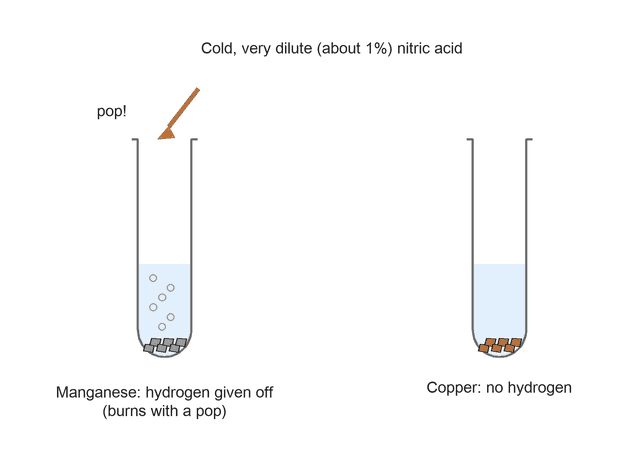
Other dilute acids react with active metals to liberate hydrogen. Dilute nitric acid does not liberate hydrogen: the nascent oxygen it forms oxidises the hydrogen to water, and the acid is reduced to oxides of nitrogen such as NO:
It even reacts with copper, which other dilute acids do not attack.
Step 2 — (a) The exception.
Only very dilute (about 1%) nitric acid gives hydrogen, and only with magnesium and manganese, because its oxidising action is then much weaker:
Step 3 — (b) Copper with dilute and with concentrated acid.
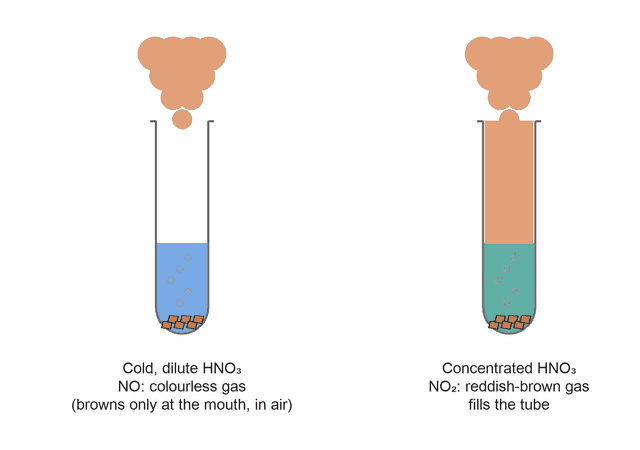
Dilute nitric acid gives colourless nitric oxide:
Concentrated nitric acid gives reddish-brown nitrogen dioxide:
Therefore, (a) dilute nitric acid does not liberate hydrogen with metals (except very dilute acid with Mg and Mn) because it is an oxidising agent; (b) 3Cu + 8HNO₃ (dil.) → 3Cu(NO₃)₂ + 4H₂O + 2NO and Cu + 4HNO₃ (conc.) → Cu(NO₃)₂ + 2H₂O + 2NO₂.
- 485 marks
Question 48
The figure given below illustrates the apparatus used in the laboratory preparation of nitric acid.
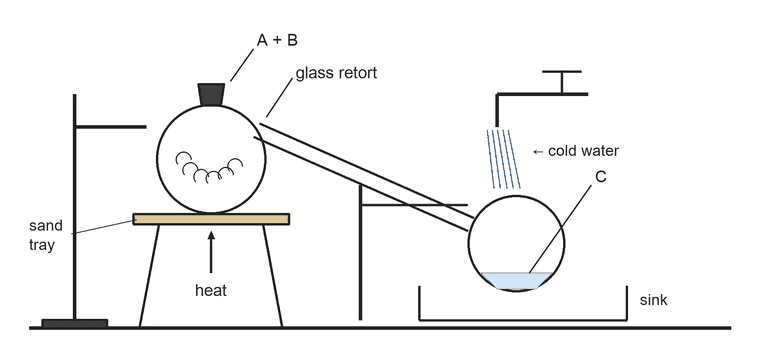
(a) Name A (a liquid), B (a solid) and C (a liquid). (Do not give the formulae).
(b) Write an equation to show how nitric acid undergoes decomposition.
(c) Write the equation for the reaction in which copper is oxidized by concentrated nitric acid.
Solve with AIWritten solution
Solution:
Concept: In the laboratory, nitric acid is made by heating potassium nitrate (nitre) with concentrated sulphuric acid in an all-glass retort, below 200 °C. Concentrated sulphuric acid is non-volatile, so it displaces the volatile nitric acid, which distils over and is condensed in a cooled receiver.
Step 1 — (a) Name A, B and C.
The retort holds a liquid and a solid, and the receiver collects the product:
- A = concentrated sulphuric acid (the liquid in the retort);
- B = potassium nitrate (or sodium nitrate), the solid;
- C = nitric acid, the liquid collected in the receiver.
Step 2 — (b) Decomposition of nitric acid.
In light or on heating, nitric acid gives reddish-brown nitrogen dioxide, water and oxygen; the dissolved NO₂ makes the acid yellow:
Step 3 — (c) Copper oxidised by conc. nitric acid.
Copper is oxidised to copper nitrate and the acid is reduced to NO₂:
Watch out: The question asks for names, not formulae, in (a).
Therefore, (a) A is concentrated sulphuric acid, B is potassium nitrate and C is nitric acid; (b) 4HNO₃ → 4NO₂ + 2H₂O + O₂; (c) Cu + 4HNO₃ → Cu(NO₃)₂ + 2H₂O + 2NO₂.
- 495 marks
Question 49
With respect to the brown ring test for nitrates, explain :
(a) Freshly prepared ferrous sulphate is used.
(b) Brown ring disappears if the test tube is disturbed.
(c) Lead nitrate does not respond properly to the brown ring test.
Hint : Salt solutions forming insoluble sulphates interfere with the result of the Brown ring test.
(d) What is the name and formula of the brown ring formed ?
Solve with AIWritten solution
Solution:
Concept: The brown ring is nitroso ferrous sulphate, an unstable compound of iron (II) sulphate and nitric oxide. It forms only at the junction of the two layers, and only if nothing else hides it.
Step 1 — (a) Freshly prepared ferrous sulphate.
On exposure to air, ferrous sulphate is oxidised to ferric sulphate, which cannot reduce the nitrate to NO and will not give the brown ring.
Step 2 — (b) The ring disappears when disturbed.
Shaking mixes the two layers. The heat evolved when conc. sulphuric acid mixes with the water of the solution decomposes the unstable brown compound, so the ring disappears.
Step 3 — (c) Lead nitrate.
Lead ions react with the sulphate ions of the sulphuric acid (and of the ferrous sulphate) to form a white precipitate of insoluble lead sulphate, which hides the brown ring:

Step 4 — (d) Name and formula of the ring.
The brown ring is nitroso ferrous sulphate:
Watch out: Add the conc. sulphuric acid slowly down the side of the tube; poured straight in, it mixes and heats the solution and no ring forms.
Therefore, (a) old FeSO₄ is oxidised to Fe₂(SO₄)₃, which does not give the test; (b) mixing produces heat that decomposes the unstable compound; (c) white insoluble PbSO₄ forms and hides the ring; (d) nitroso ferrous sulphate, FeSO₄·NO.
What Class 10 Chemistry Ch 10 covers
The sections of the chapter, in the order the book takes them. Every question above comes from one of these.
- 01Laboratory Preparation of Nitric Acid
- 02Manufacture of Nitric Acid
- 03Properties of Nitric Acid
- 04Uses of Nitric Acid
- 05Tests for Nitric Acid and Nitrates
- 06Effects of Heat on Nitrates
More ways to study this chapter
The same chapter asked three other ways. Practise it, revise it, and see what the board has set on Ch 10 before.
- Competency-Based Questions (CBQ)Case study questions: a situation, and the part of the chapter that answers it.40questionsOpen
- Previous Year QuestionsQuestions that have actually appeared in board papers, each tagged with its year.29questionsOpen
- Practice QuestionsExtra questions per chapter, for when one attempt at a method is not enough.45questionsOpen
Ch 10 in past ICSE papers
The same chapter as the board has actually asked it. These are worded differently from the textbook exercise, which is the point of reading them.
- 11 mark
Board paper question 1
Write balanced chemical equations for each of the following:
Action of hot and concentrated Nitric acid on copper.
Solve with AIWritten solution
Solution:
Concept: Copper lies below hydrogen in the activity series, so it cannot set hydrogen free from an acid. Concentrated nitric acid still attacks it, because the acid is a strong oxidising agent: it oxidises copper to copper nitrate and is itself reduced to nitrogen dioxide, NO₂, a reddish-brown gas.
Step 1 — Decide the products.
Hot, concentrated nitric acid oxidises copper to copper nitrate. The acid is reduced to nitrogen dioxide, and water is also formed.
Step 2 — Write the balanced equation.
One copper atom needs four molecules of the acid: two of them supply the nitrate ions of copper nitrate and two are reduced to nitrogen dioxide.
Step 3 — Check that the equation is balanced.
We count each kind of atom on both sides of the copper–nitric acid equation; every count must be the same on the left and the right.
Atom Left side Right side Cu 1 1 N 4 4 H 4 4 O 12 12 Step 4 — Note what is seen.
Reddish-brown fumes of nitrogen dioxide are given off, the copper dissolves and the solution turns greenish blue (copper nitrate).
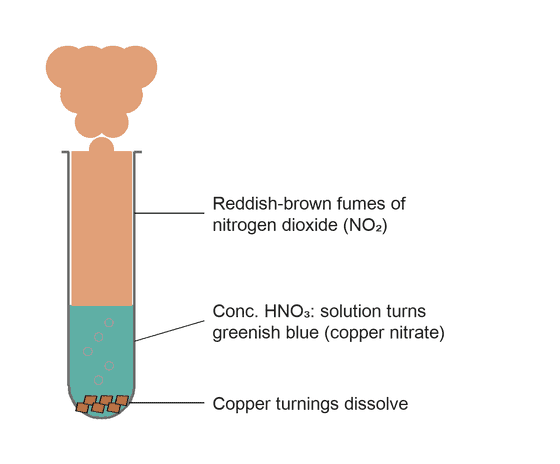
Watch out: Cold, dilute nitric acid gives NO with copper and concentrated acid gives NO₂; neither gives hydrogen, so never write H₂ as a product of copper and nitric acid.
Therefore, Cu + 4HNO₃ (conc.) → Cu(NO₃)₂ + 2H₂O + 2NO₂↑ (reddish-brown NO₂ is given off).
- 22 marks
Board paper question 2
Fill in the blanks using the appropriate words given below:
(Sulphur dioxide, Nitrogen dioxide, Nitric oxide, Sulphuric acid)
(i) Cold, dilute nitric acid reacts with copper to give ...............
(ii) Hot, concentrated nitric acid reacts with sulphur to form ...............
Solve with AIWritten solution
Solution:
Concept: Nitric acid is an oxidising agent. With copper, cold, dilute acid is reduced to nitric oxide (NO), while concentrated acid is reduced to nitrogen dioxide (NO₂). With a non-metal such as sulphur, hot concentrated acid oxidises it to its highest oxyacid, sulphuric acid.
Step 1 — (i) Copper with cold, dilute nitric acid.
Cold, dilute nitric acid oxidises copper to copper nitrate and is reduced to nitric oxide, so the blank is nitric oxide.
Nitrogen dioxide does not fit here, because it is the gas given by concentrated nitric acid with copper.
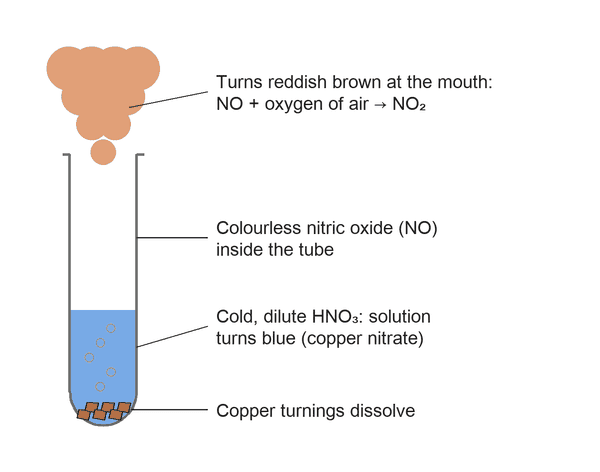
Step 2 — (ii) Sulphur with hot, concentrated nitric acid.
Hot, concentrated nitric acid oxidises sulphur to sulphuric acid and is reduced to nitrogen dioxide, so the blank is sulphuric acid.
Sulphur dioxide does not fit, because nitric acid is a strong enough oxidising agent to take sulphur past the +4 state of SO₂ to the +6 state of H₂SO₄.
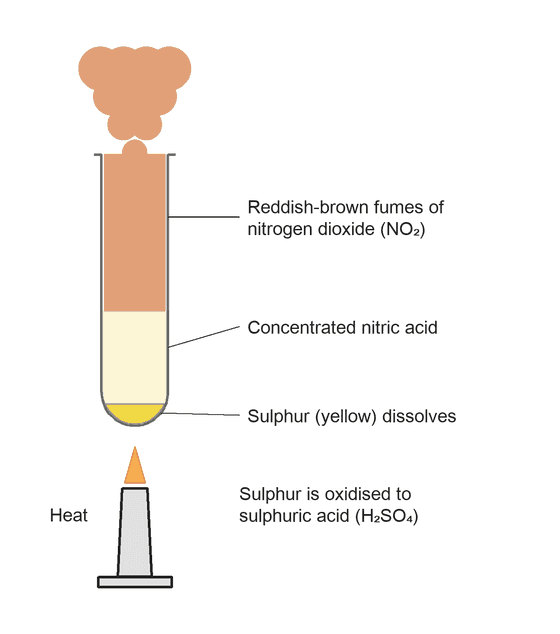
Watch out: The gas from copper depends on the concentration of the acid (dilute → NO, concentrated → NO₂).
Therefore, (i) cold, dilute nitric acid reacts with copper to give nitric oxide; (ii) hot, concentrated nitric acid reacts with sulphur to form sulphuric acid.
- 31 mark
Board paper question 3
Write a balanced chemical equation for each of the following:
Action of cold and dilute Nitric acid on Copper.
Solve with AIWritten solution
Solution:
Concept: Nitric acid is an oxidising acid, and the gas it gives with copper depends on its concentration. Cold, dilute nitric acid is reduced only as far as nitric oxide, NO (a colourless gas), while concentrated nitric acid is reduced to nitrogen dioxide, NO₂.
Step 1 — Decide the products.
Cold, dilute nitric acid oxidises copper to copper nitrate and is itself reduced to nitric oxide; water is also formed.
Step 2 — Write the balanced equation.
Three copper atoms react with eight molecules of the acid: six of them become the nitrate ions of three copper nitrate units and two are reduced to nitric oxide.
Step 3 — Check that the equation is balanced.
We count each kind of atom on both sides of the copper–dilute nitric acid equation; every count must be the same on the left and the right.
Atom Left side Right side Cu 3 3 N 8 8 H 8 8 O 24 24 Step 4 — Note what is seen.
The copper dissolves, the solution turns blue, and a colourless gas (NO) is given off. At the mouth of the tube it meets the oxygen of the air and turns reddish brown (NO₂).
Watch out: Cold, dilute nitric acid gives NO with copper and concentrated acid gives NO₂; neither gives hydrogen, so never write H₂ as a product of copper and nitric acid.
Therefore, 3Cu + 8HNO₃ (dil.) → 3Cu(NO₃)₂ + 4H₂O + 2NO↑.
- 44 marks
Board paper question 4
Give a balanced chemical equation for each of the following:
(i) Action of conc. Nitric acid on Sulphur.
(ii) Catalytic oxidation of Ammonia.
(iii) Laboratory preparation of Nitric acid.
(iv) Reaction of Ammonia with Nitric acid.
Solve with AIWritten solution
Solution:
Concept: Nitric acid shows three kinds of behaviour in this question: as an oxidising agent (with sulphur), in its manufacture (catalytic oxidation of ammonia) and laboratory preparation, and as an acid (neutralised by the base ammonia). Each equation is written with its conditions and checked atom by atom.
Step 1 — (i) Conc. nitric acid on sulphur.
Hot, concentrated nitric acid oxidises sulphur to sulphuric acid and is reduced to nitrogen dioxide.
Atom Left side Right side S 1 1 N 6 6 H 6 6 O 18 18 Step 2 — (ii) Catalytic oxidation of ammonia.
This is the first step of the Ostwald process. Dry ammonia mixed with dust-free air (1 : 10 by volume) is passed over a platinum gauze catalyst at about 800 °C. The reaction gives out heat, which keeps the catalyst hot.
Atom Left side Right side N 4 4 H 12 12 O 10 10 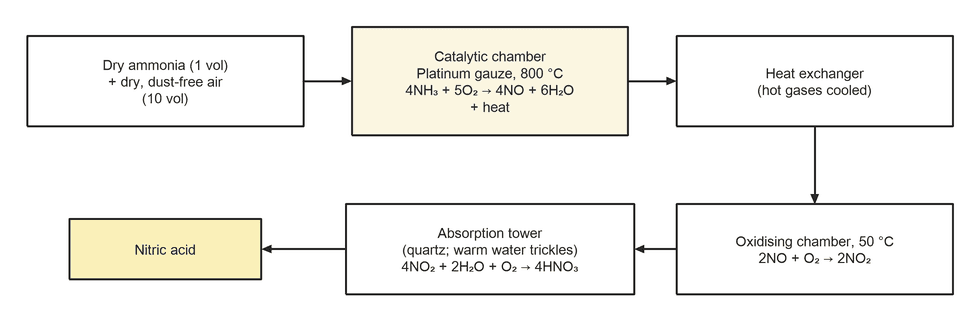
Step 3 — (iii) Laboratory preparation of nitric acid.
Potassium nitrate is heated gently with concentrated sulphuric acid in an all-glass retort, below 200 °C. The non-volatile sulphuric acid displaces the volatile nitric acid, whose vapours are condensed in a receiver cooled by water.
Atom Left side Right side K 1 1 S 1 1 N 1 1 H 2 2 O 7 7 Step 4 — (iv) Ammonia with nitric acid.
Ammonia is a base, so nitric acid neutralises it and forms the salt ammonium nitrate (used as a fertiliser). No water is formed, because ammonia simply takes up the H⁺ ion of the acid.
Watch out: In (iii) the temperature is kept below 200 °C, so the product is the acid salt KHSO₄, not K₂SO₄.
Therefore, (i) S + 6HNO₃ → H₂SO₄ + 2H₂O + 6NO₂; (ii) 4NH₃ + 5O₂ → 4NO + 6H₂O (Pt, 800 °C); (iii) KNO₃ + H₂SO₄ → KHSO₄ + HNO₃ (below 200 °C); (iv) NH₃ + HNO₃ → NH₄NO₃.
- 51 mark
Board paper question 5
Name the gas that is produced in each of the following cases:
Sulphur is oxidized by concentrated nitric acid.
Solve with AIWritten solution
Solution:
Concept: Hot, concentrated nitric acid oxidises the non-metal sulphur all the way to sulphuric acid (sulphur goes from oxidation state 0 to +6) and is itself reduced to reddish-brown nitrogen dioxide.
Step 1 — Find what the acid is reduced to.
Concentrated nitric acid gives nascent oxygen and is reduced to nitrogen dioxide; this nascent oxygen oxidises the sulphur.
Step 2 — Write the overall reaction.
Putting the oxidation of sulphur to sulphuric acid together with this reduction of the acid gives the overall equation, which shows the gas formed.
Step 3 — Name the gas.
The gas given off is nitrogen dioxide, seen as reddish-brown fumes. (The sulphur ends up in solution as sulphuric acid, so no sulphur dioxide escapes.)
Watch out: The sulphur is oxidised to sulphuric acid, not to sulphur dioxide; the only gas is NO₂.
Therefore, the gas produced is nitrogen dioxide (NO₂).
- 61 mark
Board paper question 6
Name the gas that is produced in each of the following cases:
Action of cold and dilute nitric acid on copper.
Solve with AIWritten solution
Solution:
Concept: Nitric acid is an oxidising acid, and the gas it gives with copper depends on its concentration. Cold, dilute nitric acid is reduced only as far as nitric oxide, NO (a colourless gas), while concentrated nitric acid is reduced to nitrogen dioxide, NO₂.
Step 1 — Write the reaction.
Cold, dilute nitric acid oxidises copper to copper nitrate and is reduced to nitric oxide.
Step 2 — Name the gas.
The gas produced is nitric oxide (nitrogen monoxide), NO. It is colourless, but at the mouth of the tube it combines with the oxygen of the air and turns reddish brown.
Watch out: The brown colour at the mouth comes from NO₂ formed in the air; the gas the reaction produces is NO.
Therefore, the gas produced is nitric oxide (NO).
All 29 board paper questions for this chapter, solved the same way.
Class 10 Chemistry Ch 10 questions students ask
How many questions are there in Class 10 Chemistry Ch 10?
49 questions. Every one is solved step by step on this page.
Are these Class 10 Chemistry solutions free?
Yes. Every question and its full working is free to read, with no account needed.
Can I download the Class 10 Chemistry Ch 10 solutions as a PDF?
There is no PDF to download. Every solution is on this page instead, which means it is searchable, always the current syllabus, and readable on a phone. Use your browser's print option if you want it on paper.