Study of Compounds – Nitric Acid · Question 33 of 49
Name : (a) a nitrate of metal which on heating does not give nitrogen dioxide.
Question 335 marksEasy
Name :
(a) a nitrate of metal which on heating does not give nitrogen dioxide.
(b) a nitrate which on heating leaves no residue behind.
(c) a metal nitrate which on heating is changed into metal oxide.
(d) a metal nitrate which on heating is changed into metal.
(e) a solution which absorbs nitric oxide.
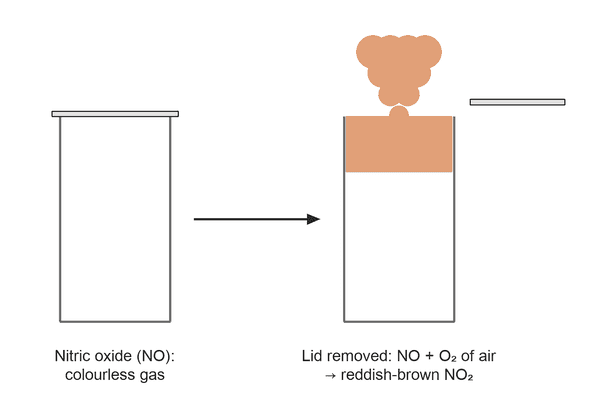
(f) the oxide of nitrogen which turns brown on exposure to air.
(g) the gas produced when copper reacts with conc. HNO3.
Solution:
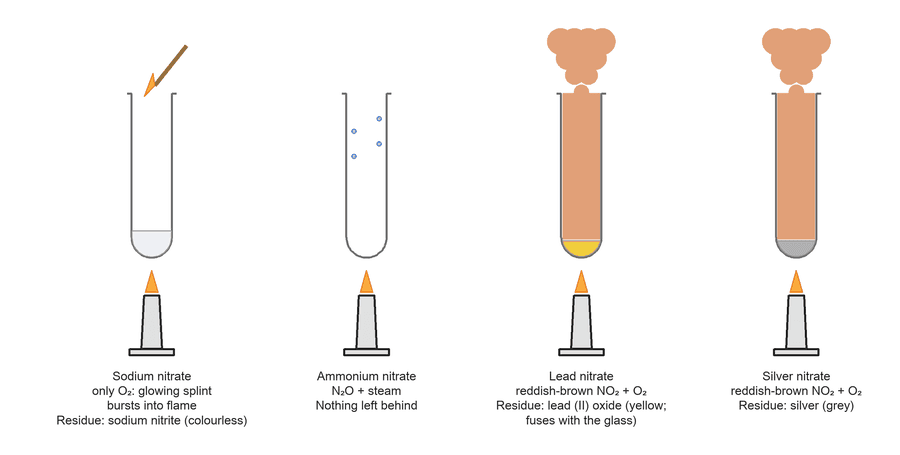
Concept: Nitrates behave in four ways on heating. Sodium and potassium nitrates melt and give only oxygen, leaving the nitrite. Ammonium nitrate changes completely into dinitrogen oxide (N₂O) and steam, leaving nothing. Silver (and mercury) nitrates leave the metal, with NO₂ and O₂. Most other metal nitrates (lead, zinc, copper, calcium …) leave the metal oxide, with reddish-brown NO₂ and O₂.
Step 1 — (a) A metal nitrate that gives no nitrogen dioxide.
Sodium nitrate (or potassium nitrate) melts and gives only oxygen, leaving the nitrite:
2NaNO3Δ2NaNO2+O2↑
Step 2 — (b) A nitrate that leaves no residue.
Ammonium nitrate contains no metal, so it changes completely into gases:
NH4NO3ΔN2O+2H2O
Step 3 — (c) A metal nitrate that changes into the metal oxide.
Lead nitrate (also copper, zinc or calcium nitrate) leaves the metal oxide:
2Pb(NO3)2Δ2PbO+4NO2+O2
Step 4 — (d) A metal nitrate that changes into the metal.
Silver nitrate (or mercury nitrate) leaves the metal, because the oxide of silver is itself broken down by heat:
2AgNO3Δ2Ag+2NO2+O2
Step 5 — (e) A solution that absorbs nitric oxide.