Study of Compounds – Nitric Acid · Question 32 of 49
The following questions are Assertion-Reason based questions. Choose the answer based on the codes given below.
Question 321 markMCQEasy
The following questions are Assertion-Reason based questions. Choose the answer based on the codes given below.
(1) Both A and R are true and R is the correct explanation of A.
(2) Both A and R are true but R is not the correct explanation of A.
(3) A is true but R is false.
(4) A is false but R is true.
Assertion (A) : Cold and dilute nitric acid oxidise metals to their nitrates and nitric oxide.
Reason (R) : Hot and concentrated nitric acid liberates nitrogen dioxide.
Select your answer
(A) (1)
(B) (2)
Correct answer
(C) (3)
(D) (4)
Answer: (B) (2)
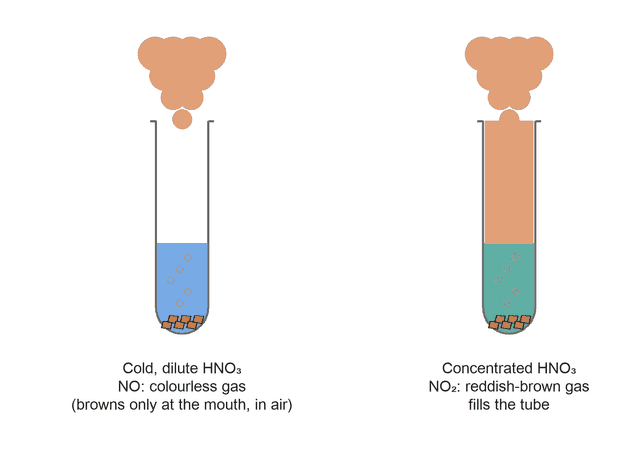
Concept: In an assertion–reason item, judge the assertion (A) and the reason (R) separately as true or false, and then decide whether R correctly explains A. The product of nitric acid with a metal depends on the concentration and temperature of the acid: cold, dilute acid gives NO; hot, concentrated acid gives NO₂.
Step 1 — Judge the assertion.
Cold, dilute nitric acid oxidises metals such as copper to nitrates and gives nitric oxide, so A is true:
3Cu+8HNO3→3Cu(NO3)2+4H2O+2NO↑
Step 2 — Judge the reason.
Hot, concentrated nitric acid gives nitrogen dioxide, so R is true:
Cu+4HNO3ΔCu(NO3)2+2H2O+2NO2↑
Step 3 — Link them.
R is about the concentrated acid, so it does not explain why the dilute acid gives nitric oxide.
Watch out: Two true statements about the same acid need not explain each other; check that R gives the reason for A.
Why the other options are wrong:
(A) (1): Code (1) would need R to explain A, but R is about a different acid strength.
(C) (3): Code (3) says R is false, but R is true.
(D) (4): Code (4) says A is false, but A is true.
Therefore, both A and R are true but R does not explain A, option (B).