
Question 392 marksEasy
A dilute acid B does not normally give hydrogen when reacted with metals but does give a gas when reacts with copper. Identify B. Write equation with copper.
Confirming your payment
Sign up now and get 250 free tokens.
Study of Compounds – Nitric Acid · Question 39 of 49
A dilute acid B does not normally give hydrogen when reacted with metals but does give a gas when reacts with copper. Identify B. Write equation with copper.
Solution:
Concept: Ordinary dilute acids give hydrogen with active metals but do not attack copper. An acid that does the opposite must be an oxidising acid: it oxidises the hydrogen to water and can oxidise copper.
Step 1 — Identify B.
Dilute nitric acid does not give hydrogen with metals (its nascent oxygen oxidises the hydrogen to water), yet it reacts with copper. So B is dilute nitric acid.
Step 2 — Write the equation with copper.
Copper is oxidised to copper nitrate (blue solution), and the acid is reduced to nitric oxide:
Step 3 — Name the gas.
The gas is nitric oxide (NO). It is colourless, but turns reddish brown at the mouth of the tube, in air.
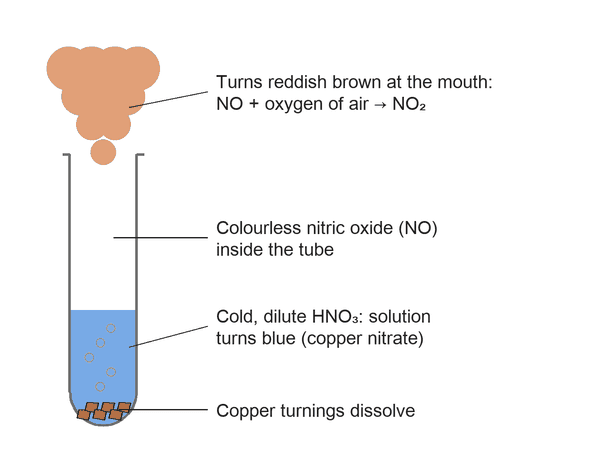
Watch out: The gas is NO, not hydrogen; it is the brown colour in air that shows it is NO.
Therefore, B is dilute nitric acid, and 3Cu + 8HNO₃ → 3Cu(NO₃)₂ + 4H₂O + 2NO.