Study of Compounds – Nitric Acid · Question 38 of 49
Explain why (a) Only all-glass apparatus should be used for the preparation of nitric acid by heating concentrated…
Question 385 marksMedium
Explain why
(a) Only all-glass apparatus should be used for the preparation of nitric acid by heating concentrated sulphuric acid and potassium nitrate.
(b) Nitric acid is kept in a reagent bottle for a long time.
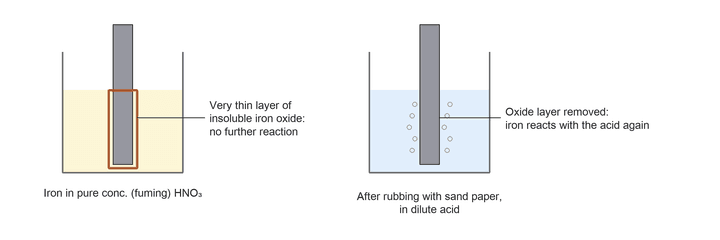
(c) Iron is rendered passive with fuming HNO3. Give reason.
(d) Dil. HNO3 is generally considered a typical acid but not so in the reaction with metals.
(e) When it is left standing in a glass bottle concentrated nitric acid appears yellow.
Solution:
Concept: Nitric acid is corrosive, unstable to light and heat, and a strong oxidising agent. Each part follows from one of these properties.
Step 1 — (a) Only all-glass apparatus.
Nitric acid vapours are highly corrosive and attack rubber and cork. Stoppers or tubing made of them would be destroyed and would make the acid impure, so the retort has a glass stopper and only glass is used.
Step 2 — (b) Kept in a coloured reagent bottle.
Nitric acid decomposes in light, even at room temperature. For long storage it is kept in a coloured (dark brown) glass-stoppered reagent bottle in a cool, dark place, so that it does not decompose.
Step 3 — (c) Iron made passive.
Fuming nitric acid forms an extremely thin layer of insoluble iron oxide on the surface. This layer stops any further reaction, so the iron becomes passive (inert).
Step 4 — (d) Not a typical acid with metals.
Dilute nitric acid shows the usual acid properties: it turns blue litmus red, neutralises alkalis and decomposes carbonates. But with metals it does not liberate hydrogen. It is a powerful oxidising agent, and the nascent oxygen it forms oxidises the hydrogen to water:
2HNO3→2NO+H2O+3[O]
Step 5 — (e) Turns yellow on standing.
Concentrated nitric acid slowly decomposes (faster in light), and the reddish-brown nitrogen dioxide formed dissolves in the acid and makes it yellow:
4HNO3light or heat4NO2+2H2O+O2
Therefore, (a) its vapours attack cork and rubber; (b) it decomposes in light, so a coloured bottle is used; (c) a thin insoluble oxide layer forms on the iron; (d) its nascent oxygen oxidises hydrogen to water, so no hydrogen is given off; (e) dissolved NO₂ from its decomposition makes it yellow.