
Question 371 markEasy
Complete the table :
| Name of Process | Inputs | Equation | Output |
|---|---|---|---|
| Ammonia + Air | Nitric acid |
Confirming your payment
Sign up now and get 250 free tokens.
Study of Compounds – Nitric Acid · Question 37 of 49
Complete the table :
| Name of Process | Inputs | Equation | Output |
|---|---|---|---|
| Ammonia + Air | Nitric acid |
Solution:
Concept: In the Ostwald process, ammonia is oxidised by the oxygen of the air over a platinum gauze catalyst at about 800 °C to nitric oxide. Nitric oxide is then oxidised by more air to nitrogen dioxide, which is absorbed in water, with air, to give nitric acid.
Step 1 — Name the process.
Ammonia and air are the inputs and nitric acid is the output, so the process is the Ostwald process.
Step 2 — Write the equations.
The conversion takes three stages. First, ammonia is oxidised over platinum:
Next, nitric oxide is oxidised by more air:
Last, nitrogen dioxide is absorbed in water, with air:
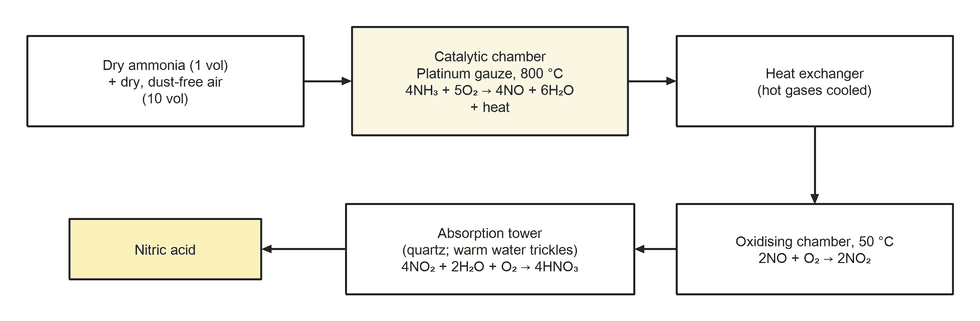
Step 3 — Complete the table.
The key equation (the catalytic oxidation of ammonia) goes in the table:
| Name of Process | Inputs | Equation | Output |
|---|---|---|---|
| Ostwald process | Ammonia + Air | (then the two steps of Step 2) | Nitric acid |
Watch out: The Haber process makes ammonia; the Ostwald process turns ammonia into nitric acid.
Therefore, the process is the Ostwald process: 4NH₃ + 5O₂ → 4NO + 6H₂O (Pt, 800 °C), then 2NO + O₂ → 2NO₂ and 4NO₂ + 2H₂O + O₂ → 4HNO₃.