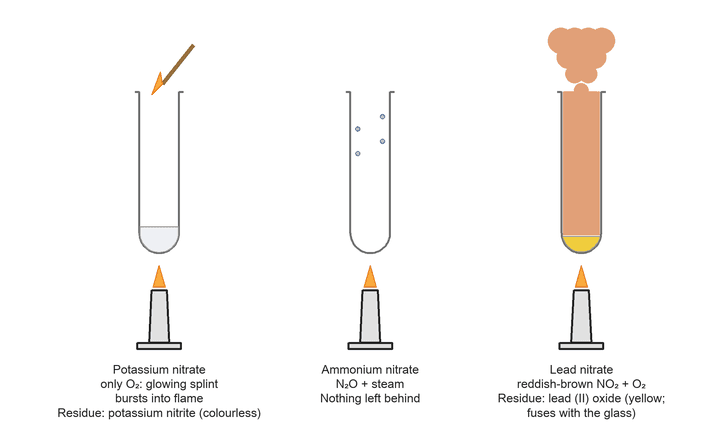
(a) A substance which gives off only oxygen when heated.
(b) A substance which on heating decomposes into dinitrogen oxide [nitrous oxide] and steam.
(c) A substance which gives off oxygen and nitrogen dioxide when heated.
(d) A substance which on heating leaves yellow residue.
Solution:
Concept: Nitrates behave in four ways on heating. Sodium and potassium nitrates melt and give only oxygen, leaving the nitrite. Ammonium nitrate changes completely into dinitrogen oxide (N₂O) and steam, leaving nothing. Silver (and mercury) nitrates leave the metal, with NO₂ and O₂. Most other metal nitrates (lead, zinc, copper, calcium …) leave the metal oxide, with reddish-brown NO₂ and O₂. The carbonates in the list give carbon dioxide on heating, so they cannot match (a)–(c).
Step 1 — (a) Gives off only oxygen.
Potassium nitrate gives only oxygen:
2KNO3Δ2KNO2+O2↑
Step 2 — (b) Gives dinitrogen oxide and steam.
Ammonium nitrate gives dinitrogen oxide and steam:
NH4NO3ΔN2O+2H2O
Step 3 — (c) Gives oxygen and nitrogen dioxide.
Lead nitrate is the only other nitrate in the list, and it gives nitrogen dioxide and oxygen:
2Pb(NO3)2Δ2PbO+4NO2+O2
Step 4 — (d) Leaves a yellow residue.
Lead nitrate leaves yellow lead (II) oxide, which stays yellow and fuses with the glass (equation as in (c)). If a different substance is wanted for each part, zinc carbonate also fits: it leaves zinc oxide, which is yellow while hot (and white when cold):
ZnCO3ΔZnO+CO2↑
Watch out: The residue of zinc carbonate is yellow only while hot; lead (II) oxide is yellow hot and cold.
Therefore, (a) potassium nitrate; (b) ammonium nitrate; (c) lead nitrate; (d) lead nitrate (or zinc carbonate, whose residue is yellow while hot).