Study of Compounds – Nitric Acid · Question 40 of 49
State one observation
Question 405 marksEasy
State one observation :
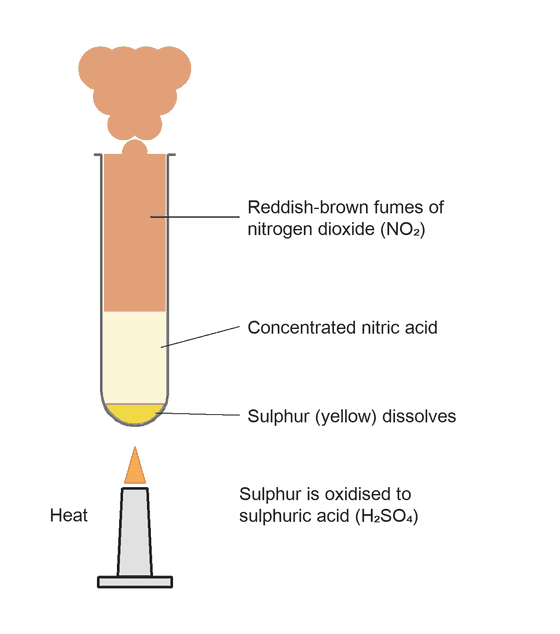
(a) Concentrated nitric acid is reacted with sulphur.
(b) Lead nitrate is heated strongly in a test tube.
(c) Zinc nitrate crystals are strongly heated.
(d) Copper nitrate crystals are heated in a test tube.
Solution:
Concept: An observation is what is seen: the colour of the gas, the change in the solid and the colour of the residue.
Step 1 — (a) Conc. nitric acid and sulphur.
Reddish-brown fumes of nitrogen dioxide are given off and the yellow sulphur dissolves, because it is oxidised to sulphuric acid:
S+6HNO3ΔH2SO4+2H2O+6NO2↑
Step 2 — (b) Lead nitrate heated strongly.
The crystals crackle (decrepitate), reddish-brown NO₂ is given off, and a yellow residue of lead (II) oxide is left, which fuses with the glass:
2Pb(NO3)2Δ2PbO+4NO2+O2
Step 3 — (c) Zinc nitrate heated strongly.
A reddish-brown gas is given off, and the residue (zinc oxide) is yellow when hot and white when cold:
2Zn(NO3)2Δ2ZnO+4NO2+O2
Step 4 — (d) Copper nitrate heated.
The blue crystals give off reddish-brown gas and leave a black residue of copper (II) oxide:
2Cu(NO3)2Δ2CuO+4NO2+O2
Watch out: An observation is not the name of a product: say 'reddish-brown gas', not just 'NO₂ is formed'.
Therefore, (a) reddish-brown fumes, sulphur dissolves; (b) crackling, reddish-brown gas and a yellow residue fused to the glass; (c) reddish-brown gas and a residue yellow when hot, white when cold; (d) reddish-brown gas and a black residue.